
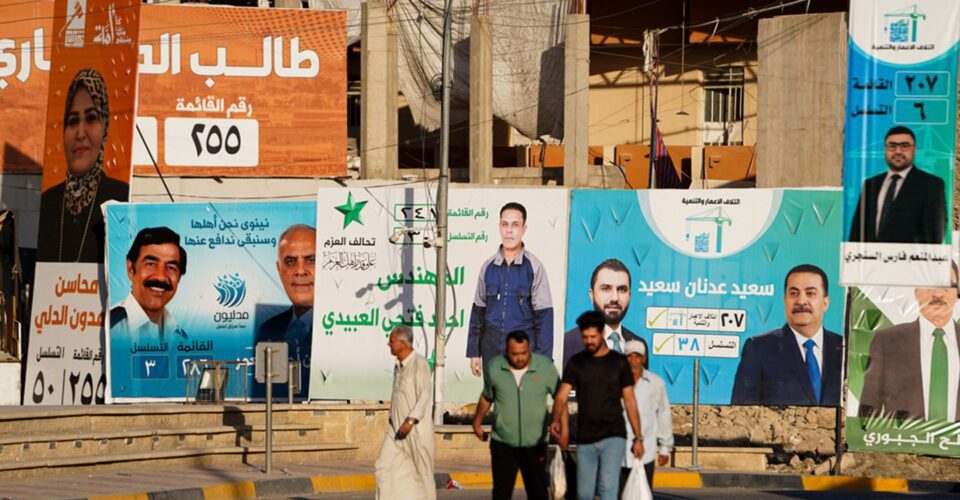
High turnout masks familiar challenges as Prime Minister Sudani’s electoral victory faces uncertain path to second term.
Iraq’s November 11 parliamentary elections have produced a striking paradox that encapsulates the country’s delicate position between competing regional powers. Prime Minister Mohammed Shia al-Sudani’s Reconstruction and Development Coalition secured the largest bloc with 46 seats out of 329, yet the intricate mathematics of Iraqi coalition politics may still deny him a second term. More significantly, the election results have thrust Iraq back into the center of US-Iranian rivalry, with both powers maneuvering to shape the political future of Iran-aligned militias that operate in a gray zone between state institutions and independent armed networks.
The elections themselves offered encouraging signals. Voter turnout reached 56 percent, a substantial increase from the dismal 43 percent participation in 2021, achieved despite a boycott by influential Shia cleric Muqtada al-Sadr’s movement. For ordinary Iraqis who have endured decades of dictatorship and violence, this renewed civic engagement came at a moment of relative stability, as the country narrowly avoided being drawn into escalating regional conflicts.
Yet the fragmented results virtually guarantee another prolonged government formation process. Sudani’s coalition claimed only 15 percent of parliamentary seats, leaving the final outcome dependent on months of political horse-trading among rival factions negotiating amid competing pressures from Washington and Tehran. At the heart of this bargaining lies a fundamental question: can Iraq’s powerful Popular Mobilization Forces, known locally as Hashd al-Shaabi, transform from militias into conventional political actors without undermining either Iranian influence or Iraqi sovereignty?
Washington’s Careful Calculus
The United States is deploying a familiar mix of sanctions, terrorist designations, and diplomatic pressure to force Baghdad’s hand on the militia issue. American officials have made clear that post-war stabilization aid, investment, energy cooperation, and continued access to US dollars all depend on Iraq reining in Iran-backed factions.
Yet Washington faces constraints of its own. Major American energy companies have expanded operations in Iraq, with ExxonMobil, Chevron, and KBR signing deals for conventional and liquefied natural gas projects designed to reduce Iraqi dependence on Iranian energy. Iraqi oil revenues flow through the US Federal Reserve system—a powerful lever, but one Washington hesitates to weaponize too aggressively for fear of destabilizing a government it still needs for counterterrorism cooperation.
The result is a cautious balancing act: pressure without destabilization, threats paired with inducements, and careful calibration to avoid spooking global energy markets or undercutting US commercial interests.
Tehran’s Strategic Interests
For Iran, Iraq represents strategic depth, political sanctuary, and economic lifeline simultaneously. The election results will determine who controls budget allocation, security appointments, and parliamentary committees that could either codify or constrain militia autonomy.
Tehran’s ideal outcome is a cabinet dominated by the Shia establishment that observes key red lines: no wholesale disarmament of core pro-Iran factions, no hostile alignment on US sanctions policy, and no opening for Israeli or American military action via Iraqi territory. Beyond ideology, Iran has practical economic concerns. Its sanctions-battered economy depends on Iraqi trade, banking channels, and procurement routes.
Iran appears to be conducting a quiet experiment: encouraging select militia factions to de-emphasize their military wings while building political party machines. This isn’t demobilization but mutation—trading rocket launches for budget meetings, military parades for procurement paperwork. The Badr Organization exemplifies this model, presenting civilian faces while pursuing political control through ballots and budgets.
Sudani’s Uncertain Path
Sudani’s campaign marked a dramatic departure from his 2021 approach, when his ticket won merely two seats before Iran-backed Shia militias elevated him to prime minister. This time, he ran on domestic accomplishments without apparent backing from Tehran, a strategy that resonated particularly with Sunni Arab voters. Pre-election polling showed 58 percent of Sunni and Shia Arabs expressing confidence in him—the highest rating for any candidate except Sadr.
His government received relatively high marks for infrastructure development in Baghdad and strengthening Iraq’s regional position through unprecedented diplomatic moves. He promoted energy independence from Iran while improving relationships with Arab neighbors and Washington, persuading militias to cease drone attacks on Israel and US personnel.
However, the Iran-friendly Coordination Framework bloc controls a near-plurality of parliamentary seats, with nearly 10 percent of parliament controlled by US-designated terrorist organizations. This bloc harbors what observers call “buyer’s remorse” over Sudani’s balanced approach toward Washington and possesses sufficient leverage to install a more Tehran-friendly prime minister.
The Road Ahead
The most probable scenario is continued semi-institutionalization: incremental audits, partial integration of select brigades, stricter budget controls, and political rewards for commanders who maintain discipline. True dissolution of the militias remains unrealistic, as they are woven into provincial governance, logistics, construction, and patronage systems.
US-Iranian co-existence in Iraq remains possible because all three principals—Baghdad, Washington, and Tehran—need it more than they admit. Co-existence will hold as long as militia entities avoid kinetic embarrassments and Iran’s deterrence posture relies more on political engineering than spectacular proxy attacks.
The danger is that one side, convinced it can lock in advantage during post-election negotiations, pushes just hard enough to tip Iraq back from politics to violence. For now, Iraq enters another period of political uncertainty, where electoral success proves insufficient to guarantee power in a system where nothing is decided until everything is decided.
By Jawad Qadir