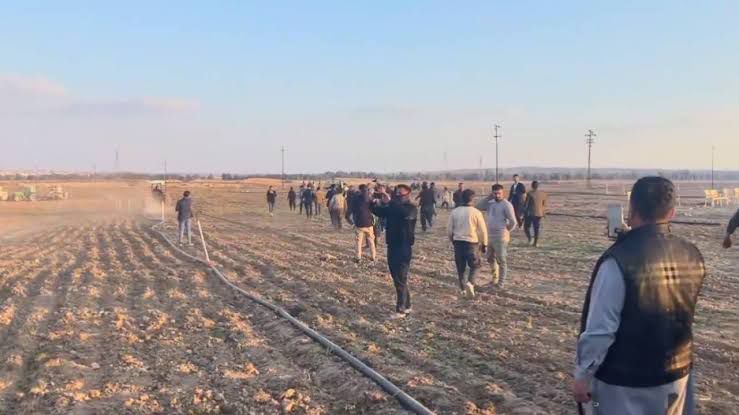
At dawn, long before the city stirs, Kurdish farmers in the villages surrounding Kirkuk walk toward fields their families have cultivated for decades. For many, each planting season now begins with uncertainty: Will this be the year they are forced off their land?
Despite the repeal of Ba’ath-era decisions by the Iraqi Council of Representatives, Kurdish farmers across Kirkuk’s disputed areas say the reality on the ground has barely changed. In districts such as Prde (Altun Kupri), Khurmatu, Sargaran, and Palkana, land disputes persist, driven not by new laws but by old power struggles and political interference.
Farmers interviewed by The Kurdish Globe describe a pattern of pressure, administrative delays, and legal ambiguity that has left them vulnerable. “We have documents, witnesses, and history on our side,” said one farmer from the Prde area, who asked not to be named out of fear of retaliation. “But every time we get close to reclaiming our land, another obstacle appears.”
Although parliament formally annulled decisions issued by the Ba’ath regime’s Revolutionary Command Council—decisions that stripped many Kurdish families of their land—local enforcement remains weak. In practice, farmers say, the repealed laws are still being applied under different pretexts, prolonging a sense of injustice that has lasted for generations.
Speaking to The Kurdish Globe, Shokhan Hasib Shwani, a member of the Kirkuk Provincial Council representing the Kurdistan Democratic Party (KDP), acknowledged the depth of the problem and criticized the performance of local institutions.
“The stance of the Kirkuk Provincial Council has not been strong enough,” Shwani said. “The Agriculture Committee, in particular, has failed to fulfill its responsibilities. Until now, no clear decision has been issued to return land to its rightful owners or to formally reject unjustly imposed regulations.”
Shwani also pointed to political tensions as a major obstacle. “What should be a legal process has turned into a political battle,” he told The Kurdish Globe. “There is clear interference, and the rule of law has been sidelined in favor of political interests.”
According to Shwani, Article 140 of the Iraqi Constitution remains the most viable path toward resolving the land issue in Kirkuk. The article, which addresses normalization and property restitution in disputed territories, has long been stalled. “Article 140 must not be treated as optional,” he said. “If it were properly implemented, many of these disputes would already be resolved.”
Behind the political debates are families whose lives remain on hold. In Khurmatu and Sargaran, farmers say they hesitate to invest in their land, fearing sudden eviction. Some have stopped planting entirely, while others continue out of necessity, aware that a single administrative decision could erase their work overnight.
Shwani emphasized that the KDP leadership continues to prioritize the issue. “President Masoud Barzani has consistently stressed that we must defend the rights of Kirkuk’s farmers and work to return land to its original owners,” he said. “Land is not just property—it is dignity, history, and survival.”
Concluding his remarks, Shwani warned that without collective action, the problem will deepen. “This issue requires broad political and legal consensus,” he said. “As the Kurdistan Democratic Party, we will not compromise on the land of Kurdistan. In both the Provincial Council and the Iraqi Parliament, we have made every effort to prevent the erosion of our citizens’ rights.”
For the farmers of Kirkuk, however, progress is measured not in statements or sessions, but in deeds. Until the law is fully enforced and political interference removed, many will continue to work their fields under the shadow of uncertainty—planting crops while waiting for justice.