
By Younes Mohammad
For days, the sky over that part of the front line had been black.
The darkness had settled into it like an old wound, hardened and scarred. Every day, the sky wept soot, raining black dust onto the dry, burned skin of the city.
The area had only recently been liberated from ISIS, yet no one dared to go there. Even from afar, the blackened sky felt like a warning, as if time and land were still under the enemy’s control. The fear was so real that the temptation to see the place with my own eyes died before it could even fully form in my mind.
Still, I eventually decided to go.
I wanted to silence that temptation by confronting the reality.
The closer I got to the city, the darker the world became. Fear grew heavier. I watched everything with suspicion as I entered.
There was absolute silence. Nothing existed but rubble, destruction, fire, smoke, and blackness.
In front of a government clinic, I saw a few people running back and forth, their bodies completely covered in soot. They looked like mechanics, masters and apprentices from a car repair shop, frantic and shouting. I stepped inside to see what had happened.
They had brought in a wounded man. He had been shot. Everyone was anxious.
Someone explained: “An ISIS fighter came out of a hole, fired, and wounded our brother. Then he disappeared. We haven’t seen him since. We brought him here, hoping to save him.”
I immediately thought of ISIS tunnels, the underground veins they carved everywhere. They would emerge, strike, and vanish again, leaving no trace, no direction to follow.
I took a few photographs and left with even greater fear than before.
I wanted to understand the source of that black sky. When I moved slightly outside the city, I found the answer: burning oil wells.
They were still on fire. No one was guarding them. No one dared to get close. The flames were what had turned the sky into a ceiling of darkness.
I returned to the city, seeking a sense of safety, and wandered through its streets.
I saw no people, but I saw chickens, roosters, sheep, their bodies blackened by the soot falling from the sky. It was hard to believe that war here had targeted not only humans, but animals and nature itself.
After hours of wandering, the sound of children’s voices pulled me into a narrow alley.
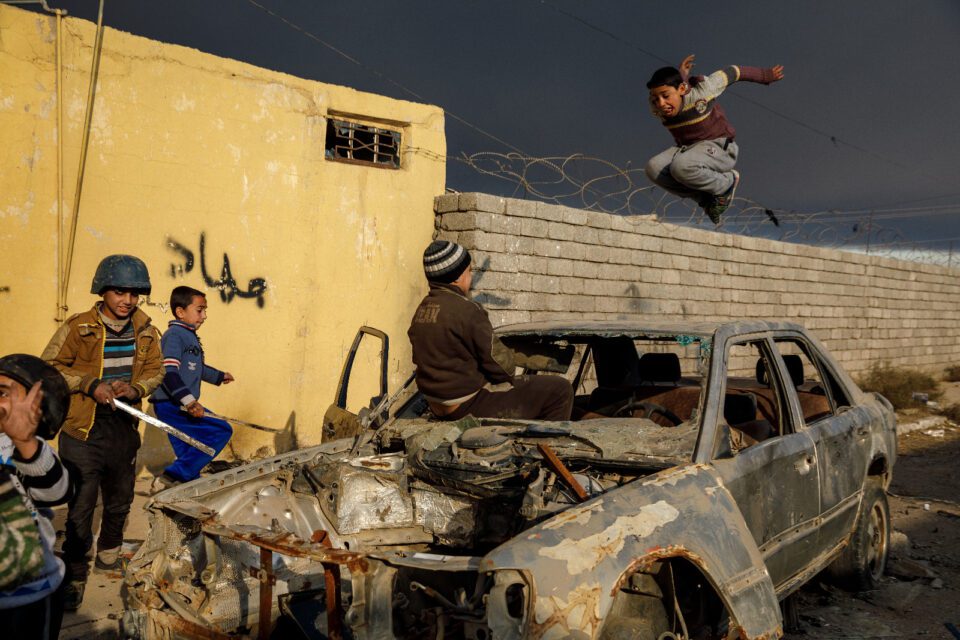
Four or five boys were there, wearing military helmets, jumping and shouting on top of an old, burned, wrecked car.
They were the only living humans I had seen for a long time.
And they were playing.
I approached and began photographing. Their play was aggressive, kicking, shouting, striking the car with force. I asked them, “What game are you playing?”
One of them, clearly the leader, looked at me seriously and said:
“We’re not playing, sir. This is the front line. We are soldiers, and we are fighting. This car belonged to ISIS. These helmets are theirs. They ran away from us because they were afraid.”
At that moment, the violence of their play made sense.
Their words multiplied my respect for them.
I was about to leave.
But I turned back.
I photographed them again.
This image became a document of a war whose true victors were children, children who had already learned the language of conflict before learning the language of peace.
The blackened children of this front line
will remain, forever, worthy of my deepest respect.