
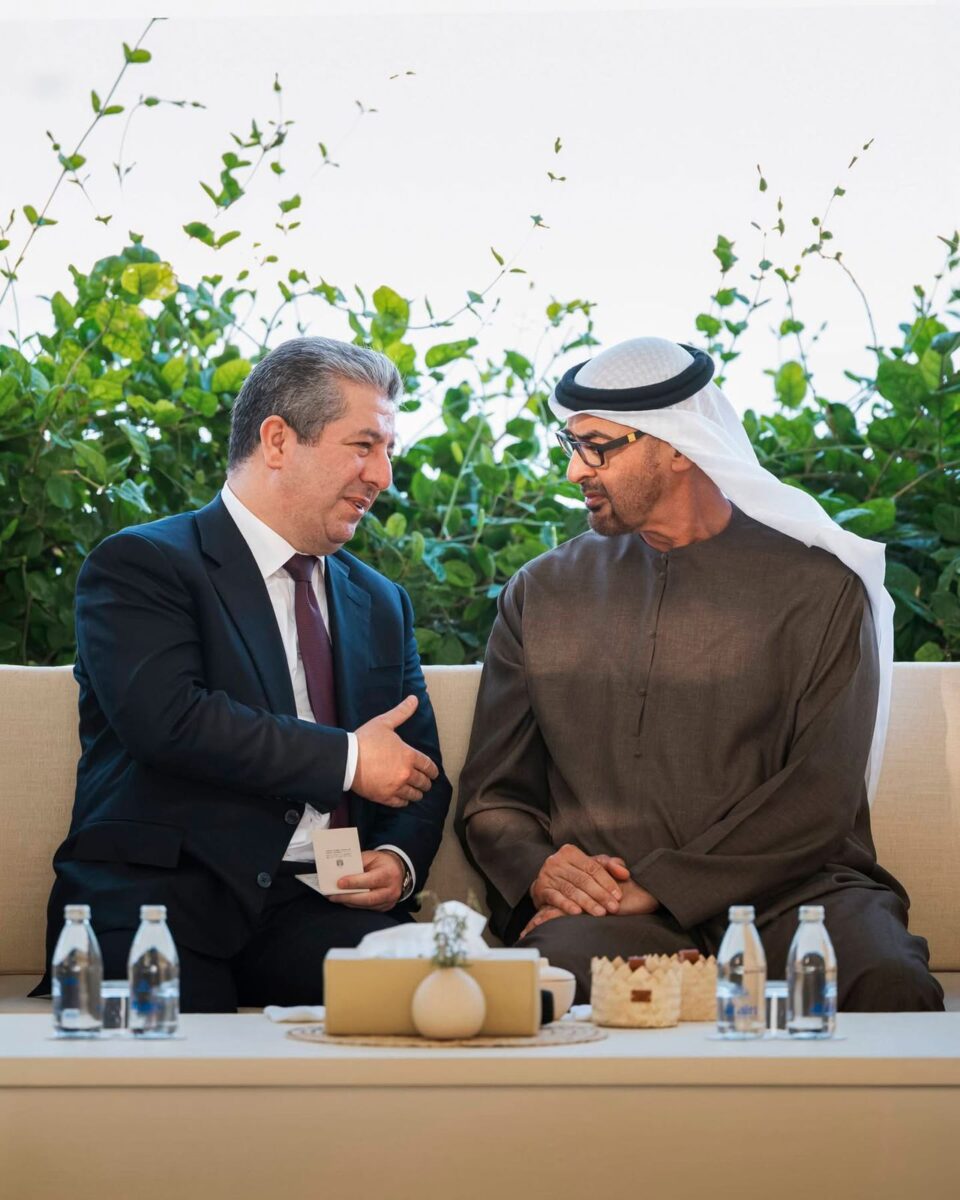
Kurdistan PM Masrour Barzani used Dubai talks to push stability, reforms and investment partnerships.
Kurdistan Region Prime Minister Masrour Barzani used the World Government Summit in Dubai to position the Kurdistan Region as a pillar of stability in a volatile Middle East and a growing economic partner for Gulf states and global investors.
Barzani’s participation at the summit, held under the theme “Shaping Future Governments,” came at a time when regional powers are recalibrating alliances amid wars, political fragmentation, and mounting pressure on governments to modernize. With delegations from around 150 governments and a packed agenda of high-level bilateral meetings, the summit provided Barzani with a global stage to advance what his office described as Kurdistan’s strategic integration into regional security and economic frameworks.
His visit followed an official invitation from the UAE Vice President and Prime Minister Sheikh Mohammed bin Rashid Al Maktoum, a move Kurdish officials framed as recognition of Erbil’s expanding diplomatic and economic role.
PM Barzani has long argued that Kurdistan’s stability is not merely a local achievement but a strategic asset for the wider region. At the summit, he reiterated that message bluntly.
“We have always said that the Kurdistan Region is part of the solution,” Barzani said, framing the region as a constructive actor rather than a crisis zone.
His engagements in Dubai reflected a diplomatic strategy aimed at deepening ties with Gulf partners, diversifying relationships beyond Iraq’s borders, and attracting investment linked to reforms and digital modernization in the Kurdistan Region.
Gulf diplomacy and a push for strategic depth
PM Barzani held talks with UAE President Sheikh Mohamed bin Zayed Al Nahyan, a meeting that Kurdish officials described as central to consolidating an increasingly strategic relationship between Erbil and Abu Dhabi.
The discussions focused on strengthening cooperation across security and economic sectors, and on regional developments, including Iraq and Syria. The meeting signaled the Kurdistan Region’s continued effort to embed itself in regional security calculations at a time when instability in Syria and the threat of militant resurgence remain persistent concerns.
Barzani also met UAE Interior Minister Sheikh Saif bin Zayed Al Nahyan, part of a broader Kurdish push to strengthen institutional-level cooperation with Emirati authorities.
For Erbil, building a strong UAE relationship serves multiple purposes: attracting Emirati capital, positioning Kurdistan as a secure gateway into Iraq, and reinforcing its role as a reliable partner in an unpredictable neighborhood.
Jordan message underscores Erbil’s regional role
Barzani’s meeting with Jordanian Prime Minister Jafar Hassan carried symbolic weight, as the Jordanian official delivered a personal message from King Abdullah II to PM Barzani.
Kurdish officials described the exchange as a sign that Amman views the Kurdistan Region as a strategic partner rather than a provincial player, reflecting the region’s historic role as a relatively stable zone in Iraq.
Caucasus outreach and the “Middle Corridor” ambition
In a notable expansion of his summit diplomacy, Barzani met Georgian Prime Minister Irakli Kobakhidze, a meeting Kurdish officials framed as part of a broader strategy to build transcontinental partnerships linking Kurdistan to the Caucasus and European markets.
Kobakhidze praised the “positive role” of Kurds in Georgia’s development, according to Kurdish readouts of the talks. The meeting highlighted Erbil’s effort to diversify alliances and explore emerging trade corridors that could reshape regional connectivity.
Arab League endorsement strengthens stability narrative
One of Barzani’s most politically significant meetings in Dubai was with Arab League Secretary-General Ahmed Aboul Gheit, who Kurdish officials said praised both Prime Minister Masrour Barzani and Kurdish leader Masoud Barzani for their role in “preserving security and stability.”
The endorsement carried weight in a region where recognition by Arab institutions has often been politically sensitive for Kurdish leadership.
Aboul Gheit also referenced the Kurdistan Region’s role in promoting peaceful solutions for Syria, Kurdish officials said, aligning with Erbil’s long-standing emphasis on inclusive political settlements.
The Kurdistan Region has repeatedly framed itself as a stabilizing counterweight to regional chaos, highlighting its role in the fight against Islamic State and its ability to maintain internal security even during Iraq’s political crises.
Barzani used the summit to reinforce that message, stating that Kurdistan’s stability is inseparable from wider Middle Eastern stability.
Reform agenda and economic modernization pitch investors
Beyond diplomacy, Barzani used the summit to present Kurdistan as a reform-driven investment destination, stressing that internal modernization is the foundation of external credibility.
His meeting with UAE Minister of Industry and Advanced Technology Sultan Al Jaber focused on energy, natural resources, and technology cooperation, according to Kurdish officials.
The Kurdistan Region holds substantial oil and gas reserves, and Kurdish leaders have increasingly argued that economic survival requires more than hydrocarbons. The KRG cabinet has promoted digital governance, administrative reform, and investment facilitation as key priorities.
Speaking in Dubai, Barzani linked his reform agenda to learning from regional success stories.
He pointed to the importance of adopting practical governance models and eliminating bureaucratic barriers that discourage investors, according to his office.
Kurdish officials said the talks were aimed at aligning Kurdistan’s resource base with UAE technological expertise, signaling that the region wants to be seen not only as an energy supplier but also as a market for innovation and advanced infrastructure.
Soft power and UNESCO push for cultural recognition
Barzani also met with UNESCO Director-General-designate Khaled el-Anany and formally requesting that the Kurdistan Region be accepted as a “participating member” in UNESCO.
The talks focused on heritage protection, including ongoing work at the Erbil Citadel, one of the oldest continuously inhabited sites in the world and a UNESCO World Heritage landmark.
The request reflects a broader Kurdish strategy: using international cultural institutions to strengthen legitimacy and ensure Kurdish heritage is represented globally through direct engagement rather than through Baghdad.
UNESCO’s expressed readiness to cooperate, according to Kurdish officials, was seen as a step toward deeper institutional recognition for the region.
A regional actor on a global stage
Barzani’s participation in the World Government Summit underscored a shift in how the Kurdistan Region seeks to define itself internationally: not simply as an Iraqi federal entity, but as a strategic partner to Gulf states, a contributor to regional security, and a reform-oriented economy seeking global investment.
While Kurdistan remains locked in recurring disputes with Baghdad over oil exports, revenue sharing, and constitutional authority, Kurdish officials argue that the region’s stability and economic openness make it an indispensable partner for Iraq’s allies and neighbors.
Barzani framed his engagement in Dubai as part of a long-term effort to ensure the Kurdish voice is heard in international forums.
“Every platform that allows us to raise the voice of our people to the world is important for us,” he said.
“We will continue to participate in every forum that allows the voice of the Kurdish people to be heard and their interests protected.”
The 2026 World Government Summit (WGS) in Dubai has emerged not merely as a forum for administrative discourse, but as a high-stakes laboratory for the design of global governance. Operating under the theme “Shaping Future Governments,” the summit serves as a preeminent platform where 150 governments, 60 heads of state, and over 6,250 delegates—including 87 Nobel laureates—converge to navigate the complexities of a fragmented international order.
The Kurdish Globe