
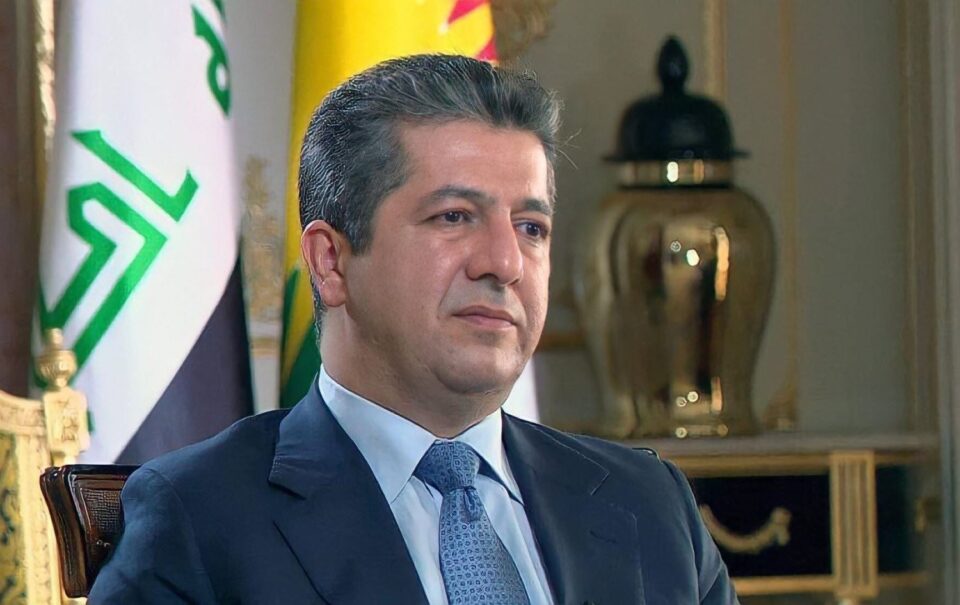
Prime Minister Barzani says Kurdistan’s next government must reflect election results, not bargaining.
Prime Minister Masrour Barzani has called for what he described as a “mandate of the majority” to break a year-long political deadlock that has left the Kurdistan Region without a new government and has complicated negotiations over Iraq’s presidency in Baghdad.
Speaking as talks between the Kurdistan Democratic Party (KDP) and the Patriotic Union of Kurdistan (PUK) remain frozen, Barzani said any future administration must be formed on the “basis of respect for the voter’s voice,” warning that post-election bargaining should not override the outcome of the ballot box.
His remarks reflect growing frustration within the KDP, which emerged as the largest party in the Kurdistan Region elections, but the talks reached a deadlock to form the new cabinet. The stalemate has created a political vacuum at a moment when the region is facing financial pressure from Baghdad, regional instability driven by the Syrian crisis, and rising security tensions linked to Iran and Israel.
Barzani has increasingly framed the dispute not as a routine political negotiation, but as a test of democratic legitimacy in the Kurdistan Region.
“It is not right to hold elections and then ignore the results,” he said, criticizing parties he believes are demanding more power than their electoral share justifies.
A dispute over entitlement and influence
At the heart of the deadlock is a widening gap between what the KDP calls “electoral entitlement” and what it describes as the PUK’s expanding institutional demands.
The PUK has sought to increase its influence within the next cabinet by pressing for a number of key ministries and strategic positions, including several traditionally viewed as sovereign portfolios. The demands include the Ministry of Interior, Natural Resources, Finance, Electricity, and other bodies such as the Kurdistan Region’s Security Council advisory post, the Investment Board, and the Department of Foreign Relations.
For the KDP, these demands are seen as an attempt to reshape the balance of power beyond what election results would justify. KDP officials argue that sovereign ministries should remain under the authority of the party that won the largest share of seats, particularly ministries linked to security, oil, finance, and diplomacy.
Barzani has been direct in his criticism of what he calls a culture of political bargaining that undermines democratic practice.
“Some parties are asking for more than their entitlement,” he said, suggesting that negotiations have shifted from coalition-building to political leverage.
One notable element of the current negotiations is that the PUK has reportedly stepped away from demanding what are known as the “three presidencies” — the Kurdistan Region presidency, the premiership, and the parliament speakership.
Instead, the party appears focused on expanding direct executive control through ministries that influence security forces, financial flows, and investment.
This shift is widely interpreted as tactical. By dropping symbolic leadership posts, the PUK may be seeking stronger influence through institutions that shape real power on the ground: security command structures, budget decisions, and control over oil and energy.
The KDP argues that such an approach risk creating an unstable division of authority inside government, where major ministries are split between the two parties in a way that could weaken coordination and increase internal competition.
KDP says earlier offer was rejected
KDP Political Bureau member Pishitwan Sadiq has said his party previously offered the PUK a package that included nine ministries and the Iraqi presidency, describing it as a generous settlement that would have secured a broad-based government.
According to the KDP, the PUK rejected the offer without presenting a clear counterproposal, deepening distrust and prolonging negotiations.
The PUK has not publicly accepted the KDP’s narrative and has argued in the past that power-sharing should reflect not only parliamentary seats but also historical legitimacy, administrative balance, and the need for equal partnership between Kurdistan’s two dominant parties.
However, Barzani has signaled that the KDP is no longer willing to accept open-ended negotiations that dilute its electoral advantage.
“The results of the election must be respected,” he said, portraying the dispute as a matter of principle rather than political rivalry.
The Iraqi presidency becomes a second battleground
The paralysis in Erbil has spilled into Baghdad, where the Iraqi presidency remains unresolved. Traditionally, the post has been held by the PUK, which has treated it as a political entitlement since 2005. The KDP is now pushing to end what it calls a monopoly over the office.
PM Barzani has argued that the Kurdish nominee for president should be selected through a formal mechanism that reflects majority support, rather than through informal party tradition.
He proposed two possible models.
The first is for the Kurdistan Parliament to vote and select a unified Kurdish nominee. The second is for Kurdish members of Iraq’s parliament in Baghdad to hold a caucus vote to decide on a single candidate.
Both mechanisms would likely benefit the KDP, which holds stronger numerical weight in both the Kurdistan parliament and among Kurdish MPs at the federal level. Analysts say the KDP’s approach is designed to institutionalize its political dominance.
Barzani framed the matter as a question of representation.
The president, he said, should be someone who “represents the majority of the people of Kurdistan,” not a candidate imposed through tradition or party entitlement.
Barzani has also raised concerns about what he described as “deliberate changes” in seat distribution across Iraqi provinces, suggesting that the KDP’s parliamentary representation in Baghdad does not reflect its vote totals.
He insisted the KDP remains the largest political force not only in the Kurdistan Region but across Iraq, implying that electoral mechanisms may have been used to suppress the party’s influence.
Such claims add to another layer of tension, feeding into the KDP’s narrative that political competition is no longer only between parties, but also between the voter’s will and institutional manipulation.
A fragile moment for Kurdish unity
Barzani has repeatedly called for Kurdish unity, especially as the region watches developments in Syria and rising regional tensions.
But he has tied unity to a clear condition: respect for election results.
For the KDP, the message is that consensus must not mean equal division regardless of voter choice.
For now, negotiations remain stalled, the 10th cabinet remains unformed, and Iraq’s presidency remains hostage to Kurdish division. As Barzani frames it, the crisis is no longer simply about positions, but about whether elections in Kurdistan still carry meaning.
“The results of the election must be respected,” he said.
The Kurdish Globe