
A Diplomatic Marathon for Kurdish Interests
Kurdistan Region President in Munich to Champion Stability and Kurdish Rights
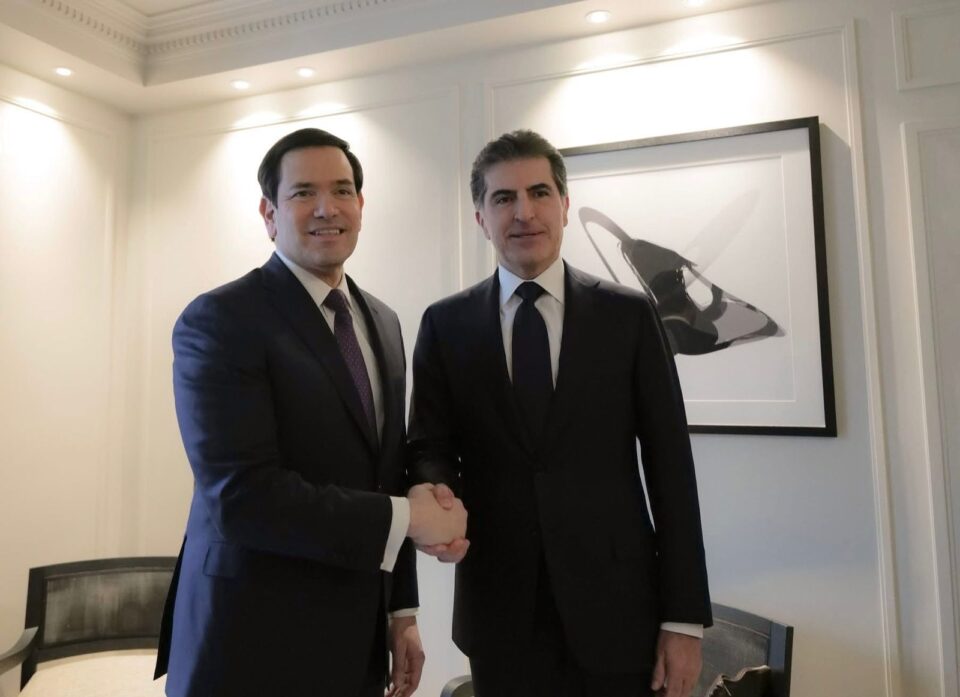
Kurdistan Region President Nechirvan Barzani concluded three days of intensive diplomatic activity at the 62nd Munich Security Conference last weekend, holding meetings with more than a dozen world leaders and senior officials to advance the Kurdistan Region’s security interests and advocate for Kurdish rights across a region in flux.
A Packed Diplomatic Agenda
Barzani met French President Emmanuel Macron on the sidelines of the annual gathe
ring, where both leaders underscored the importance of protecting Kurdish rights in any future Syrian constitution. He also sat down with U.S. Secretary of State Marco Rubio, European Commission President Ursula von der Leyen, Germany’s Defense Minister Boris Pistorius, U.S. Senator Lindsey Graham, the prime ministers of the Netherlands, Qatar, and Lebanon, the UK’s National Security Adviser Jonathan Powell, and the Vatican’s foreign minister, among others.
On Saturday, Barzani held talks with Syrian Foreign
Minister Asaad al-Shaibani on Syria’s future, the situation of displaced persons, and the need for inclusive national dialogue. The Syrian diplomat reportedly praised Barzani’s mediating role in the recent agreement between Damascus and the Kurdish-led Syrian Democratic Forces — a rare acknowledgment that reflects the Kurdistan Region’s growing quiet diplomacy in a volatile neighborhood.
Syria and the Kurdish Question at the Center
Throughout his meetings, the Syrian file dominated discussions. Barzani has positioned the Kurdistan Region as a pragmatic broker, maintaining contacts with Ankara, Damascus, and Kurdish factions simultaneously. At a press conference held on the final evening of the conference, he was direct about his assessment of the SDF-Damascus agreement.
“Considering what has transpired and what can realistically be achieved, I view the present situation as a reasonable agreement,” he said, drawing a deliberate parallel to the 2005 Iraqi constitution, which he acknowledged did not fulfill all Kurdish aspirations but nonetheless provided a workable foundation. He urged Kurdish parties in Syria, including the ANKS and SDF, to engage politically with Damascus rather than remain outside the process. “Damascus is their capital,” he said. “They should return to Damascus and work seriously toward resolving the existing issues within a unified Syria.”
Barzani expressed cautious optimism about Damascus’s intentions following his meeting with al-Shaibani, though he was careful not to overstate the case. “The key question is whether there is commitment to a solution. In my view, such commitment does exist from Damascus,” he said, while leaving open the question of implementation.
Regional Diplomacy and Domestic Challenges
Beyond Syria, Barzani addressed the Turkey-PKK peace process, expressing support and offering thanks to President Erdoğan, Devlet Bahçeli, and Abdullah Öcalan for their respective roles. He was measured in tone, acknowledging public frustration at the pace of progress while expressing hope the effort would bear fruit. He was equally clear that the PKK bore its own responsibilities: “It must implement the demands that President Öcalan has made of the PKK.”
On Iraq, Barzani said the conference reinforced broad international support for a stable Kurdistan Region within a federal Iraq, and indicated that talks on forming a new Iraqi cabinet were ongoing. He also addressed the political stalemate within the Kurdistan Region itself, noting recent meetings between President Masoud Barzani and PUK leader Bafel Talabani as a hopeful, if still inconclusive, development. “We are moving in the right direction,” he said, without offering a timeline.
Barzani also used his meetings to thank Germany for its support for displaced communities and the Yazidi population, while pressing European and American partners to channel investment into northwestern Syria following the SDF-Damascus agreement.
The conference underscored Barzani’s role as one of the region’s more active diplomatic interlocutors — a position built on accessibility and consistency, if not always on concrete outcomes.
By The Kurdish Globe Staff