
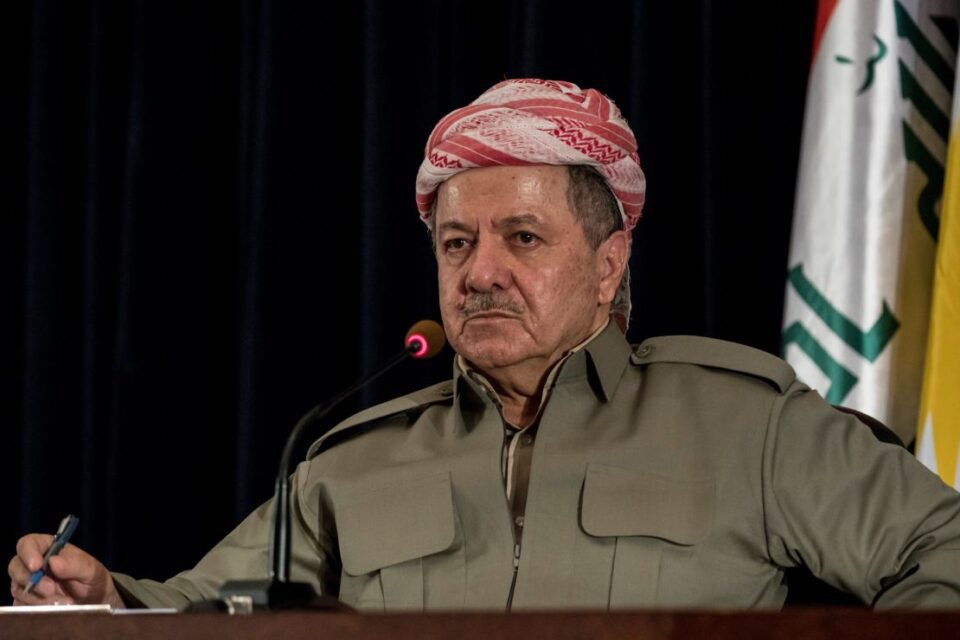
President Barzani denounces Iraq’s presidential election, urging consensus and warning against unilateral political decisions.
Kurdistan Democratic Party (KDP) leader President Masoud Barzani has sharply rejected the process that led to the election of Iraq’s new president, arguing it violated political norms, constitutional balance, and the principle of national consensus that has underpinned Iraq’s post-2003 political system.
In a statement addressing the developments, President Barzani said, “It is not acceptable for some parties to insist on proceeding with the election of the President of the Republic while others continue to delay the selection of the Prime Minister,” framing the issue not as a procedural disagreement but as a fundamental breach of political sequencing and agreement among Iraq’s main blocs.
He added, “We emphasize that no constitutional entitlement can be resolved unless these issues are addressed simultaneously,” underscoring that the presidency and premiership should be treated as a unified political package rather than separate tracks driven by competing alliances.
President Barzani further stressed the need for inclusive participation, stating that progress requires “ensuring the presence and participation of all parties in the upcoming session of the Council of Representatives,” signaling that legitimacy, in his view, derives from broad political buy-in rather than numerical majority alone.
The comments came after Iraq’s parliament convened on April 11, 2026, with 249 lawmakers present, and elected Nizar Amedi as president with 227 votes in a second round of voting. The session proceeded despite a boycott by the KDP, exposing deep fractures among Kurdish factions and between Kurdish and other Iraqi political actors.
The KDP has framed the election not only as politically flawed but also as legally questionable. In a strongly worded statement, the party’s Political Bureau said the process “was conducted outside the approved internal procedures of the Council of Representatives,” adding that “the presidency of parliament ignored the internal bylaws in setting the session agenda, which constitutes a violation of the law.”
The party also challenged the legitimacy of the candidate himself, stating that “the candidate nominated for the position of President of the Republic was outside the Kurdish framework,” despite the long-standing understanding that the presidency is allocated to the Kurdish component within Iraq’s ethno-sectarian power-sharing system.
“This position is the entitlement of the people of Kurdistan, not a single party,” the statement continued, criticizing what it described as a unilateral nomination backed by non-Kurdish actors. “The candidate was nominated by one party and approved by several other Iraqi components.”
The KDP concluded unequivocally: “We reject this method of election and do not recognize anyone chosen in this way as representing the majority of Kurdistan, nor will we engage with them.”
The party linked its position directly to its decision to boycott the parliamentary session. “For these reasons, our parliamentary bloc boycotted participation in the session,” the statement said, adding that “our candidate’s name should have been withdrawn from the electoral process following the boycott.”
In response to the outcome, the KDP has taken the step of recalling its representatives from Baghdad. “At this stage, for the purpose of assessing the situation and conducting consultations, both our parliamentary and government teams in the federal institutions are returning to the Kurdistan Region,” the statement said.
Senior KDP officials have reinforced President Barzani’s position, emphasizing that the issue extends beyond political rivalry with the Patriotic Union of Kurdistan (PUK), which backed Amedi’s candidacy.
Ali Hussein, a member of the KDP Political Bureau, said the party does not oppose Amedi personally or the PUK as a political actor. “The KDP has no issue with Nizar Amedi or the PUK,” he said. “However, according to political norms, the presidency is the share of the Kurds, and Kurdish parties should have agreed on it as a national entitlement, just as Shia and Sunni parties settle positions among themselves.”
Hussein warned that failure to reach intra-Kurdish consensus opens the door to external bargaining. “When the presidency is not settled internally among Kurds, one side will inevitably reach agreements with Shia and Sunni parties,” he said, adding that such deals “will involve concessions,” including key positions like the governorship of Kirkuk and other Kurdish gains.
He also drew a sharper political line, suggesting that the alliances underpinning the vote carry broader security implications. “Those who voted for the president in the Iraqi parliament are the same ones who carry out daily drone attacks on the Kurdistan Region,” he said, adding that “it is clear who they are.”
The KDP’s position reflects a broader concern that the balance of power within Iraq is shifting in ways that marginalize Kurdish consensus and dilute the negotiating leverage historically exercised by Kurdish parties as a unified bloc.
Internally, the party has moved quickly to consolidate its response. All KDP ministers and lawmakers in Baghdad have returned to Erbil, where a series of high-level meetings are underway under President Barzani’s supervision. These meetings aim to assess the political landscape and determine the party’s next steps.
A member of the Political Bureau said the consultations are ongoing and focused on both immediate and long-term strategies. “The meetings will continue, with further assessment of the regional situation and the formation of Iraq’s new government,” he said. “After that, the results will be clarified to the public.”
Another official described the discussions as comprehensive, covering “the entire political process in Iraq and deciding on future steps after the events that took place in parliament.”
The KDP has also linked the current crisis to broader regional dynamics, noting that political developments in Iraq cannot be separated from instability across the Middle East. Party officials said this context has contributed to the suspension of talks with the PUK over forming a new Kurdistan Regional Government cabinet.
Despite its strong messaging, the KDP has not outlined specific next steps such as withdrawing from federal institutions or forming a government in the Kurdistan Region without the PUK. However, its statements indicate that further actions may be considered if its concerns remain unresolved.
By insisting that the presidency and premiership must be resolved together and through agreement, President Barzani is effectively calling for a return to a model of power-sharing that prioritizes stability over speed and inclusion over unilateral action.
Whether that model can be restored in Iraq’s current fragmented political environment remains uncertain. What is clear, however, is that the election of the president has not resolved Iraq’s political deadlock — it has deepened it.
Nizar Amedi, Iraq’s newly elected president, is a senior figure within the Patriotic Union of Kurdistan (PUK) with decades of experience in political and administrative roles. Born in 1968 in Amedi in the Kurdistan Region, he began his career in the 1990s working closely with the late Kurdish leader Jalal Talabani, a relationship that helped shape his political trajectory. Over the years, he built a reputation as a disciplined party operator, later serving as Iraq’s Minister of Environment between 2022 and 2024 before taking on a senior role within the PUK’s political bureau in Baghdad. His elevation to the presidency comes at a moment of heightened political fragmentation, placing him at the center of efforts to navigate Iraq’s complex power-sharing system and strained inter-party relations.
The Kurdish Globe