
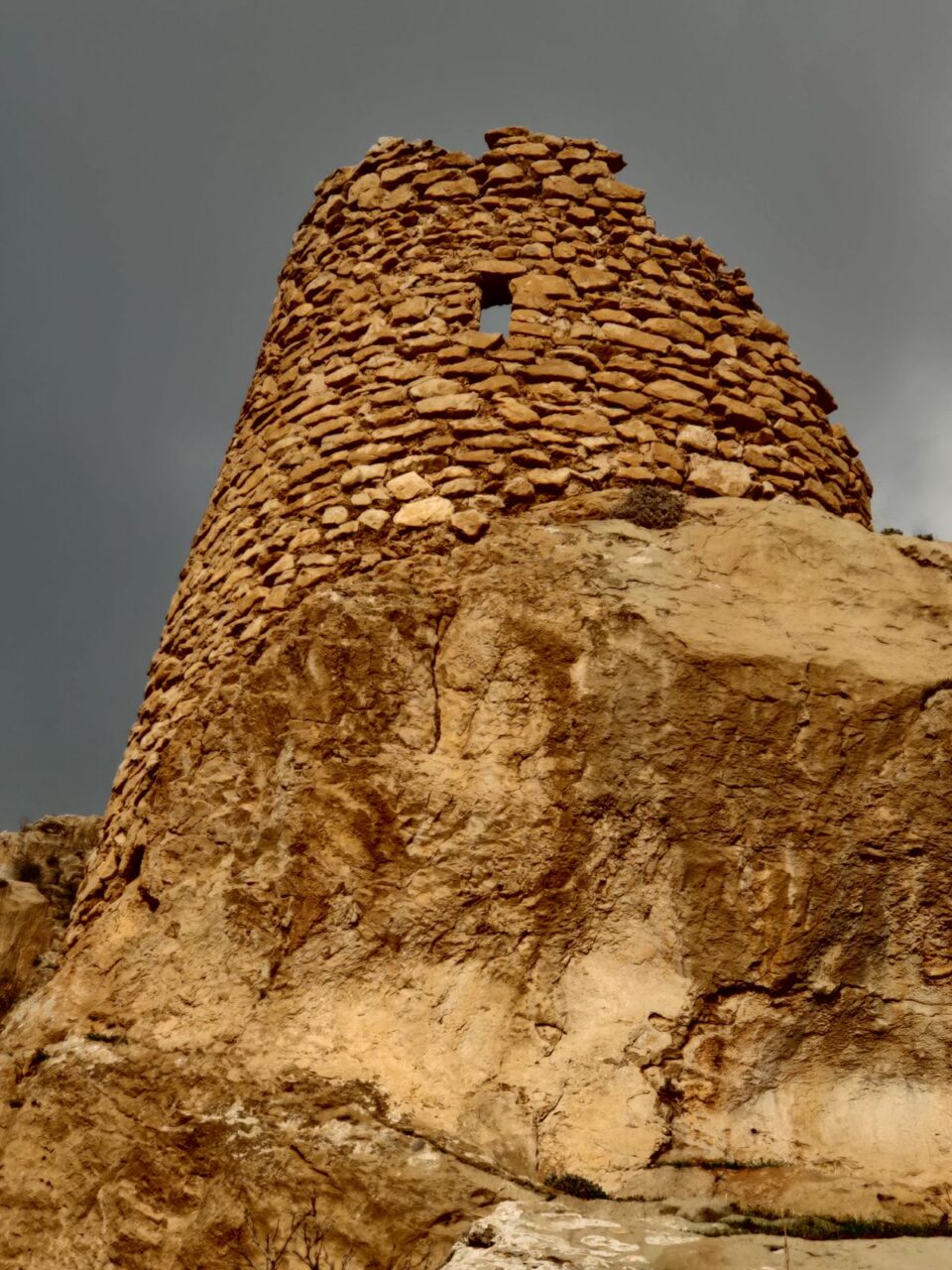
In this journey, we head to a summit in the Bani Harir mountain range, which contains several civilizational and archaeological sites that remain to this day. The most prominent site on this peak is the Khanzad Citadel of the Soran Emirate. Built in a rugged and difficult location, it features a number of wells and pits carved directly into the rock. Despite their significance, these sites have been neglected from an archaeological and tourism perspective. In this article, I shed light on its structure and components, bringing them to the attention of researchers, archaeologists, and authorities so that they may be preserved and developed into a future tourism destination.
The Location of Khanzad Citadel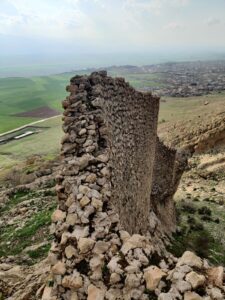
Khanzad Citadel is located 3 km east of the town of Harir and 65 km north of Erbil, the capital of the Kurdistan Region. It sits atop a high peak in the Harir mountain range, 1,025 meters above sea level and more than 400 meters above its surrounding terrain. The citadel was built on a summit that extends upward from below, flanked by valleys on both sides, ending in a peak that is isolated from its surroundings. This makes the location extremely formidable, with only one path leading up from the foot of the mountain. Due to its elevation and the valleys to the north, east, and west, the peak is independent, overlooking Khrawatan village and the Harir plain. Along the path leading to the summit, protective walls were built on both the eastern and western sides to ensure no other access points existed. These walls range from 4 to 7 meters in height. While the mountain ridge varies in width from 50 to 100 meters, the foundation of the citadel building itself is estimated to be approximately 6 by 7 meters.
Components and Structure
At the foot of the mountain near the road, ruins of stones and walls suggest the remains of a village or a cluster of houses that likely served as a reception area or gateway for the citadel. After a 20-minute hike, one reaches a plateau containing the foundations of buildings. As the path becomes steeper, there are ten rock-cut steps (a stone staircase) carved into the mountain. Along the climb, there are various spaces carved into the rock, some resembling rooms, though their exact purpose remains unclear.
The Architecture of the Citadel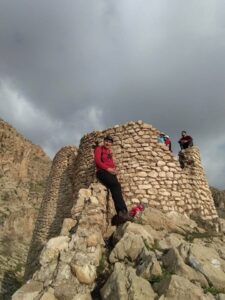
After more than an hour of climbing and passing several wells and ruins, we reach the top of the ridge where Khanzad Citadel stands at the highest point. The citadel is composed of two sections and two floors, appearing overall as a large military watchtower.
The first floor of the first section serves as an entrance; it is cylindrical in shape, though only three of its walls remain and the roof has collapsed. The rooms are small, roughly 3 by 3 meters. The second section is egg-shaped or domed, with its ceiling and roof still intact. The lower floor contains a room that appears to have been a prison. The roof of this room was constructed with stone, mortar, and gypsum. The walls feature several defensive embrasures (slits) that are wide on the inside and narrow on the outside. About 50 meters to the west, below these three rooms, stands another tower with 4-meter-high walls and several embrasures overlooking the Harir plain. Further down, the remains of the citadel’s enclosure wall stand at a height of 7 meters.
The Rock-Carved Wells and Deep Pits
Along the path to the citadel, I observed 15 wells (pits) engineered into the mountain in circular or square shapes. Each pit is between one and two meters wide and two to five meters deep. Some pits widen toward the bottom, taking on a jar-like shape. Several are coated internally with lime and gypsum—materials that resist moisture. In my view, while some may have been used for grain storage, the majority were likely used for water storage. Our guide mentioned that 45 to 50 wells used to exist, though many are now hidden or lost. It is fascinating to consider why such a fortress was built in such a difficult location and what tools were used to carve such large pits into the heart of the mountain. I believe the wells are much older than the citadel itself and were likely used for various purposes over different eras.
The citadel is in dire need of restoration, protection, and promotion as a tourist site. It records an important piece of history, particularly as it was established and led by a Kurdish female ruler during her reign.
History of the Citadel and Khanzad’s Rule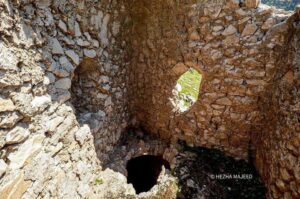
The exact history of the citadel is not entirely clear, but some sources point to the rule of Princess Khanzad between 1590 and 1597 AD (though dates vary among historians). Harir was the capital of the Soran Emirate after 1550 AD, particularly during the era of Emir Suleiman and Khanzad of Soran. During Khanzad’s reign, several notable citadels and sites were built, some of which still stand, such as the Khanzad Citadel in Banaman and this citadel on Mount Bani Harir.
By Nadir Rusti