
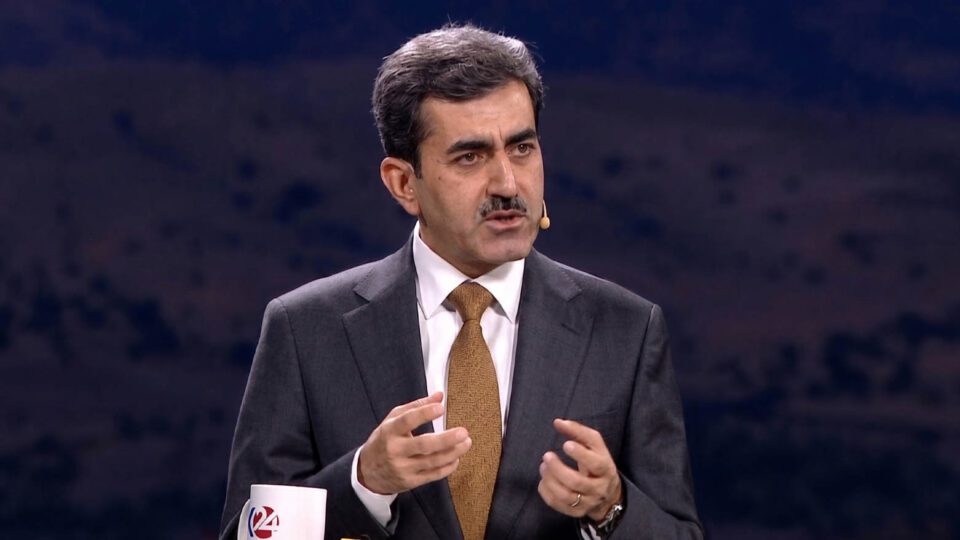
Dr. Agrin Abdullah: Strategic road projects face no technical barriers, only financial challenges
The road and construction sector is considered a backbone of economic development, trade, tourism, and social stability. In the Kurdistan Region, despite financial challenges and previous economic crises that delayed several projects, the Kurdistan Regional Government has resumed work on strategic infrastructure projects through a new approach aimed at improving connectivity, reducing traffic risks, and strengthening economic activity.
To discuss the current projects, challenges, and future plans for the sector, The Kurdish Globe conducted an exclusive interview with Dr. Agrin Abdullah Agrin, Deputy Minister of Construction and Housing of the Kurdistan Regional Government.
Dr. Agrin said the Ministry is currently focusing on several major strategic road projects and emphasized that the main obstacle facing these projects is not technical but financial.
“The Ministry is currently giving special attention to four to five important strategic projects, and we have prepared a detailed list of them. I want to make it clear that these projects face no technical problems, and their engineering work is proceeding without difficulties. The only challenge is financial, due to the lack of sufficient cash liquidity in banks to continue the work,” he told The Kurdish Globe.
Among the major projects under the Ministry’s supervision is the Erbil-Koya dual carriageway, which has a total budget of 683 billion Iraqi dinars and a length of 48.5 kilometers. The project has reached a completion rate of around 10 percent and work is ongoing.
Another key project is the Kore-Shaqlawa dual carriageway (Mawaran-Merawa section), with a budget of 197 billion Iraqi dinars and a length of 9.6 kilometers. The completion rate of this section has reached 53 percent.
The Ministry is also supervising the Dukan-Chwarqurna dual carriageway project (phases two and three), which extends for 35 kilometers with a budget of 260 billion Iraqi dinars. The completion rate currently stands at 24 percent.
The fourth major project is the Kalar-Darbandikhan road (Warmawa to the Darbandikhan tunnel entrance), which covers approximately 16 kilometers with a budget of around 200 billion Iraqi dinars. The project has reached 10 percent completion and work continues.
Regarding the possibility of relying on private sector investment and the Build-Operate-Transfer (BOT) system due to financial constraints, Dr. Agrin said the Ministry has not yet implemented this model.
“Currently, all our projects are implemented through the contracting system according to government contract regulations. Although the BOT system exists, no investor has so far approached the Ministry with a proposal to build a road, such as an expressway, and recover costs through toll collection,” he said.
Addressing concerns over traffic accidents on external roads, Dr. Agrin said accidents have generally decreased due to the installation of speed monitoring cameras.
“According to international statistics, only 5 to 10 percent of traffic accidents are related to road conditions, while around 90 percent are caused by speeding and driver behavior,” he said.
He added that the average traffic fatality rate in the Kurdistan Region is around 8.5 deaths per 100,000 people, which he described as an acceptable level according to international standards.
“Of course, if there is an engineering problem on a road, such as a dangerous curve or a defect that could cause accidents, the Ministry immediately works to address it,” he said.
Regarding the Ministry’s future strategy, Dr. Agrin said a comprehensive 10-year master plan has been prepared covering all types of roads across the Region.
“Our roadmap does not focus on one type of road while neglecting another. The master plan includes major dual carriageways, main roads, secondary roads, village roads, and renovation projects. Every sector has its own share and importance,” he said.
He stressed that improving existing roads and constructing new strategic routes are both priorities for the Ministry.
“The development of village roads is also important. We are not neglecting any part of the road sector; both new construction and renovation projects have received significant attention,” he added.
The road infrastructure sector remains one of the most important foundations for the Kurdistan Region’s economic future. Despite financial difficulties, the Ministry’s efforts to continue strategic projects and follow modern standards reflect the Region’s ambition to strengthen transportation networks, support trade and tourism, and improve connections with regional and international markets.
Dr. Agrin said the success of this roadmap depends on securing the necessary funding, ensuring transparency in implementation, and maintaining coordination among government institutions. If these projects continue, the Kurdistan Region has the potential to become an important transportation and connectivity hub.
By: Frsat Said Shkur