

Younes Mohammad
That day, I left home in my own car and came back in a taxi.
When I arrived, my wife and my parents were surprised to see me in it. They asked what it was, where I had got it, whose it was. When I told them I had bought it, they asked, You bought a taxi, what do you need a taxi for.
More than their words, I remember their looks. Their eyes, their faces, the way they behaved. Even those who said nothing looked at me in a way that felt worse than an insult.
A few days earlier, two Italian friends had been staying with me. One day they told me they had visited an old friend who was now managing an organization. They had known her for years in Italy. During the visit, they learned that the organization needed a driver. One of them told me he could introduce me and thought she would probably hire me.
I was not looking for work. I did not need a job. Perhaps my friends thought they were doing me a favor by telling me about the opportunity. Becoming a driver was not something I had ever considered. I was a photographer, and I wanted to take photographs.
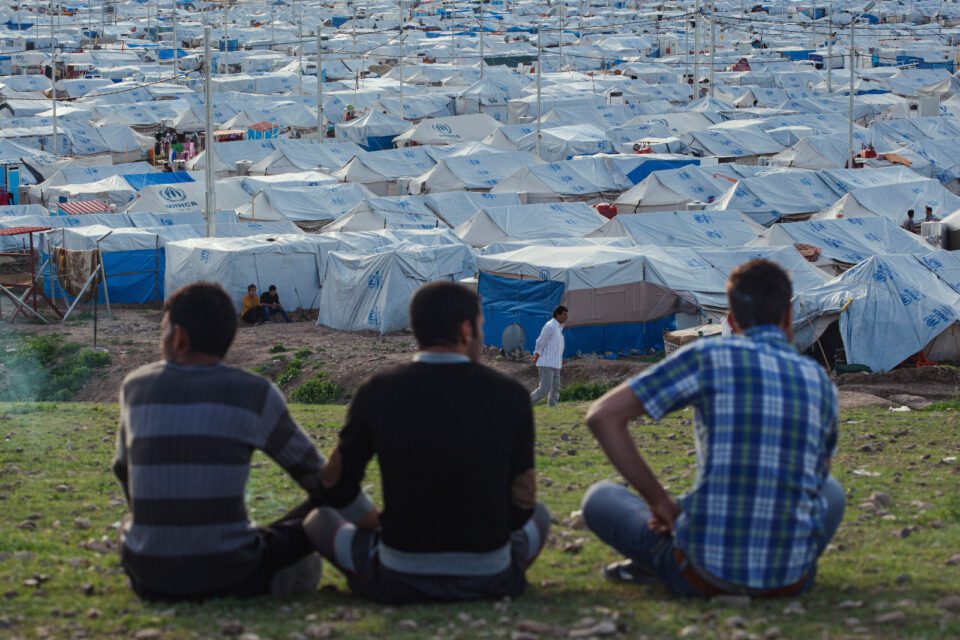
At the time, more and more displaced people were arriving in our region. Some had fled the war in Syria, others had come from different parts of Iraq. New camps were appearing, and their management was becoming more organized. It was no longer like the early days, when you could simply say you were a journalist and walk in. You needed permission, and getting it was becoming increasingly difficult.
Sometimes I spent seven or eight hours chasing permission for only one or two hours of photography. On some days, most of my energy went into reaching the place where my work was supposed to begin.
That was when my friend’s suggestion began to mean something else. The organization that needed a driver worked inside those same camps. What may have been just a job opportunity to my friends became something different to me. If I drove for the organization, perhaps I could finally enter through the door I had spent months trying to open.
I went to meet the manager. She was kind and respectful, and serious about her work. I told her the truth. I was a photographer and had never thought about becoming a driver. I did not care much about the salary or how demanding the work might be. I had only one request. Once I had finished the work they needed me to do, I wanted to use my spare time in the camps to take photographs. She smiled and simply said, Why not.
My car did not meet the organization’s requirements. I looked at the other drivers. They all had taxis. I sold my car and bought an almost new taxi. The same taxi I drove home.
At that time, where we lived, taxi driving did not have a good reputation. Until then, I had a certain standing among my family, friends, and neighbors because of the work I had done. Becoming a taxi driver changed the way they looked at me. I saw it not only in their words, but in their behavior.
Before, when I drove my car out of the house, if someone was nearby, they would get up, open the gate, wait for me to drive out, then close it again. After the taxi, nobody got up anymore.It hurt me, more than I showed, but every day I got back into that taxi and left.
Sometimes I drove at night too. When you drive a taxi, people raise their hands for you. I could not see someone waiting in the heat or cold and drive past with an empty car. Often I picked people up without even discussing the fare. My mother used to say, I am sure Younes gives people money instead of taking it from them.
But in the mornings, that same taxi took me somewhere else. I drove the organization’s staff to camps for hours. It was exhausting, but I no longer waited outside for permission. I had their ID card and uniform. I went in, did my work, and whenever I had time, I picked up my camera.
For months, my life moved between the taxi, the road, the camps, and my camera. I had already seen war many times in Syria and on the front lines in Iraq. Now, every day, I saw people whose homes and lives that same war had taken away. Then I returned to the city, where ordinary life continued. Gradually, I felt less connected to that life. In the camps and on the front lines, despite everything I saw there, I felt more that I was where I needed to be.
Six, seven, perhaps eight months passed. I photographed in different camps until I felt I had recorded what I had come to record. I had a friend who was unemployed. On the days I went to the front lines, he worked in my place, and little by little, I gave my place to him.
Once I knew I no longer needed the job, I left the organization. When that chapter was over, I sold the taxi that had taken me to all those photographs.