
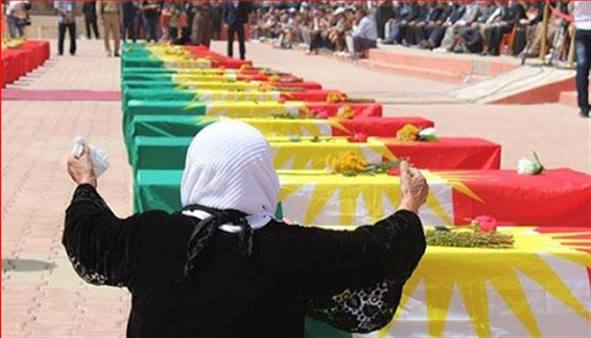
Kurdish leaders renew calls for justice, recognition, and compensation for victims.
In the late 1980s, the Ba’athist regime in Iraq carried out a systematic campaign of genocide and destruction against the Kurdish people across eight stages. As a result, more than 182,000 people were killed or disappeared, and thousands of villages were destroyed. Nearly four decades later, victims’ families are still waiting for justice, compensation, and full recognition of the crime by the Iraqi federal state.
The most intense phase of the Anfal operations took place in 1988. April 14 is now observed as the official day of remembrance, marking the peak of these atrocities, although the campaign began earlier. Despite the scale of the destruction, the regime failed to achieve its goal of erasing the Kurdish presence. Instead, its wars and internal policies contributed to its eventual collapse, followed by the 1991 Kurdish Uprising that led to the liberation of the Kurdistan Region.
This year, the Kurdistan Region marked the anniversary through ceremonies, seminars, and public events across its cities and towns. Senior Kurdish leaders issued messages reflecting on the tragedy and its lasting impact.
President Masoud Barzani described Anfal as a deep wound in the heart of Kurdistan and one of the most serious crimes committed against the Kurdish nation by former Iraqi authorities. He highlighted that chemical attacks, forced displacement, Arabisation policies, demographic changes, and the destruction of thousands of villages were all part of a coordinated effort to dismantle Kurdish society. He also stressed that the crime must be internationally recognised as genocide and that Iraq bears responsibility for compensating victims and ensuring such atrocities are never repeated.
President Nechirvan Barzani stated that more than 182,000 Kurdish men, women, and children were killed during the campaign, describing Anfal as a failed attempt to eliminate an entire people. He reaffirmed the Kurdistan Region’s commitment to international recognition of the genocide and continued efforts to locate and repatriate the remains of victims, while supporting their families.
Prime Minister Masrour Barzani also emphasized that the memory of Anfal must remain alive for future generations. He noted that the Kurdistan Region’s current achievements were built on the sacrifices of martyrs and survivors. He further urged the Iraqi government to fulfill its constitutional and moral obligations by compensating victims and their families.