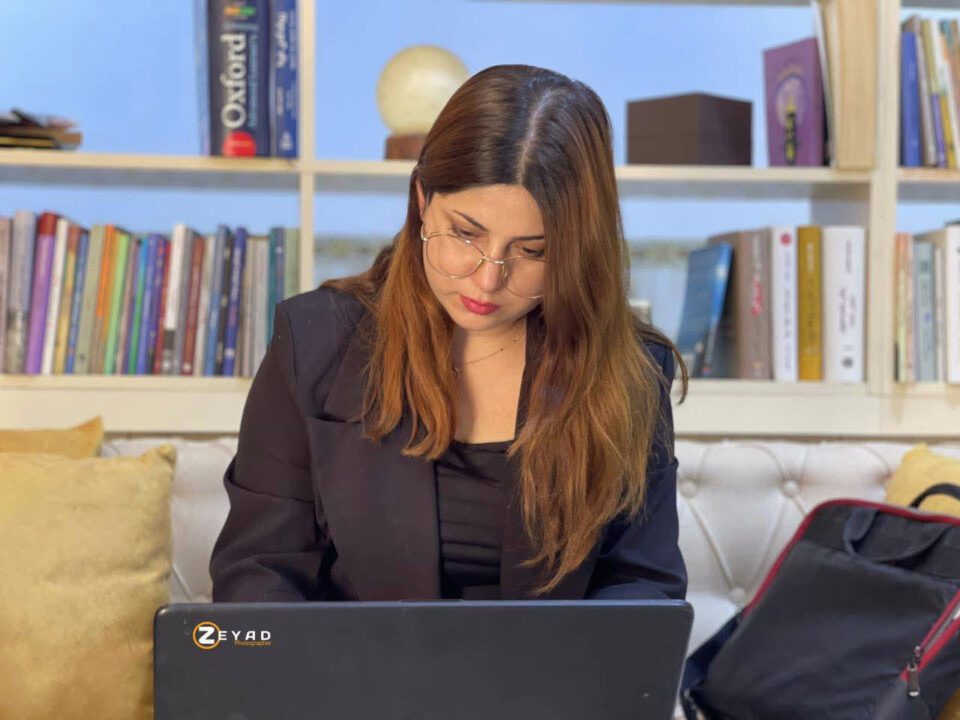
In a quiet corner of Kalar’s Rzgari district, where language and literature often intertwine, a young woman has been steadily carving her path in the world of translation. Ashti Salih, born in 1997, has emerged as a rising voice in the Kurdish literary scene—not only as a translator but as an advocate for cultural and intellectual exchange.
After earning her degree in English Language and Literature from the University of Garmian’s College of Education, Salih embarked on her translation journey in 2019. Since then, she has translated a diverse body of work spanning children’s literature, educational texts, poetry, and spiritual writings. Among her most notable translations are The Scarlet Letter by Nathaniel Hawthorne (Culture House), Bitter and Sweet by Susan Cain, and Searching for Love by Yasmin Mogahed (both published by Adiban House). Her work also includes Rumi’s Light of the Soul, Alan Sherko’s poetry collection One Evening I Block the Moon’s Path, and Etiquette for Children, emphasizing her broad literary range and sensitivity to audience.
Salih views translation not simply as linguistic transference, but as a form of cultural service. “My goal is to introduce Kurdish-speaking readers to texts they’ve never encountered before,” she explains. It’s a mission rooted not only in passion, but in the firm belief that the Kurdish language possesses the richness and flexibility to accommodate the world’s vast literary canon.
To Salih, the foundation of good translation lies first in a deep mastery of language—both the translator’s native tongue and the source language. But knowledge alone is not enough. What distinguishes an ordinary translator from an exceptional one, she asserts, is their breadth of reading and intellectual engagement. “Reading is experience,” she says. “And experience grows through reading. Without it, a translator becomes disconnected from the larger intellectual sphere.”
Salih describes a successful translator as someone with a command of composition, vocabulary, and expression in both languages. Just as importantly, they must be well-read enough to recognize what has and hasn’t yet been translated into their target language. It is in these gaps, she believes, that opportunities lie. A translator, then, becomes “a worker filling the gap”—building bridges between cultures and ideas.
Her personal philosophy of translation is rooted in advocacy for her native language. “I want to prove that Kurdish can hold its own against any language in the world,” she affirms. Each translation, for her, is not only an artistic effort but also a form of resistance against linguistic marginalization.
While she has worked across various genres, Salih speaks most passionately about translating poetry, which she calls both the most difficult and the most rewarding of all forms. “It’s exhausting,” she admits, “but I enjoy it more than any other field.” Her process is meticulous: each poem is rewritten multiple times, translated in various styles, and then refined through repeated revisions until the essence of the original is captured without compromising the soul of the Kurdish language.
Though translation is often seen as a solitary act, Salih does not view herself in competition with other translators. Instead, she believes in collaboration—even when working within the same genres or texts. “It’s not necessary for me to translate just to be different,” she says. “Others and I can translate in similar styles and still serve the reader and the language.”
However, the process of translating books—particularly from bestselling or internationally recognized authors—is not without legal and ethical complications. Salih acknowledges the importance of obtaining permission from rights holders, especially for prominent authors whose works are protected. But she also notes the practical challenges Kurdish publishers face, such as the high costs of licensing relative to limited local print runs. “If an author demands their rights, it’s absolutely their legal right,” she concedes, though she notes that many lesser-known authors are often pleased simply to see their work reaching new audiences.
With her growing portfolio and clear literary vision, Ashti Salih continues to play a key role in enriching Kurdish literature. Her work offers a window not just into foreign texts, but into the untapped potential of the Kurdish language itself—proving, with every line she translates, that words can indeed build worlds.