
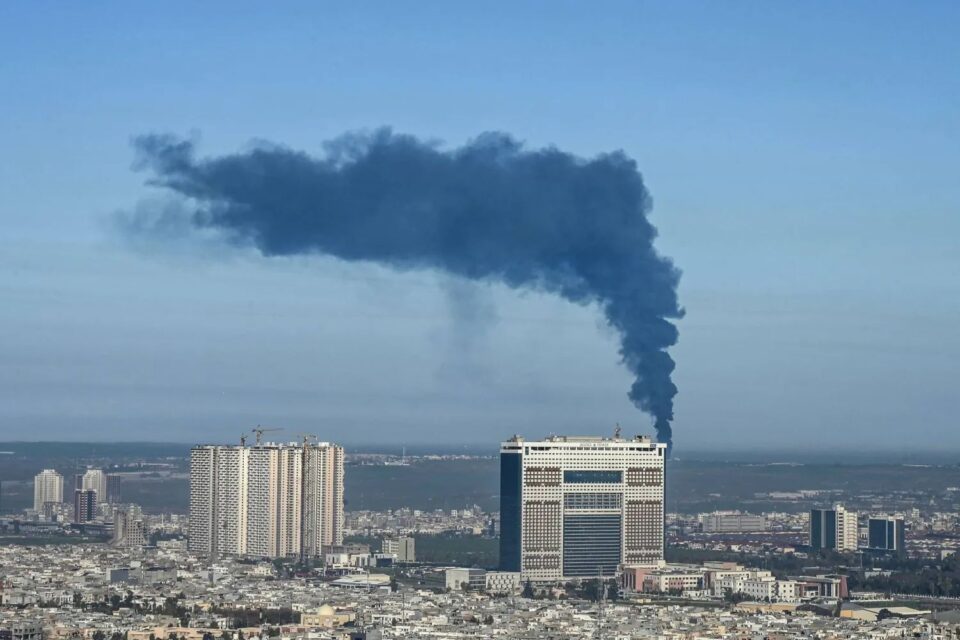
Sustained drone strikes on Kurdistan expose security gaps and intensify pressure on Kurdish leadership
The Kurdistan Region is facing a sustained and evolving campaign of drone and missile attacks, transforming its security landscape and placing mounting pressure on Kurdish political leadership, civilian infrastructure, and economic stability. From a Kurdish perspective, the escalation is no longer a series of isolated incidents but a coordinated effort testing both Erbil’s defensive limits and the resolve of its international partners.
What initially appeared as sporadic harassment has shifted into a prolonged pattern of aggression. Kurdish officials and analysts increasingly describe the region as a frontline in a new form of asymmetric warfare, where drones are deployed systematically to probe vulnerabilities and impose continuous psychological and economic strain.
The scale of the attacks reflects this shift. Erbil Governor Omed Khoshnaw and multiple security sources confirm that the Kurdistan Region has been targeted more than 600 times. Since February 2026 alone, nearly 600 projectiles have been directed toward the region, marking one of the most intense sustained aerial campaigns in Iraq in recent years.
The geographical concentration of these strikes underscores a clear targeting strategy. Erbil Province has absorbed 78% of all attacks, reinforcing its status as the primary political and economic hub under pressure. Sulaymaniyah accounts for 17.5%, while Duhok and Halabja together represent just 4.5%. For Kurdish officials, this distribution is not incidental but reflects a deliberate focus on Erbil as the center of governance and international engagement.
The intensity peaked on March 31, 2026, when defense systems intercepted more than 20 drones in a single coordinated wave. While interception capabilities have prevented greater devastation, the human cost continues to mount. Fourteen people have been martyred, including Peshmerga forces, Kurdish security personnel, and a French soldier. Ninety-one others have been injured, many of them civilians affected not by direct strikes but by falling debris from intercepted drones.
This evolving pattern has given rise to what residents describe as a “debris war,” where even successful interceptions carry consequences on the ground.
Beyond physical damage, Kurdish officials argue the campaign has entered a more dangerous phase: the direct targeting of leadership. The most significant escalation occurred on March 28, when a drone strike targeted the private residence of Kurdistan Region President Nechirvan Barzani in Duhok. For many in the region, this crossed a political red line.
President Masoud Barzani responded by reaffirming the region’s neutral stance, stating that the Kurdistan Region “has never been and will never be a part of the conflict.” At the same time, he warned that armed groups operating outside state control represent a “dangerous development” for Iraq as a whole.
The attack triggered swift international and regional reactions. United Nations Secretary-General Antonio Guterres condemned the strike “in the strongest terms” and called for an investigation into violations of Iraqi sovereignty. The United Kingdom’s Foreign Minister Yvette Cooper expressed solidarity with Kurdish leadership and sympathy for the “brave Peshmerga.” The United States State Department attributed the attack to “Iran’s terrorist proxy militias,” calling it a direct assault on Iraq’s territorial integrity.
Regional actors also responded. Turkey’s President Recep Tayyip Erdogan reiterated Ankara’s commitment to Iraq’s stability. Arab League Secretary-General Ahmed Aboul Gheit denounced the attacks, while Jordan’s King Abdullah II and UAE President Sheikh Mohamed bin Zayed Al Nahyan conveyed support through direct calls.
Despite this diplomatic backing, Kurdish officials argue that statements alone have not translated into deterrence on the ground.
As military pressure failed to alter Kurdish political positions, the campaign appears to have expanded toward economic targets. Kurdish authorities describe a deliberate shift to undermine investor confidence and weaken the region’s financial autonomy.
One of the clearest examples came on April 1, when four drones struck the Sardar Group’s Castrol oil warehouse. The initial strike at 7:20 AM was followed by additional attacks at 8:40 AM and 10:20 AM, employing what officials identify as a “double-tap” or “triple-tap” tactic designed to target first responders.
An official emphasized the purely civilian nature of the facility, with damages estimated at $5 million. Smaller businesses have also been hit. In the Alana Valley, a charcoal factory was destroyed in a drone strike, with owner Burhan Balayi calling it a blatant “injustice” that caused $70,000 in losses and eliminated eight jobs.
The energy sector remains the primary strategic target. Repeated strikes on the Khor Mor gas field and other facilities signal an intent to disrupt the Kurdistan Region’s main revenue stream. For Kurdish policymakers, these attacks are not random but part of a broader effort to destabilize the region’s economic foundation.
At the civilian level, the impact is both physical and psychological. In Erbil’s Iskan neighborhood, drone debris crashed through a café ceiling, leaving what owner Fakher Hariri described as “psychological shock” among women and children present. In Sebiran, agricultural machinery including harvesters and tractors was destroyed, resulting in more than $60,000 in losses.
Residents describe a growing sense of exhaustion. One Erbil resident recounted that a drone fell on his home, causing fire and roof damage, noting it was the “third or fourth time” his property had been hit. This environment has created a sense what many Kurds see as a no-win scenario: even successful interceptions lead to damage on the ground.
In response, the Kurdistan Regional Government has intensified diplomatic outreach. Prime Minister Masrour Barzani has sought to frame the attacks not as an isolated Kurdish issue but as a broader threat to regional stability. His strategy aims to build a coalition of support among Gulf states and Western allies.
During a call with Qatari Prime Minister Sheikh Mohammed bin Abdulrahman Al Thani, both leaders condemned the attacks and agreed that illegal armed groups must be brought under control by Iraq’s federal government. Kurdish officials, however, increasingly interpret Baghdad’s limited response as either an inability or unwillingness to act.
This perceived gap has amplified calls within the Kurdistan Region for stronger defensive capabilities. Governor Omed Khoshnaw maintains that systems are operational around the clock, supported by coordination with coalition forces.
The issue is compounded by financial constraints. Kurdish authorities argue that budgetary pressures imposed by Baghdad directly affect their ability to invest in advanced air defense systems, turning what might otherwise be a manageable threat into a sustained vulnerability.
External experts have reinforced these concerns. Myles Caggins, a former coalition spokesperson, has pointed to the scale of attacks as evidence of a systematic campaign against the region’s stability and development. He has called on Washington to provide “direct anti-drone systems” to the Peshmerga, referencing a 2024 mandate to assess air defense needs.
Yuri Sak, a former advisor to Ukraine’s Defense Ministry, has suggested practical adaptations based on Ukraine’s wartime experience. These include deploying mobile heavy machine gun units against low-flying drones, installing protective netting over critical infrastructure, and educating civilians on safer sheltering techniques.
For Kurdish officials, these recommendations highlight a broader reality: the region is being forced to adapt to a new type of warfare without the resources typically available to sovereign states.
The Kurdistan Region now stands at a critical juncture. The targeting of Kurdistan Region President Nechirvan Barzani’s residence marked a turning point, elevating the conflict from infrastructure disruption to direct political intimidation. While international condemnation has been swift, Kurdish leaders argue that the absence of concrete defensive support leaves the region exposed.
Historically positioned as a reliable partner for Western and regional interests, the Kurdistan Region now finds its stability under sustained pressure. For many, this vulnerability carries implications beyond its borders, affecting broader regional security calculations.
The Kurdish Globe