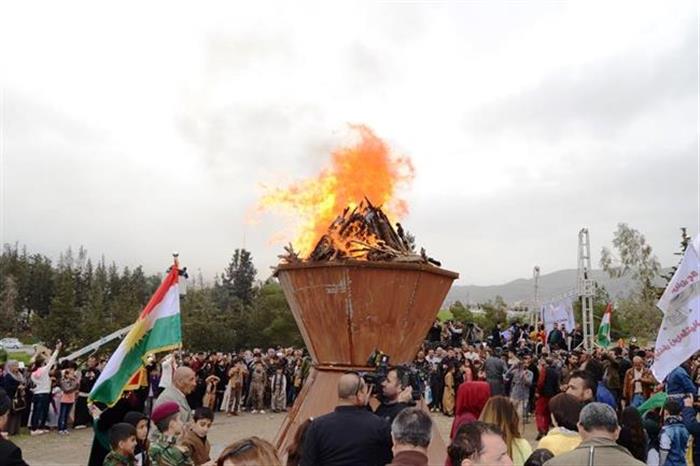
Newroz is an ancient festival deeply rooted in Kurdish culture, rich in symbolism and national significance. In addition to marking the Kurdish New Year, it celebrates the arrival of spring and the renewal of nature. Kurds observe the occasion by lighting fires, gathering together, exchanging greetings, and wearing traditional clothing.
The origins of Newroz stretch far back in history, with differing interpretations among historians regarding its beginnings. It is widely associated with Aryan peoples, whose traditions span a vast region from Eastern Europe to South Asia, including present-day Kurdistan, Iran, Afghanistan, India, and Pakistan. As a result, Newroz is celebrated across these regions, each with its own customs and interpretations.
Shkur Mustafa writes in Daftari Kurdewari: “The Aryan peoples had seven principal festivals: Newroz, Mehregan, Sadeh, Tiregan, Farvardegan, and Kosa.” Among these, Newroz and Mehregan are considered the most sacred.
Kawa the Blacksmith
While the historical origins of Newroz remain complex, among Kurds it is most closely associated with a powerful legend of resistance against oppression.
According to tradition, Jamshid, the fourth king of the Pishdadian dynasty, was a just ruler who helped organise society and build infrastructure. After him came Zahhak, a tyrannical king whose rule brought widespread suffering. The people sought liberation from his oppression.
Kawa the Blacksmith emerged as a symbol of resistance. Leading a rebellion, he overthrew Zahhak and installed Fereydun, a descendant of Jamshid, as ruler. The victory of this uprising is said to have coincided with Newroz. To mark the triumph and signal the end of tyranny, fires were lit on mountaintops, a tradition that continues today.
Kurdish historians also recount that, in ancient times, rulers would open their doors on the first day of spring to meet their people, exchange gifts, and celebrate with all levels of society.
Fire as a sacred symbol
Some accounts suggest that Newroz marks the discovery of fire, though this interpretation is largely considered legendary. More widely accepted is the view that fire has long held symbolic importance in Kurdish belief.
Before the spread of Islam, many Kurds followed Zoroastrian traditions, in which fire was regarded as a sacred symbol rather than an object of worship. It represented light, purity, and continuity, and was used in caves and places of worship.
Newroz and the Kurdish calendar
Newroz also marks the beginning of the Kurdish New Year. Like many peoples and cultures, Kurds have maintained their own calendar, rooted in significant historical events.
One of the key reference points for the Kurdish calendar is the founding of the Median State, established more than 700 years before the common era in the Mukrian region of eastern Kurdistan. Many historians and scholars view this connection as meaningful, as it ties Kurdish identity to an early state that reflected the foundations of nationhood.
Linking Newroz to the era of the Medes reinforces both the historical depth of the celebration and the long-standing presence of Kurdish political and cultural life in the region.