
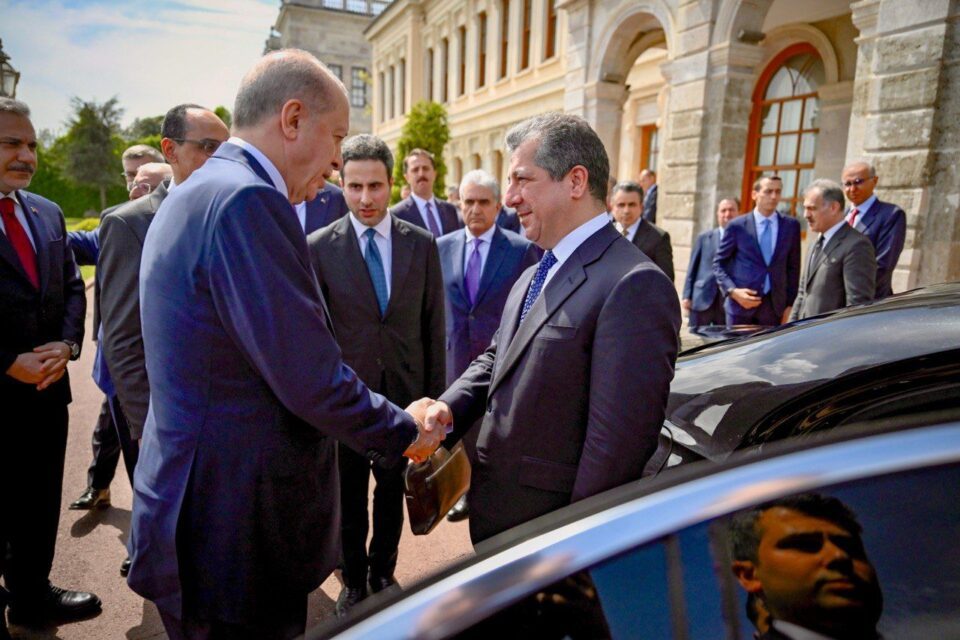
Masrour Barzani used Istanbul diplomacy to strengthen Kurdistan-Turkey ties during growing regional instability..
In the ornate halls of Dolmabahçe Palace overlooking the Bosphorus, Prime Minister Masrour Barzani arrived in Istanbul on Saturday, May 9, 2026, carrying a message that Kurdish officials believe has become increasingly important for the future of the Kurdistan Region: stability, economic integration and strategic diplomacy depend on deeper relations with Turkey.
Over a series of high-level meetings with Turkish President Recep Tayyip Erdoğan and senior ministers, Barzani sought to position the Kurdistan Region not merely as a neighboring Iraqi entity, but as a reliable regional partner at a moment when much of the Middle East is struggling with war, political uncertainty and economic pressure.
The visit came at a sensitive time for the region.
The aftermath of the Iran conflict, uncertainty surrounding the formation of Iraq’s next federal government, concerns over regional escalation, and renewed discussions around Turkey’s peace process with the PKK have all raised the stakes for regional diplomacy.
Rather than adopting a cautious or limited approach, PM Barzani used the Istanbul meetings to publicly reinforce Erbil’s strategic relationship with Ankara across nearly every major file: security, energy, trade, transportation and regional peace efforts.
In a message posted on X after his meeting with President Erdoğan, PM Barzani wrote: “We emphasized the importance of strengthening relations between Türkiye and the Kurdistan Region.”
The tone of the visit reflected more than routine diplomacy.
Turkish officials themselves appeared eager to underline the importance of Barzani’s presence. The Turkish Presidency later highlighted the Erdoğan-Barzani meeting as one of the most important diplomatic engagements of the week — something Kurdish political observers viewed as a sign of Ankara’s growing recognition of Barzani’s regional role.
During the meeting at Dolmabahçe Palace, attended by senior Turkish officials, discussions focused heavily on Iraq’s future political direction and the need for broader regional stability.
Barzani wrote afterward that both sides “hoped that the new federal cabinet will promote peace and stability in Iraq, serve all communities without discrimination, and resolve issues between the Kurdistan Region and the federal government on the basis of the Constitution.”
For Kurdish officials close to the government, the statement reflected one of Barzani’s central diplomatic objectives: ensuring that the Kurdistan Region remains an active and influential participant in Iraq’s political future while maintaining strong international and regional partnerships.
The meetings also demonstrated the increasingly strategic nature of Ankara-Erbil relations.
According to statements released after the talks, Erdoğan praised “the role of President Barzani and the Kurdistan Region as a key factor in peace and stability in the region.”
Kurdish analysts supportive of the visit saw those remarks as particularly significant at a time when Erbil continues attempting to balance relations with Baghdad, Ankara, Washington and Gulf capitals while avoiding direct entanglement in broader regional confrontations.
Barzani’s diplomacy throughout the visit focused heavily on presenting the Kurdistan Region as a stable partner capable of contributing to regional security rather than instability.
That message was especially visible during his meetings with Turkey’s defense leadership.
Following talks with Turkish Defense Minister Yaşar Güler, Barzani wrote: “We stressed the importance of safeguarding the security and stability of the Kurdistan Region, Iraq, and the broader region, and underscored the need to de-escalate tensions across the Middle East.”
In another statement, he added: “We expressed our determination to protect the security and stability of the Kurdistan Region and Iraq and the region and to end the threats in the region.”
Economic diplomacy formed another major pillar of the visit.
At the center of many discussions was the ambitious “Development Road” project — the massive transportation and trade corridor expected to link the Gulf through Iraq and the Kurdistan Region to Turkey and Europe.
For Kurdish, the project represents far more than infrastructure.
The corridor is increasingly viewed inside Erbil as a long-term geopolitical opportunity capable of transforming the Kurdistan Region into one of the Middle East’s most important transit and logistics hubs.
Stretching roughly 1,200 kilometers from Iraq’s Grand Faw Port to the Turkish border, the railway and highway network is expected to reshape trade routes across the region.
Barzani has emerged as one of the project’s strongest advocates, repeatedly emphasizing that the Kurdistan Region should play a central role in its future.
In earlier comments referenced during the visit, Barzani argued that routing the project east of the Tigris River would provide “greater economic benefits” and lower costs than alternative proposals supported by Baghdad.
His meetings in Istanbul reinforced that message.
After talks with Turkish Foreign Minister Hakan Fidan, Barzani wrote: “We further emphasized the importance of implementing the Development Road project and connecting the Gulf countries, Iraq, and the Kurdistan Region with Türkiye and Europe through a railway network.”
In another statement, he described the discussions as “productive” and focused on “developments affecting the region.”
Kurdish officials increasingly view the project as central to the Kurdistan Region’s long-term economic future.
Trade relations between Turkey and the Kurdistan Region are already extensive. Annual trade between Turkey and Iraq stands near $20 billion, with a large portion directly connected to the Kurdistan Region through border crossings and commercial activity.
The Kurdistan Region’s oil exports also continue flowing through Turkey’s Ceyhan port, further deepening economic interdependence between both sides.
Barzani’s meetings with Turkish Energy Minister Alparslan Bayraktar focused heavily on expanding that partnership.
“I met with Alparslan Bayraktar, Minister of Energy and Natural Resources of Türkiye, in Istanbul, to discuss strengthening relations between Türkiye and the Kurdistan Region in the fields of energy and natural resources,” Barzani wrote after the meeting.
“We also emphasized the importance of enhancing cooperation and coordination between Türkiye and the Kurdistan Region in the areas of trade, oil, electricity supply and energy in general.”
In another post, Barzani said both sides expressed “our desire to strengthen cooperation and coordination between Turkey and the Kurdistan Region in the areas of trade, industry, energy, and employment.”
The peace process with the PKK also emerged as a central issue during the visit.
Barzani has repeatedly voiced support for dialogue and peaceful solutions regarding the Kurdish issue in Turkey, positioning the Kurdistan Region as supportive of de-escalation and political engagement rather than armed confrontation.
Following his meeting with Erdoğan, Barzani wrote: “On the peace process and the disarmament of the PKK, I reiterated my support for the process, and we stressed the importance of continuing the efforts to ensure its success and completion.”
That position aligns with earlier statements by President Masoud Barzani, who previously described peace as “the only correct path for resolving problems.”
Recent developments surrounding the PKK, including symbolic disarmament steps and renewed political messaging, have given fresh momentum to discussions about Turkey’s peace process.
Throughout the visit, Turkish officials repeatedly emphasized the close nature of Erbil-Ankara relations.
Turkish Consul General Erman Topçu described relations as being at “a very high and exceptional level,” while stressing the historical and social connections linking both sides.
“I always say we are brothers,” he said. “Kurds, Turkmens, and Christians live in that region, on the same land.”
For supporters of the prime minister, the Istanbul meetings ultimately represented something larger than diplomacy alone.
They viewed the visit as evidence that Barzani is attempting to define the Kurdistan Region’s place in the region as an increasingly connected regional actor linked to major trade routes, energy networks and diplomatic initiatives.
In a Middle East increasingly shaped by uncertainty and shifting alliances, Barzani’s message from Istanbul was consistent throughout the visit: the Kurdistan Region sees its future tied not to isolation or confrontation, but to strategic partnerships, economic connectivity and regional diplomacy anchored by strong relations with neighbors.
The Kurdish Globe