
The Kurdistan Region possesses a vast and significant civilization, having witnessed numerous eras and dynasties. Its land is home to dozens of important and fascinating archaeological sites. Centuries before the Common Era, it was a center for the emergence of the Zoroastrian and Mithraic religions and a hub for coexistence. However, due to a lack of tourism promotion or the general regional
situation, these sites remained largely unintroduced and unmarketed to international travelers. Consequently, many—even those that have been restored—do not receive the number of visitors they deserve. Examples include
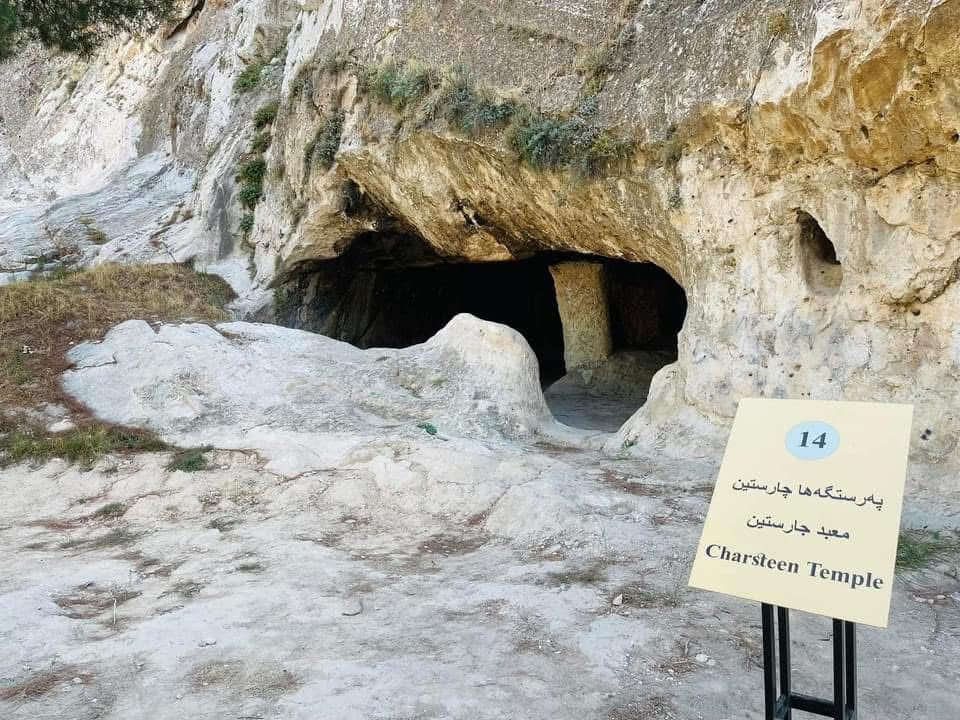
the Erbil Citadel, Jasana Cave, the Qizqapan rock-cut reliefs, Khanzad Citadel in Banaman, and the heritage houses of Sulaymaniyah, Koya, and Akre. In our journey this time, we visit the Charsteen Cave, which was once the oldest Zoroastrian religious temple and has recently been renovated to become a welcoming station for tourists.
Location of the Charsteen Temple
The Charsteen Temple and Cave is located in the Duhok Governorate of the Kurdistan Region, specifically within the Duhok Valley (Gali Duhok). The temple is situated about 800 meters north of Duhok’s city center and has now become part of the urban fabric. It is one of the most important archaeological sites in the region. As you head from the city toward the Duhok Dam and the surrounding tourist areas, the Charsteen complex is located on an elevation to the right. Visitors ascend via a series of stairs—some ancient and carved directly into the rock, others modern and made of iron and wood—to reach different sections of the temple complex. Its history dates back to the first millennium BCE, during the Zoroastrian era. Architecturally, it is the largest temple in the region where traces of ancient religious rituals are still clearly visible.
Structure and Components of the Temple
The temple complex consists of two main areas connected by a tunnel carved through the mountain.
The First Area (Station One): This section includes:
1. A reception entrance on the Gali Duhok road.
2. A wall relief of Median kings.
3. A wall relief of the winged bird (Faravahar/Ahura Mazda), the symbol of the Zoroastrian religion.
4. Ascending stairs (both ancient stone-cut and modern metal/wood).
5. Various archaeological sites on either side of the stairs, each marked with informational signs.
6. The walls of several small and large rooms.
7. A platform for laying out the dead (burial platforms).
8. A hermitage or place of seclusion.
9. A water channel.
10. An 11-meter-long tunnel carved into the mountain, roughly 2 meters high, which connects the first and second areas through the hillside. This section also includes rest areas and viewpoints for tourists.
The Second Area (Station Two): After passing through the tunnel, you reach the Charsteen Cave itself, which faces northwest. In front of the cave, amenities and rest areas have been built under the shade of tall trees. A rectangular entrance leads into the main temple chamber. The cave overlooks the tourist areas of the Duhok Valley and the Duhok Dam. The cave entrance is rectangular and 7 meters long. Inside, the chamber is a square-shaped room measuring 15 by 15 meters. In the center of the cave stand four columns (which is why it is called “Charsteen,” meaning “Four Pillars”). These columns are over 1.5 meters thick. Between the columns sits a large fire altar (3×3 meters) used for sacred fire rituals. Seating areas were carved into the rock along three walls of the cave, and a drainage channel was built to prevent moisture from the cave walls from reaching the seating areas. Much of the cave was manually carved and organized to function as a temple.
Archaeological Findings
Several important signs and remains representing the religion of that era have been found or observed within this temple:
– The Fire Altar (Atashgah): As a Zoroastrian temple, it contains a specific place for lighting the sacred fire.
– Engravings: Various carvings on the stone walls represent the sun, stars, and other Zoroastrian religious symbols.
– Water Basins and Channels: Remains of water installations used for purification (as per Zoroastrian tradition) before entering the temple.
– Cemetery: Near the temple, several rock-cut tombs (Dakhmas) were found, carved in a unique style.
Renovation and Opening
The site was first renovated in 1999 and reorganized in 2013. In 2025, it became the first archaeological site in the Kurdistan Region to be fully converted into a modern tourist destination with comprehensive services.
After three years of intensive restoration work, the Charsteen site was opened to the public and tourists in the presence of Duhok officials and the local community. This was a major step in the effort to turn Kurdistan’s archaeological sites into tourist hubs. The project was supervised by UNESCO, funded by the European Union and the Duhok Governorate, and implemented by the Duhok Directorate of Antiquities and Heritage in collaboration with the German organization Wadi.
Tourism Services
A reception and ticketing office has been built at the start of the path. The site features safety fences, organized walkways, and informational signs for every section. Tourist services include numerous rest benches, a green square with shade for relaxing, and even an artificial waterfall next to the cave that flows down toward the main road. Essential facilities (WC) were built 100 meters away behind a mountain slope to maintain the site’s aesthetics. The surrounding valley, all the way to the Duhok Dam, has also been developed with services, making the entire area a cohesive tourist zone.
Visitor Turnout
Many citizens and tourists have a passion for Kurdish civilization and ancient heritage. Often, people visit these sites even without services, though such visits can sometimes damage the ruins. Charsteen is now unique in being fully equipped to receive guests. Dr. Bekas Brifkani, the Director of Duhok Antiquities and Heritage who supervised the project, noted: “Since the renovation of this important archaeological site, the number of tourists has increased. In a single week, more than 400 tourists and citizens visit to learn about their country’s history and benefit from the available services.”
By Nadir Rusti