
By Younes Mohammad
In my childhood, I often accompanied my father to his workplace not only to help him, but to learn something about life from those ordinary days. Work, dust, sun, silence, they were all there. But more than anything else, a question followed me everywhere. A persistent question that would not let go. Why are we so alone in this city? Why do we have no relatives, no friends, no familiar voices, no one who speaks our language?
That question came from displacement. We had been forced to leave Kurdistan and resettle in a distant city in Iran, near the Afghan border. A place that was merely where we lived, never quite home. No one came to visit us, and we had nowhere to go. No uncles, no aunts, no familiar laughter. Just us, and a quiet, isolated life.
One day, I shared this sadness with my father. I complained, childish, yet sincere. I told him we had no one, that we were alone. He paused, looked at me, and with his usual calm said: “We are a big family. A family with deep roots. Don’t think you have no one.”
I couldn’t believe him. I asked: if our family is so large, where are they? Why don’t we gather? Why is our share of family only memory?
He smiled, a smile that seemed to carry history and said: “They are everywhere. There is no country where we do not exist.”
Then he began to name places: Hakkari and Shemdinan, Qamishli and Serekaniye, Sanandaj, Baneh, Bukan, Duhok, Sulaymaniyah. He said we even had relatives in Khorasan. He spoke of lineage, of roots, of a past whose branches had scattered across borders. He said few families carry such a history. Then, more quietly, he added: “Time rises and falls. Life has pushed us far from one another.”
Back then, his words sounded like a legend. Years later, when I gradually found my relatives, when I came to know our language, our culture, our customs, and our history, I finally understood what he meant. And I felt proud.
When I decided to make photography not just a passion but my profession, my camera became a bridge. I began photographing my relatives. One day in Hakkari, another in Sanandaj. Each time, a place, a person. It felt as though I was slowly gathering the scattered pieces of a fragmented family. I told myself that if one day my son asked me the same question I once asked, I would place an album before him and say: this is your cousin, this is your aunt’s daughter. Look, you are not alone.
Since childhood, I had carried the idea of our relatives in Khorasan with me. I waited for a chance to visit them, not only to meet them, but to let them know that if they too carried the loneliness of displacement, someone from their own blood had come to see them.
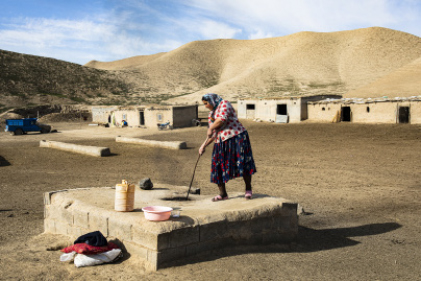
That chance finally arrived. With the help of a friend, I traveled to North Khorasan, near the Turkmenistan border. They were happier to see me than I was to see them. I felt a strange closeness as I shared their bread and salt, sat beside them, witnessed their lives, and photographed them. They were called Kormanj. We understood each other, not always through words, but through the heart.
For two days, we lived together. We herded sheep, baked bread, spoke of the old days, of migration, of separation, of today. I showed them photographs of our relatives. Tears of joy filled their eyes, as if years of waiting had suddenly found an answer. I photographed them so I could show the rest of the family, so this recognition, this joy, could travel from hand to hand.
Yes, we are a big family. We are everywhere in the world. Our words are different, but our hearts speak the same language. Our pain is shared. And I believe we are a big family that one day,will gather again.