
By Younes Mohammad
I drove along trembling roads beneath a sky ablaze, the air thick with dust and fear. I had heard of tens of thousands gathered on Mount Sinjar, trapped by darkness, thirst, and a silent killer: the slow erosion of time. In early August 2014, the Islamic State of Iraq and the Levant (ISIS) swept into the valley below, forcing entire villages of Yazidis onto the mountain and sealing every exit.
I was not there in the first hours. I tried to reach the mountain, watched as helicopters dropped water into crags where children huddled like stones. I waited below. The sky sent refuge; the land remained closed.
On the road to Simalka’s border, the convoy snaked through haze, shadows of dislocated lives passing like ghosts. Behind the wheel, the engine idling, I thought: Who will photograph the end of hope? The radio crackled: “Fifty thousand Yazidis sheltering on the slopes. No water for days. Some dying of heat as they climb.” Each number twisted my stomach; each emptied house, each missing child, made the mountain loom higher.
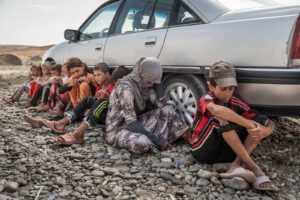
When I finally reached the border landing zone, I walked into a scene of quiet apocalypse. They came down from the mountain: ragged families, children without songs, women whose eyes had stopped seeking. They gathered under the thin shade of a lone car, its wheels resting on hot pebbles. Nearby, a line of children. Shadows draped over the stones. One girl pressed her face to her knees. A boy with a torn slipper stared at nothing. I lifted my camera, but it felt like photographing the fracture of existence. Not joy. Not grief. Only void.
The heat clung to us. The scent of burned earth and cracked rock hung in the air. The children did not see me; they did not know this moment would become their image. They sat where survival and surrender met, as if life itself had already left them. I pressed the shutter. For a heartbeat, a faint click and then silence, or perhaps the world had never made a sound at all.
Later, the history arrived in thick, brutal volumes: the destruction of shrines in Sinjar, mass graves, thousands of Yazidi men executed, women and girls abducted into slavery. As a journalist, I recorded facts; as a human, I trembled knowing I had looked into the bottom of sorrow and returned with nothing but a photograph.
When I look at that image now, the children in line under the car’s thin shade, their skin unprotected from the stones, their hollow gazes, I remember: I was photographing not only their suffering but our failure as witnesses. As fellow humans. As a society that watched a mountain fill with fear and still arrived too late.
If this image is printed, let it carry more than darkness and dust. Let it bear a quiet demand: that these children, these lives, are not fading into memory’s cracks. Let the photograph be a pulse in the stillness. And let us remember: a mountain might hide survivors, but it cannot hide the truth.