Amid growing public frustration over delayed salaries and political tension with Baghdad, Kurdistan Region Prime Minister Masrour Barzani on Sunday, July 20, defended his government’s decision to use local revenues to fund essential services—most notably a landmark water treatment and distribution project in Erbil—while reaffirming that the Region will not surrender its constitutional rights in exchange for broken promises from the federal government.
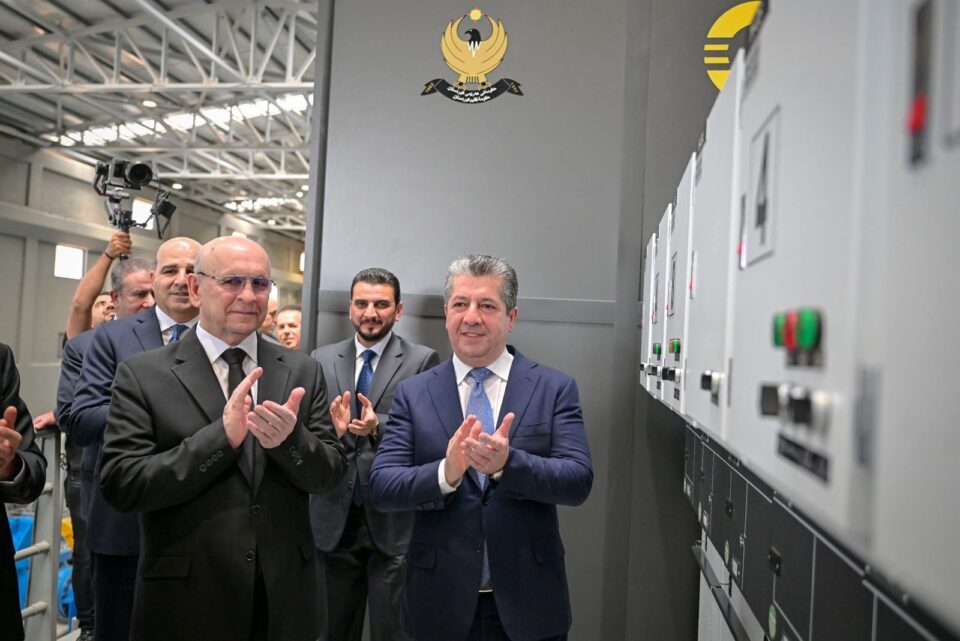
Speaking at the inauguration of the Emergency Rapid Water Project in Erbil, Barzani declared that the multi-phase project—stalled for years under previous contractors—has now entered implementation and will secure drinking water for the capital for at least the next 30 years. He emphasized the urgent need for the project, citing the effects of climate change, irregular rainfall, population growth, and declining groundwater levels.
“We had to act,” Barzani said. “The water crisis had become serious, and this government is here to serve—not to make excuses.”
While the Kurdistan Regional Government (KRG) pushes ahead with infrastructure development, the federal government in Baghdad has continued to tie the payment of public-sector salaries to full compliance with oil and revenue transfer demands. The KRG has agreed to deliver 230,000 barrels of oil per day through Iraq’s national marketer, SOMO, and to transfer 120 billion Iraqi dinars in internal revenue. But Barzani says Baghdad keeps changing the terms.
“Baghdad has promised again and again that they would send salaries, only to come back with a new excuse,” he said. “We’ve delivered on our side—but they delay, and our people cannot wait.”
Forced to choose between meeting salary obligations and funding basic services, the KRG has leaned on local revenues to maintain projects like the Erbil water system and to sustain 24-hour electricity in many parts of the Region.
In his remarks, Barzani revealed the full story behind a recent deal reached through a joint Kurdistan Democratic Party (KDP) and Patriotic Union of Kurdistan (PUK) delegation. After direct talks with Iraqi officials and foreign minister Fuad Hussein, Barzani said he agreed “on his honor” to deliver both oil and revenue. But shortly after, drone attacks on oil fields in the Region reduced production capacity—prompting Baghdad to add a new condition: no salaries would be paid until the full oil quota was received.
Barzani criticized the logic of the demand. “Terrorists bomb our oil fields and stop production. Then Baghdad says, ‘We won’t send salaries until you deliver the oil.’ How is that just?” he asked. He confirmed that a federal team visited the sites and verified the damage, yet the federal government has still withheld salary payments.
The Prime Minister also took aim at domestic critics—local political actors who had previously urged Baghdad to take over salary distribution. “They said if salaries went to Baghdad, everything would be fine. But now, where are they? Why are they silent while the people are being punished?” he said.
Barzani underscored that the KRG remains committed to its constitutional responsibilities but will not give up its constitutional rights, particularly those guaranteeing budgetary autonomy within Iraq’s federal framework.
“They want us to hand over everything—every barrel, every dinar—so we can’t implement vital projects like this one,” he warned. “But we have a constitution, and we are not prepared to give up our rights.”
As the Kurdistan Region continues to balance internal development with external political pressures, Barzani concluded with a message of determination and resilience. “We are using what we have not just to survive—but to move forward.”