
By Younes Mohammad
Despite the astonishment of many other journalists and visitors who came to the front lines and witnessed Kurdish women standing shoulder to shoulder with their men, weapons in hand, defending their land, however this was never surprising to me. I believe that throughout history, women and girls have always been fighting, sometimes for survival, sometimes to prove their capabilities, and other times to claim the rights that were denied to them. They have been wronged, not because they were incapable, but perhaps because they were never labeled the “superior sex,” or because they could not, or would not, rule through force as men often do.
I wasn’t surprised by how young many of them were. Many people found it hard to believe that at such an age one could take up arms and go to war. Perhaps they were not entirely wrong. But when the enemy has entered your home and seeks to erase your very existence, school no longer outweighs honor and land. Priorities shift.
When the soil of Kurdistan is at stake, there is no distinction between young and old, woman or man. This is a border that tolerates no compromise, a border defended with teeth and claws. Many of us, myself included, became Peshmerga when we were only fourteen years old and began defending our land and our rights.
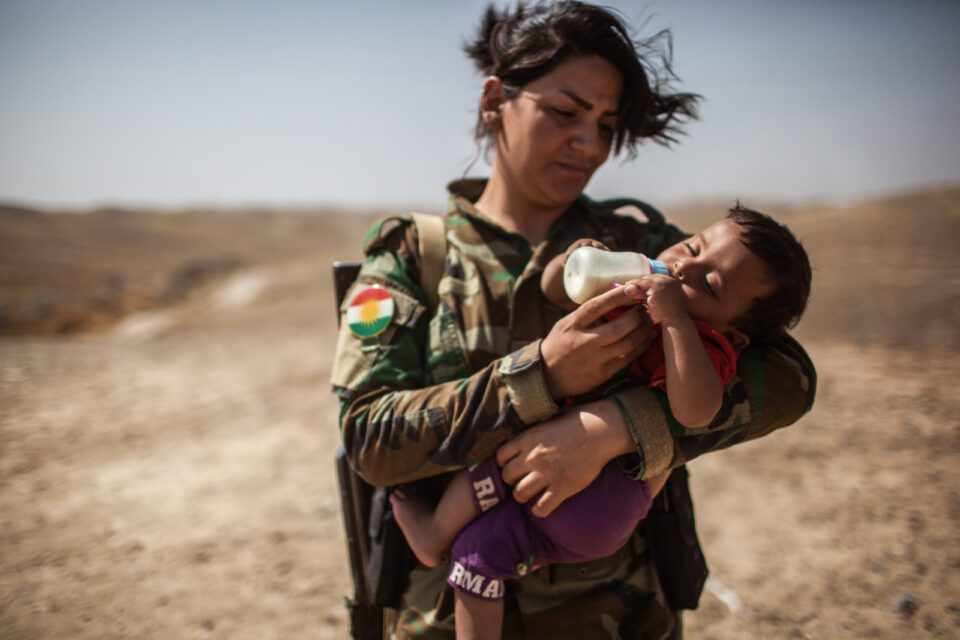
For some time, I was at the front lines documenting moments of the war, where young Kurdish women, far removed from the comforts of the world, stood guard with rifles in their hands, protecting this land. One of them is the woman in this photograph, which, to me, is the most powerful scenes of the entire war. By then, the war against ISIS had reached a stage where they began sending their families forward, women and children, hoping they would be taken in as refugees and spared from airstrikes, artillery fire, and mortar shells. At times, suicide attackers were also sent among them, exploiting this process to inflict casualties on the Peshmerga and leave fresh wounds in the hearts of the people. That is why the so-called “surrender” of ISIS families was never a calm or simple process. For years, parts of Kurdistan had been under occupation. Thousands had been killed, wounded, or displaced. It was clear that no one held any goodwill toward these people.
One day, from the enemy’s direction, a dark mass appeared in the distance. It looked as though a large group was moving toward the front line. The position stirred. Peshmerga numbers grew by the minute. Everything suggested that the fire of war was about to reignite.
Yet no shots were fired, neither from their side nor from ours. It was as if everyone already knew what was happening.
As the figures drew closer, the darkness took shape: families, perhaps around a hundred people. Soon it became clear they were unarmed ISIS families coming forward to surrender. They were allowed to advance to a certain point; beyond that, any further movement would have meant war. Several Peshmerga approached them to determine who they were and what they wanted. For a few hours, the area became a temporary shelter for identity checks and security searches.
None of this was unusual. Similar scenes were unfolding everywhere at the time. What made that day unforgettable for me was something else entirely.
I saw one of the young Peshmerga women step out from behind the trench. Calmly. Without hesitation. Everyone watched in surprise. No one could stop her. She walked toward the families. I don’t know why, but I found the courage to follow her. She went among them, straight to a woman holding a baby, two or three months old. She gently took the child from the mother’s arms, kissed him, and began to feed him.
The baby’s mother was crying. She could not believe this was how they were being received. And we, none of us, could believe what we were witnessing.
That Peshmerga woman, despite all the hatred ISIS had planted deep within her life and history, was now feeding the child of one of them.
This moment was real. I saw it with my own eyes. That was the moment when I understood that we humans are bound to one another more deeply than any war. Even war cannot strip us of our humanity. I was reminded of a verse by Saadi of Shiraz:
Human beings are members of a whole,
In creation of one essence and soul.
If one member is afflicted with pain,
Other members uneasy will remain.