

By Nadir Rusti
The man-made cave of Qizqapan is one of the archaeological masterpieces and artistic wonders of mountain carving in the Kurdistan Region. The engravings, drawings, and reliefs of Qizqapan, set within a framed niche, resemble an art gallery more than a simple carving. Etched onto a vast expanse of a high mountain cliff, this monument carries the story of a great ancient Kurdish state. It has captured the attention of thousands of tourists; due to its sheer beauty, I have visited the site four times and will introduce it to you as follows:
Geographic Location of Qizqapan
The Qizqapan rock-cut cave is located in the Chemi Rezan valley, opposite the village of Awlan within the boundaries of the Dukan District. It is situated 50 kilometers west of the city of Sulaymaniyah and 25 kilometers east of the town of Dukan. The relief is carved 8 meters high on a rock face at the foot of Kunakotr Mountain. Access to the cave is provided by man-made iron stairs installed in recent times, and a paved road leads directly to the site.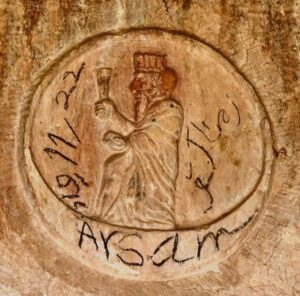
History and Etymology
“Qizqapan” is a Turkish name meaning “the kidnapped girl.” This name was given to the site during the Ottoman era and has no connection to the actual history or content of the monument. In reality, the site is a tomb for the kings of the Medes, who are known as the ancestors of the Kurds. Historians and archaeologists agree that this cave dates back to the era of Median rule, specifically the reign of the powerful Median King Cyaxares (Kaykhosraw). It dates back to approximately 700 to 500 BC and is considered one of the rarest archaeological sites that clearly bears the architectural stamp of the Medes.
Construction Style
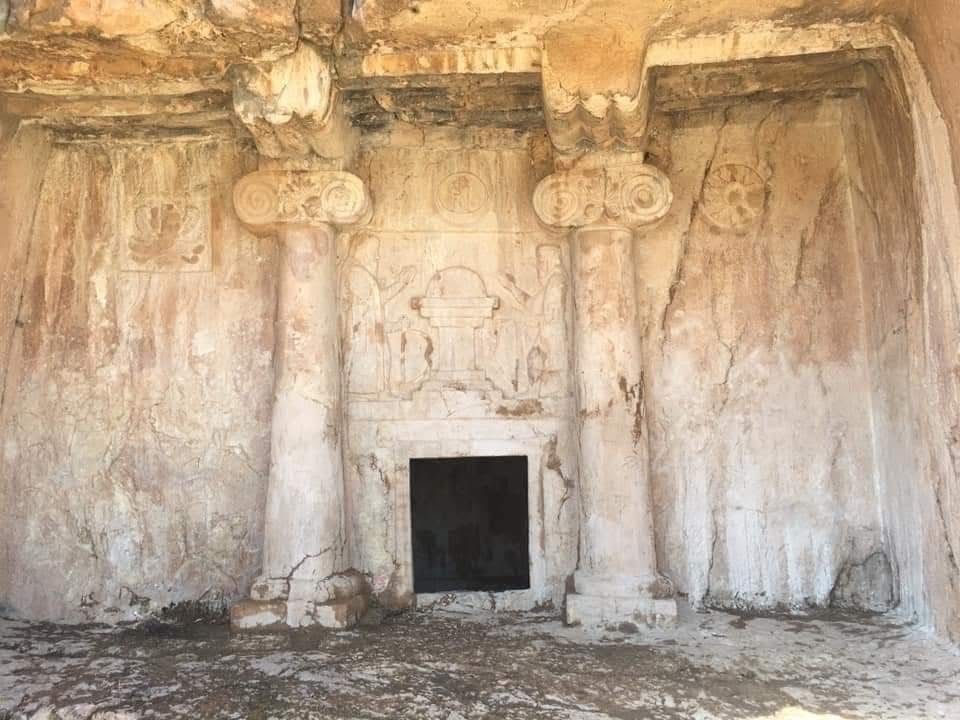
This monument is not a building made of stone and mud; rather, it is carved directly into the solid rock of the mountain. The facade of the cave resembles a house or a royal palace, featuring a porch (iwan) with two large columns topped with capitals. The ceiling and niches of the porch contain various statues, engravings, and symbols. In the center of the porch, a small door leads into the depth of the mountain, where three rooms and three graves have been constructed.
Artistic Composition of the Relief
Upon climbing the stairs to view the carvings, one is left in awe of the mystery of this artistic work and the difficult task of creating it at such a height during the pre-Christian era. The carved niche is approximately 6 meters wide, 4.5 meters high, and 160 cm deep. The details are highly intricate and consist of several main parts:
The Columns: Two large columns support the porch. The capitals are designed with double-scrolls (volutes) on both sides, resembling the Greek Ionic style. The bases of the columns are circular, resting on square platforms.
The Two Figures: In the space between the columns, two men are depicted standing opposite each other. One holds a bow, which the Medes used as a symbol of strength and warrior status. Both men wear special hats, tunics reaching the knees, and traditional trousers (shalwar). They also wear traditional footwear. Between the two men stands a three-legged altar with a burning fire. Analysts state this is a primary symbol of the Zoroastrian religion, signifying the sanctity of fire at that time.
The Royal Figure: In the upper section of the scene, above the fire altar, there is a figure carved within a circle 40 cm in diameter. The figure is dressed in royal attire, sitting on a platform and wearing a crown, holding a glass in his right hand as if drinking the “wine of victory.”
Symbolic Figures: On the upper left, a winged figure is visible, representing the Zoroastrian deity (Ahura Mazda) or the Holy Spirit. He has two circular wings raised high. The image depicts a bearded man wearing a crown and a patterned tunic. Symbols of the full moon and the sun are also visible. In short, the carvings are a blend of political power (the king and weapons), religion (fire and symbols), and culture (Kurdish/Median clothing).
The Inner Rooms: Behind the columns, three rooms are carved into the rock, each containing a grave in its center.
The Graves and Chambers
In the center of the porch, a 1×1 meter door leads inside.
Left Room: 215 cm by 185 cm.
Right Room: 210 cm by 170 cm.
Ceiling Height: 230 cm.
The graves (pits) are hollowed out of the floor to hold the bodies. Each pit is about 60 to 70 cm deep and 2 meters long. The tops of the pits were designed to be covered with large stones, similar to a sarcophagus lid.
What was Qizqapan and why was it built?
While there is limited written information on Qizqapan, historical analysis suggests it was a necropolis for three kings of the Median Empire, which ruled between 700 and 580 BC, with Zoroastrianism as the primary state religion. According to Zoroastrian tradition, kings and high religious figures were buried in rock-cut tombs known as “Gordakhma.” The royal tombs were distinct in that they were designed to look like the palaces the kings lived in during their lives. Research points toward this being the tomb of a great Median king, with some historians identifying it as the final resting place of King Cyaxares.
Due to its importance and beauty, Qizqapan attracts a large number of local and foreign tourists annually. Its status as a tourist destination is further enhanced by the presence of several other archaeological and natural attractions in the surrounding area.