
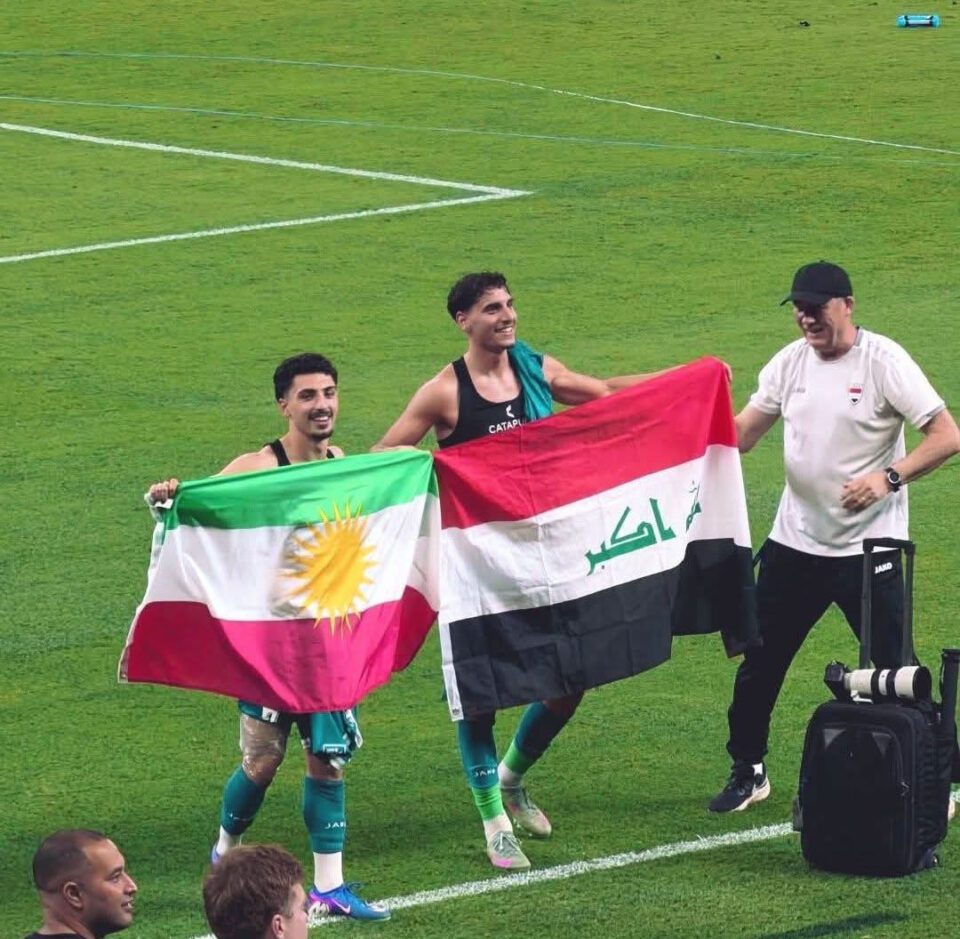
Team’s multi-ethnic composition of Arab, Kurdish, and Assyrian players symbolizes national unity on the global stage
Iraq has secured qualification for the 2026 FIFA World Cup after a dramatic 2–1 victory over Bolivia in the playoff final on Tuesday, ending a 40-year absence from football’s biggest stage. With this result, Iraq became the 48th and final team to qualify for the expanded tournament, which will be held in June–July across the United States, Mexico, and Canada. The achievement marks only Iraq’s second-ever appearance at the World Cup, following their debut in 1986 in Mexico.
The decisive match saw Ali Al-Hamadi and Aymen Hussein score the goals that sealed Iraq’s place in the competition, sparking celebrations across the country and the Kurdistan Region. The result was widely seen as a historic moment for Iraqi football and a turning point after decades of absence from the global stage.
Beyond the sporting success, Iraq’s qualification has also been highlighted as a reflection of the country’s diversity. The national team included players from Arab, Kurdish, and Assyrian backgrounds, symbolizing unity through sport. Kurdish players such as Merchas Doski, Youssef Amyn, Akam Hashim, and Marko Farji played important roles throughout the campaign, contributing strength, creativity, and tactical balance in key matches that led to qualification.
Assyrian and chirstian representation was also significant within the squad. Rebin Sulaka, born in Ankawa in Erbil, provided defensive leadership as a regular starter, while Aimar Sher, Kevin Yakob, and Peter Gwargis added technical skill, creativity, and attacking depth in midfield and forward positions. Their involvement strengthened the team’s overall structure and highlighted Iraq’s inclusive national setup.
The unity of the squad was clearly visible during celebrations, where players were seen holding and displaying the Iraqi national flag alongside Kurdish and Assyrian flags. These images quickly became symbolic of a shared national identity, reflecting pride across Iraq’s diverse communities.
Political leaders also welcomed the achievement. According to the Iraqi News Agency (INA), Prime Minister Mohammed Shia al-Sudani is awaiting the team’s return to Baghdad in order to honor the players for their historic qualification. In addition, Kurdistan Region Prime Minister Masrour Barzani congratulated the national team, praising the achievement as a moment of pride for all Iraqis and highlighting the unifying power of football.
Together, the qualification, the diverse contributions on the pitch, and the symbolic celebrations off it have turned Iraq’s return to the World Cup into more than a sporting milestone. It has become a powerful example of unity in diversity, where Kurdish, Assyrian, and Arab players stand together under one flag on the world stage.