
By Younes Mohammad
After the war against ISIS in the Kurdistan Region came to an end, one question kept circling in my mind: wars may end on the ground, but do they ever really end for the people who fought them? That question became the beginning of a project, one that followed those who had returned from war, but not with the same bodies, nor the same lives they had left with.
I spent weeks searching. From one neighborhood to another, from one half-known name to a vague direction. Until one day, I heard about a Peshmarga who had lost one of his legs in the war and now, every morning, stood somewhere in the outskirts of Erbil selling sandwiches, sandwiches he and his wife prepared together the night before.
That image alone was enough. I had to find him. It wasn’t easy. Addresses were unclear, streets unnamed, houses unnumbered. No one seemed to recognize his name. Until finally, someone said, “Oh, you mean the son of so-and-so?” And that thin thread led me to his door. An elderly woman opened it and welcomed me with quiet warmth. The house was simple, unadorned. I waited in the yard.
When he appeared, I felt more uneasy than he did. He walked slowly toward me, leaning on two crutches. One leg was gone. His body carried the marks of war, shrapnel scars scattered across his shoulder, his side, his back, like a map of something that hadn’t really ended. His two young daughters were with him. One watched him closely. The younger one held something in her arms.
We sat down and talked. He spoke about the war, about the moment he was injured, about everything that came after. About his life now—how just days ago he had to leave his home because he couldn’t afford the rent, and had moved back in with his parents. A small house, two rooms, one of them given to him and his family. He told me that was why he hadn’t responded properly before, he had wanted to sort his situation out first.
He spoke about his work. How his wife prepares the ingredients during the day, how together they assemble the sandwiches at night, and how he goes out in the morning to sell them. I asked him, “How do you manage to do this, in your condition?” He gave a brief smile. “I have to,” he said. He told me he hadn’t been paid in a long time. And even if he were, it wouldn’t be enough to cover basic living costs. Working wasn’t a choice, it was the only option.
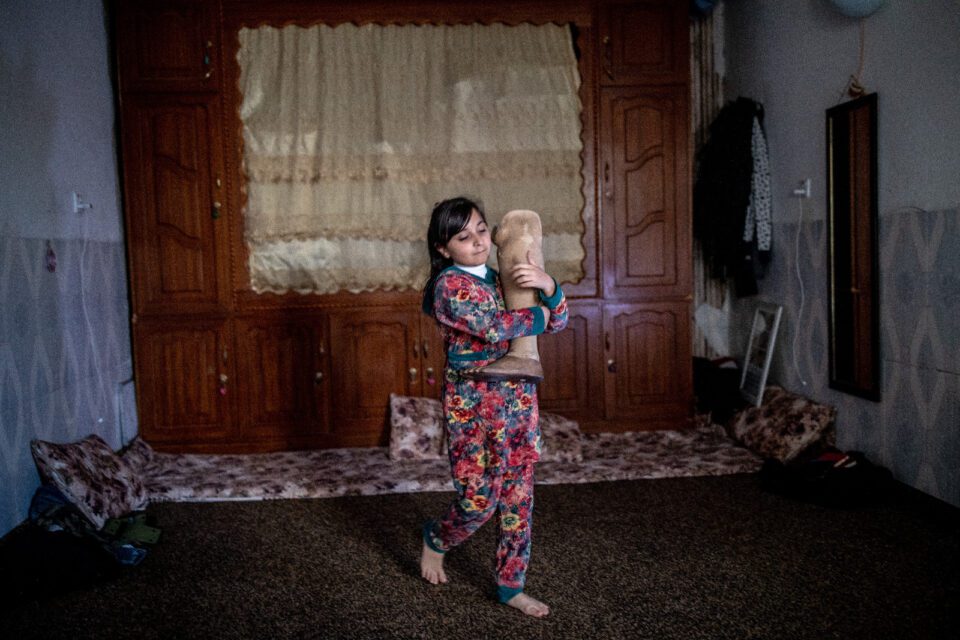
After a pause, I asked him, “Why don’t you get a better prosthetic leg? Didn’t the government help you?” He said, “They did. They gave me one… but it doesn’t work for me. It hurts. It’s uncomfortable. It feels like it wasn’t made for my body at all.” I asked if I could see it. Before he could respond, his younger daughter said, “I’ll bring it,” and ran into the room.
Moments later, she came back, holding the prosthetic leg in her arms. But not like an object. Not like something lifeless. She held it as if she were holding her father, carefully, gently, with a quiet intimacy that is hard to describe. As if that leg were a part of him she could still carry, still protect.
That image fixed itself in my mind. But his story didn’t end there. Gradually, he told me about what couldn’t be seen at first glance, about the shrapnel still inside his body. Many fragments, scattered in different places. Some, he said, he or his wife had tried to remove themselves, with their hands, through pain, through trial, through desperation.
But many were too deep. Some lodged in sensitive areas. Doctors had told him they required complex and expensive surgeries, procedures that he simply could not afford.
His body was still a battlefield. And yet, through all of this, he did not complain. Not about the pain, Not about the poverty, Not about being forgotten. It was as if he had made peace with all of it. But I couldn’t. When I left his home, many images stayed with me, the crutches, the small house, the scars, the weight of a life carried forward against all odds.
But above all, one image never left:
A little girl, holding her father’s prosthetic leg, as if she were holding her father himself.