
By Younes Mohammad
Those days, my life moved between battlefronts. A few days in Shingal, a few in Kirkuk, a few around Mosul. Names that, for many, were just headlines or distant fears that had become reality for me roads, dust, checkpoints, and nights heavy with the smell of gunpowder. I had been staying for a few days at one of the fronts near Kirkuk when I received the first call from him, from the other side of the world, from a place where war was still an image rather than an experience. He said he wanted to come. A young journalist and photographer who kept repeating the same sentence: “Take me to where the fighting is heavy. The front line.”
At first, I thought it was one of those calls driven more by excitement than real intention, but he called again, and again. Each time, the same words, spoken with a strange persistence, as if the decision had already been made long before he ever dialed my number. Taking someone to the front line was not simple. Even if my name was known in those areas, even if I had traveled those routes many times, entering an active combat zone still required permission and coordination. His insistence made me spend days chasing approvals, call after call, explanation after explanation, until I finally secured permission for one of the hottest sectors at that time. Slowly, I began to believe he was coming for something deeper than excitement, perhaps to see something that cannot be seen from a distance.
On the appointed day, I returned from a front near Kirkuk to Erbil and stayed there for a couple of days. I assumed that when he arrived, we would spend the night at home and leave early the next morning toward Shingal. I even told my wife to prepare dinner. But the moment he arrived, I realized this journey would not follow any plan I had made. When he got into the car, fatigue was still visible on his face, but his eyes carried an unmistakable urgency. “Let’s go,” he said. I told him we should rest and leave in the morning, but without hesitation he answered, “No. Now.” And just like that, the plan ended. We set off.
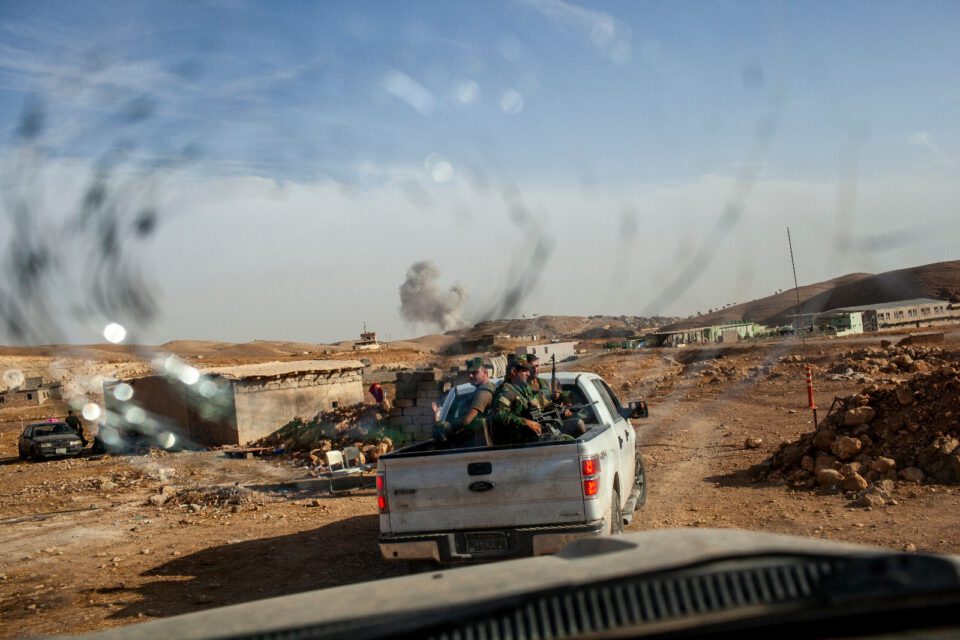
Because of the war conditions, the route was long and indirect, from Erbil to Duhok and Zakho, then along the Syrian border, and down toward Shingal. The roads were scarred and broken, and checkpoints appeared one after another, each stop feeling like it was cutting pieces out of time. But the road itself was not unfamiliar to me. Some of the fighters would nod as we passed. One asked, “Any news again?” Another laughed, “This time you brought a guest?” The further we went, the emptier everything became. No villages, no people, not even the distant sound of livestock. Only desert and dust stretched through out the horizon, as if we were moving through a space between life and death, belonging fully to neither.
As night fell, the silence grew heavier, like the calm before a storm. When we reached the high ground overlooking the area, I turned off the headlights so we would not be detected. The darkness was absolute, and the road almost disappeared. We drove slowly. From time to time, a mortar explosion would light the sky for a second, and then everything would collapse back into blackness. We arrived in the middle of the night at the sector command post, located just behind the front line. The commander came out as always, shook my hand, then looked at my companion and smiled slightly. “So, you’re the hero?” he said in Kurdish.
Tea was brought, and everything seemed calm in a way that felt unreal, as if a few hundred meters away war wasn’t devouring lives. My friend still had the same excitement. “Can we go to the front line now?” he asked. The commander smiled and said, “You haven’t even finished your first tea.” One of the Peshmerga placed a glass in front of me and laughed, “We know him, he still drinks his tea bitter.” As always, I drank it without sugar. We spent the night in a bunker. In the morning, I woke to the sound of mortars. It took a moment for my mind to adjust, then another explosion came and dust fell from the ceiling. The fighters remained calm, one pouring tea, another lighting a cigarette. For them, these sounds were part of the day. For him, everything was still new. Yet he insisted again, “Let’s go to the front line.” So we went.
Near the front, the driver stopped and said we should wait, but before he could finish, a fighter came down from a sand berm and said, “The commander says go into the bunker.” It was a trench with a hanging blanket as a door. We went inside. The air was heavy, and every few moments explosions shook the walls. He held his camera, but the excitement in his eyes had faded.
After a while I said we should go outside, then again suggested that if he wanted to take photos, we had to move. He said nothing. Then, suddenly, an explosion struck closer than before. Something hot hit my chest. I reached inside my clothes and pulled out a small piece of metal, a fragment that had passed through the entrance covering, hit the wall, and bounced back. There was no wound, no blood, but its heat remained on my hand. For a moment, no one spoke. Even the sound outside felt distant. The silence inside the bunker was heavier than the explosions.
We stayed there until midday. When the sounds eased, we came out. He walked straight to the car. I asked where he was going. He looked at me for a few seconds and quietly said, “Enough. Let’s go back.” I thought I had misunderstood him, but he repeated nothing more. We returned to the command post. The commander looked at us and smiled, not with surprise, but with understanding. “I thought you would stay a few days,” he said, then asked, “Did you get any photos?” I said no.
On the way back, silence filled the space between us, but it was not an ordinary silence. It was the silence of someone who has seen something that no longer fits into words. Halfway back, I noticed he had already changed his flight ticket. He had planned to stay longer, but had decided otherwise. When we reached Erbil, he simply said, “Airport.” I took him there, then returned once more to those same roads of dust, silence, and sound. It was only then that I understood some people do not see war; they only come close enough to feel its edge.