
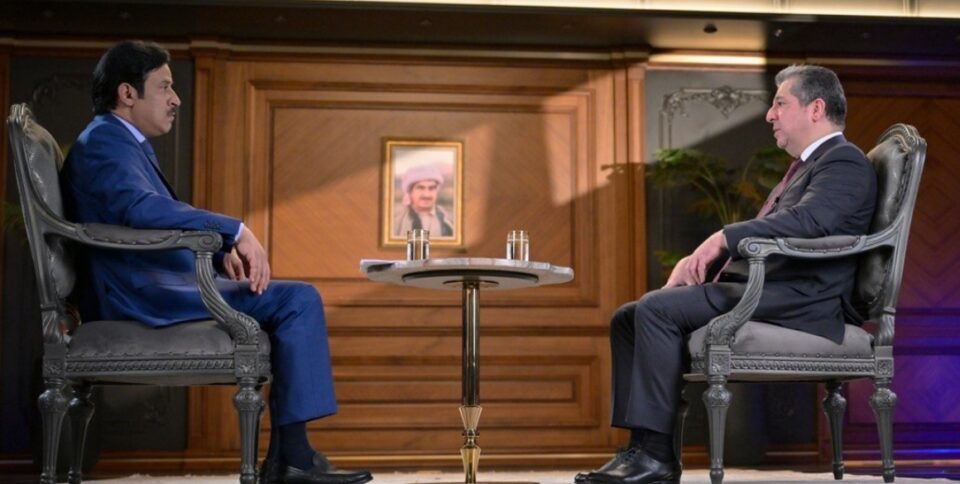
PM Barzani sees Kurdistan’s future in neutrality, stronger institutions, economic reform and dialogue with its neighbors.
Kurdistan Regional Government (KRG) Prime Minister Masrour Barzani has set out a clear position on how he wants the Kurdistan Region to navigate a dangerous period in the Middle East. In an interview with Al Jazeera, the Kurdistan Region’s Prime Minister spoke about the Iran-US war, more than 1,000 missile and drone attacks, the economy, relations with Baghdad, Iran and Turkey, Kurdish groups in neighboring countries, and the future of the Region.
His central message was simple: Kurdistan should not become part of the wars around it.
“We do not want to be part of any conflict or any war in the region,” PM Barzani said. He added that the Region had not started the war and was focused on protecting itself.
The position is important because Kurdistan has been caught in the wider conflict despite trying to stay out of it. PM Barzani said the Region had been attacked more than 1,000 times by missiles and drones launched directly from Iran or from inside Iraq by militias.
“We think these are all unjustifiable attacks on Kurdistan,” he said. “Unfortunately, we had casualties and we lost people. Many of our infrastructure have been hit badly.”
Barzani said Kurdistan had taken steps to make sure its territory was not used to threaten neighboring countries. He rejected the idea that the Region should be treated as a participant in the war.
“Kurdistan is not a part of this war,” he said.
His argument is a way to protect the Region from being pulled deeper into a conflict that it cannot control.
A region caught in a wider war
PM Barzani also rejected claims that the attacks on Kurdistan were justified by the presence of American forces.
He pointed to Harir airbase in Erbil province. The base, he said, has been empty for years. It was used during the campaign against Islamic State but was later abandoned.
He said the American forces that had been based in Erbil were there to fight terrorism and protect civilians.
Kurdistan has close relations with Western countries, especially the United States, but it also shares borders with Iran and has important economic and political ties with Turkey and Baghdad.
Maintaining those relationships has become harder as the regional conflict has widened.
PM Barzani said he hoped the war would end soon, but he did not predict when that might happen.
“I know that at some point this war will end,” he said. But, he added, there was no clear way to know when that would be.
That uncertainty is already affecting daily economic life.
War hits the economy
The conflict has damaged trade and slows economic activity in Kurdistan. Barzani said trade with neighboring countries had fallen by more than 70 per cent.
“The regional conflict and the security repercussions led to a 70 percent decrease in trade across the Kurdistan Region,” he said.
The effects go beyond Kurdistan. Iraq depends heavily on oil exports, and the closure of the Strait of Hormuz has made the situation more difficult.
Barzani said the Region was ready to help Baghdad deal with the economic shock. But he also made clear that Kurdistan could not replace Iraq’s southern oil exports.
The Region currently produces about 300,000 barrels of oil a day, he said. With more investment, that could rise to around 400,000 barrels.
Oil from Kirkuk could add to this if Baghdad sends more crude through Kurdistan to Turkey.
But even a much larger flow would not make up for Iraq’s wider losses.
This is why PM Barzani linked the immediate crisis to a longer-term economic problem: investment.
Security threats against energy facilities have made international companies cautious. Some companies have only recently begun returning after receiving guarantees from Baghdad.
For Kurdistan, the message is clear. Security is a condition for economic growth.
Baghdad and the federal system
Barzani also used the interview to make a broader argument about Iraq.
He said the problem between Baghdad and Erbil is not federalism itself. The problem is that federalism has never been fully implemented.
“There are still people in Baghdad who do not believe in the federal system, or do not understand it,” he said.
The Iraqi constitution gives powers to both the federal government and the Kurdistan Region. But many of its provisions have never been turned into clear laws.
PM Barzani pointed to Article 140, oil and gas, trade and taxation as examples.
His solution is to make the existing laws work.
“If all sides respected the federal system, our problems between us would be at the lowest level,” he said.
The issue of oil and gas remains especially important. Barzani called for a new law that clearly defines the rights of Baghdad and the Kurdistan Region.
He argued that Iraq has changed from a centralized state into a federal one, but some of its laws have not kept pace with that change.
This is one of the areas where his security and economic arguments meet. Without clear rules between Baghdad and Erbil, investment remains harder and disputes remain easier to reopen.
State power and armed groups
Barzani also backed Baghdad’s efforts to bring weapons under state control.
He said no armed group outside Iraq’s legal framework should be allowed to threaten Iraq or its neighbors.
“We have the same policy,” he said. “No group should be a threat to Iraq and the neighboring countries.”
He supported the Iraqi PM Ali Zaidi’s efforts to strengthen state authority. But he said the preferred approach should be peaceful.
The issue is especially sensitive because some armed groups in Iraq have close links with Iran and have been involved in attacks across the region.
Relations with Iran
Iraq and Iran share a long border and deep historical, religious and cultural links, he said. Their relationship is therefore natural.
But it must be based on respect.
“I believe Iraq should be completely independent in its decisions and put the interests of its people and its country above everything,” he said.
That is also how Barzani describes Kurdistan’s approach to Iranian Kurdish opposition groups living in the Region.
He said those groups had been there since before 1991 and were therefore a historical issue rather than one created by the current government.
But Kurdistan, he said, expects them to follow the Region’s official policy and not threaten neighboring countries.
He also rejected the idea that Kurdish communities in the region should be treated as security threats.
“The best way is dialogue,” he said when discussing the Kurdish question.
Turkey and Syria
Turkey remains another important part of Kurdistan’s regional strategy.
PM Barzani described relations with Ankara as very good. But he also pointed to the cost of the continuing armed conflict along the border.
Around 800 Kurdish villages, he said, remain destroyed and have not been rebuilt.
He strongly supports Turkey’s recent peace efforts. For him, resolving the Kurdish question in Turkey could have effects beyond Turkey itself.
He sees a similar opportunity in Syria.
Erbil, he said, supports dialogue between Damascus and the Syrian Kurds. Relations between Erbil and Damascus are also improving.
He pointed to the participation of Kurds in Syria’s new political institutions as a positive sign.
For Barzani, the lesson is the same across the region: Kurdish issues should be handled through politics rather than war.
A different future for Kurdistan
There is also a domestic side to PM Barzani’s vision.
He pointed to reforms in Kurdistan, including digital public services, the development of the banking system and a larger role for the private sector.
He argued that the Region has created an environment capable of attracting international companies and local investors, even during difficult periods.
His wider message is that Kurdistan needs to become stronger through institutions and economic development, not only through security.
That is particularly important for a younger generation with higher expectations.
Barzani said young people in Kurdistan compare their lives with the best examples around the world. Their expectations, he said, are different from those of previous generations.
“I am very optimistic and I have great hope for the future of the new generation of Kurdistan,” he said.
For PM Barzani, the central challenge is not to choose a side in every regional dispute. It is to ensure that Kurdistan remains stable enough to choose its own future.
The Kurdish Globe