
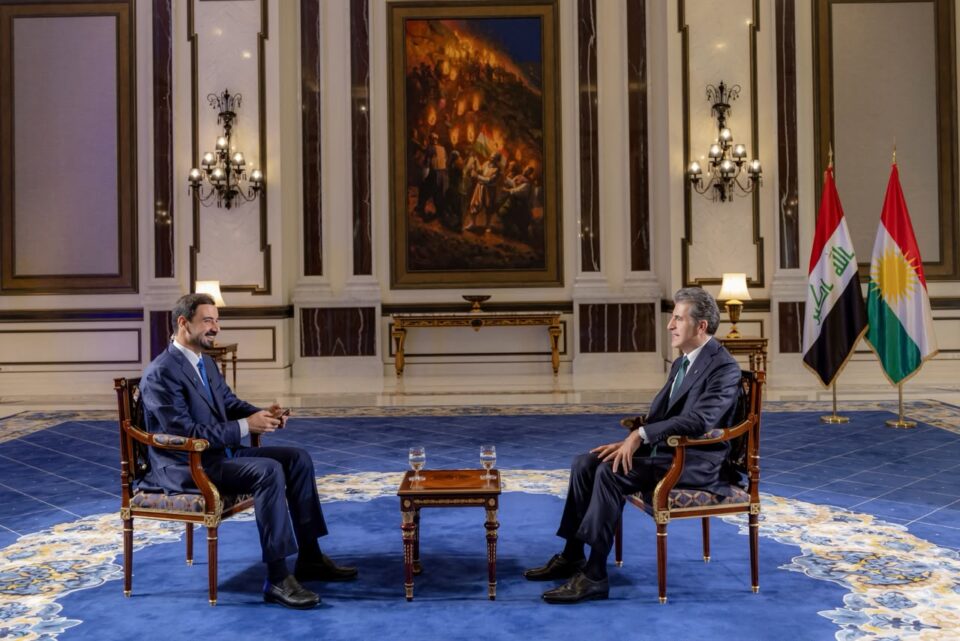
Barzani cautiones against isolation as Iraq confronts armed factions
In a televised interview on Al-Sharqiya’s “Muwajaha” on 12 August 2026,
Kurdistan Region President Nechirvan Barzani assessed the pressures bearing down on Iraq:
unregulated armed groups, an unravelling economy, and an unfinished argument over what kind of state Iraq is meant to be.
“We are all in the same boat,” he told the host, arguing that no part of the country could be rescued while another sank. The central question, he insisted, was not who was right in Iraq’s disputes but “what direction is Iraq taking?”
Weapons Under State Control: An Iraqi Demand, Not an American One
Barzani praised the sacrifices of the Popular Mobilisation Forces, the Iraqi army and the Peshmerga, describing the PMF as an institution established by law. But he was blunt about factions operating beyond state authority, noting that both they and the PMF are funded by the Iraqi state.
His objection was not personal, he said. Groups inside Iraq had launched drones toward Jordan, Saudi Arabia, the UAE, Qatar and Bahrain, and attacked oil companies in the south. When he travels abroad urging investment, the first question any company asks is about security.
He rejected the framing of disarmament as a concession to Washington. “The United States came to our country, and eventually they will depart, but we, the people of Iraq, will remain,” he said. Placing weapons under the Commander-in-Chief’s authority is an Iraqi requirement that would exist regardless. US forces are in Iraq under an agreement with the federal government and are due to withdraw by the end of September; Prime Minister Ali Al-Zaidi confirmed Baghdad remains committed to that timeline.
If Iraq fails to resolve the question of the factions, he warned, it risks international sanctions and regional marginalisation at precisely the moment Gulf states are eager to invest.
A Message From Tehran and a Mandate for Al-Zaidi
The interview’s most newsworthy disclosure concerned Iran. During his recent visit to Tehran, Iranian officials responsible for the file told him twice: convey to the Prime Minister that Iran is prepared to cooperate. Asked whether this was Tehran’s official position, he said they confirmed it was, but declined to name them.
He confirmed the State Administration Coalition had reached a consensus granting Al-Zaidi authority to act should armed groups withhold their weapons after 1 October. But confrontation must be a last resort, he stressed, warning against scenarios pitting Shiites against Shiites or Sunnis against Shiites. Dialogue must come first — and some armed individuals have already signalled willingness to disarm.
On the thousand-plus strikes the Kurdistan Region has absorbed, Barzani called claims that the perpetrators are unknown technologically obsolete. Most originated inside Iraq — Mosul, Diyala, Salahaddin, Kirkuk, Tal Afar — with some from Iran during the forty days of conflict. His verdict on the self-declared resistance was withering: it has not shortened the American presence by a day, damaging only Iraq’s reputation and the Region’s economy.
Federal or Centralised? The Unresolved Question Since 2003
On Erbil-Baghdad relations, Barzani declined to blame individuals, calling Al-Zaidi’s intentions encouraging. The problem is structural: twenty-three years on, Iraq has never settled whether it is genuinely federal or centralised. Baghdad deals with the Region through laws predating 2003, he said, in a manner more centralised than the most centralised systems — a result he described, invoking a Kurdish idiom, as something “found in no apothecary’s box.”
He dismissed as “one hundred percent baseless” accusations against Erbil, including claims of Mossad bases and harboured terrorists, citing close intelligence cooperation with Baghdad.
Economic Peril, Syria and Sinjar
With all Iraqi oil exports running through the Strait of Hormuz and roughly six to seven billion dollars needed monthly for salaries alone, Barzani called the moment extremely perilous. The Region is ready to cooperate on pipeline routes through its territory or toward Syria, though such projects are long-term.
His meeting with Syrian President Ahmed Al-Sharaa was constructive and fully coordinated with Baghdad, he said, adding that he had advised Syria’s Kurdish factions to settle their affairs with Damascus within a unified Syria, since the Kurdistan model cannot be replicated there. On Sinjar, he urged forces operating outside the law to withdraw and the 2020 agreement to be implemented, warning against politicising the Yezidi tragedy.
Asked whether Iraq had chosen between Washington and Tehran, Barzani was firm: Iraq stayed neutral in the recent conflict and should keep equal distance from all parties. The Region has not allowed its territory to become a launching pad against Iran. Iraq must never threaten a neighbour — and its future depends on all its forces rowing the same boat in the same direction.
By Jawad Qadir