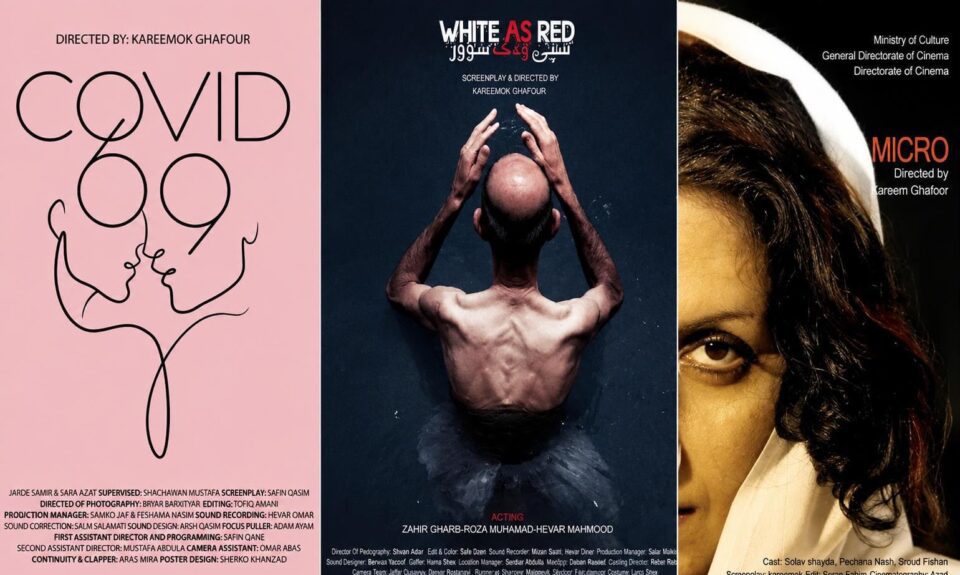
Karimok Ghafour’s trilogy uses cinema to examine love, religion, and sensitive social issues while encouraging audiences to question and reflect.
The trilogy of short films “Microphone,” “White as Red,” and “Covid-69,” all directed by Karimok Ghafour, was screened at Salim Cinema in Sulaymaniyah as part of the “Cinema and Thought” initiative, organized by the Dako Institute for Art and Culture Development.
Ghafour said that throughout his career in cinema, he has produced numerous short films with different themes, perspectives, and artistic approaches. However, he said these three films are closely connected because they emerge from a shared intellectual and artistic vision.
“These three films come from the same intellectual world and reflect a similar artistic vision and cinematic approach,” Ghafour said.
He explained that the “Cinema and Thought” initiative goes beyond film screenings by creating opportunities for reflection and dialogue on sensitive issues within Kurdish society.
Although the three films were produced in different years, Ghafour said they share a common philosophy in their choice of subjects and storytelling. “Microphone,” which was produced earlier than the other two, as well as “White as Red” and “Covid-69,” have been screened at various local and international film festivals and have received awards and critical recognition.
From a production perspective, two of the films were produced by the Erbil Cinema Directorate, while the third was produced by Sulaymaniyah Cinema. Despite their different production backgrounds, Ghafour said the films follow the same artistic and intellectual direction.
He said the central themes of the three films revolve around two powerful forces in human life: love and religion. At times, these forces coexist, while at other times they come into conflict.
“The films present this conflict to the audience without providing ready-made answers,” Ghafour said, explaining that cinema can serve as a space for questioning, reflection, and discussion. In this process, he said, viewers become active participants rather than passive observers.
The three films have a combined running time of approximately 40 minutes. Ghafour said, however, that their impact extends beyond their screening time, as each film is intended to leave audiences with questions and ideas to consider after the screening ends.
As part of the “Cinema and Thought” program, author and translator Awat Ahmed presented a critical reading of the three films from literary and philosophical perspectives. Poet and writer Ramyar Mahmoodi also offered a separate interpretation of “Microphone.”
The critical discussions were followed by an open forum, giving audience members an opportunity to share their views and raise questions about the films and their sensitive themes.
The screening of “Microphone,” “White as Red,” and “Covid-69” provided another opportunity for Kurdish cinema to explore social questions through artistic expression while encouraging public dialogue and critical thought.