
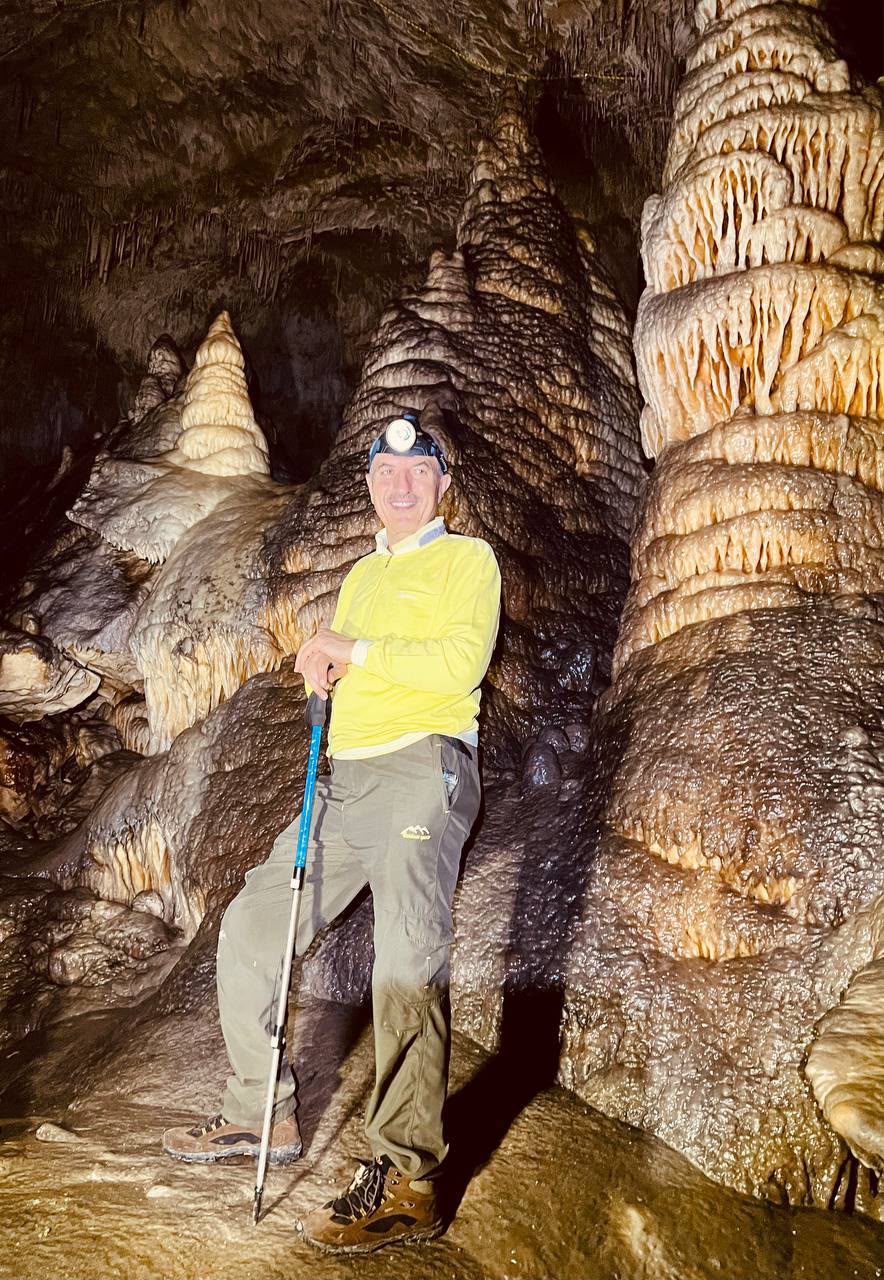
Caves are millions of years old. Over the course of millions of years, continuous transformations have shaped the structure and appearance of natural caves, resulting in a rich diversity of sizes and geological beauty. With the passage of time, their internal compositions have evolved, and many harbor captivating, awe-inspiring subterranean landscapes—particularly those where mineral-rich water seeps from ceilings, carrying limestone deposits that drip onto the floor or flow along arches and walls to forge crystalline, glass-like columns. Kunaba Cave is one such wonder whose subterranean chambers resemble a breathtaking natural art exhibition, standing as a vital piece of Kurdistan’s natural heritage. In 2022, during a mountaineering expedition, I explored several sections and depths of this cave. Through this account, I introduce you to this extraordinary natural treasure.
Geographic Location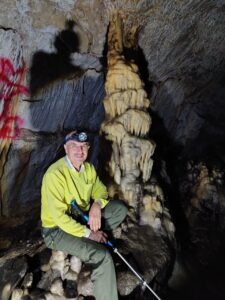
Kunaba Cave is situated in the Darbandikhan district within the Sulaymaniyah Governorate. It lies approximately 50 kilometers southeast of the city of Sulaymaniyah and 5 kilometers south of Darbandikhan town, nestled on the slopes of Mount Gulan overlooking Darbandikhan, at an elevation of roughly 600 meters above sea level.
Reaching the cave’s mountain slope on foot takes about a 30-minute hike. However, an unpaved road allows high-clearance SUVs and motorcycles to travel near the entrance, making it accessible to people of all ages and capabilities.
Cave Composition & Formations
This cave is an extraordinary natural formation created through the long interplay of moisture, seeping water, and soluble limestone bedrock. Over millions of years, water percolating through the mountain ceiling carries dissolved minerals and sediments, gradually precipitating onto ceiling ledges or steadily dripping down onto the floor.
This geological dynamic has generated hanging crystalline spires, domes, columns, and dramatic pathways—scientifically termed stalactites and stalagmites. Several chambers feature a radiant, metallic-like natural glaze that coats the inner walls and arches, producing stunning visual effects.
When beams of light strike the calcified limestone surfaces, they glisten like luminous crystals, deeply captivating hikers and speleologists. The limestone formations exhibit a spectrum of variegated hues, shifting according to the mineral variations and soil sediments embedded within the bedrock.
Length, Depth & Wind Phenomena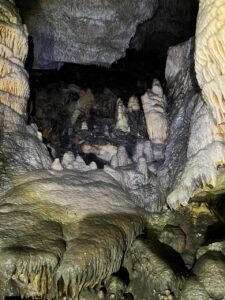
Kunaba Cave is regarded as one of the largest caves in the Kurdistan Region. Its entrance portal is narrow and oblong, resembling an egg shape, allowing only a single person to pass at a time. Right at the portal, a strong, continuous current of wind rushes outward against your face—crisply cool and refreshing in summer and reportedly warm during winter. This phenomenon gave the cave its name (“Kuna-ba”, meaning Cave of the Wind Hole or Wind Vent) and remains its signature hallmark.
After crawling and advancing approximately 10 meters inwards, the cave expands substantially, bifurcating into two main branches oriented North and South, alongside various narrow offshoots. The northern route is significantly longer and subdivides into further branches. The scenic route has been clearly designated and upgraded: mountaineering guide ropes hang from the ceiling to guide the path, while the walking surface beneath has been cleared and leveled.
Although I could not traverse every corridor, survey records estimate the cave’s explored length at 767 meters, with some accounts suggesting it extends further. A German speleological expedition reported that “the cave’s depth reaches 1,030 meters,” though full formal confirmation is ongoing. In the deep recesses of the cave lie subterranean springs and wide pools spanning several meters, where some expedition teams have even swum.
Local mountaineer and guide Dilshad Rahman noted: “In the 1990s, I ventured deep into its interior; I saw pristine springs and natural pools that were simply breathtaking, alongside diverse wonders. However, subsequent earthquakes caused structural collapses that sealed off several deep pathways, preventing access today.”
The Cave’s Spectacular Sights
Upon arriving at the threshold, I crouched low to squeeze through the narrow entry portal. After traversing 10 meters, we connected with the rope-marked ceiling path. Moving another 20 meters deeper, hundreds of marvelous vistas revealed themselves: intricate arches, pillars, and rounded domes remarkably resembling the minarets and cupolas of Islamic mosques.
Pendant crystalline formations of varied lengths, thicknesses, and exquisite geometries hang overhead. Across the cave floor, formations sparkle like crystallized sugar loaves, gemstones, polished silver, gold, and glass. Droplets of mountain water intermittently fall on your face and head. The deeper into the cave you venture, the more dramatic the vistas become.
The brighter your torches and lanterns, the more brilliantly the cave showcases its natural splendor—its beauty defies simple description. Because water continuously bathes the stone floor, certain areas carry a slip-and-fall risk. If equipped with specialized eco-lighting, the visual experience would be multiplied tenfold. These magnificent formations make Kunaba a magnet for mountaineering clubs, local residents, and travelers.
Tourism Services & Infrastructure
A vehicular track leading near the cave has been established, though it remains a rough dirt dirt road suited primarily for high-clearance four-wheel-drive vehicles. In 2022, the Italian humanitarian organization Un Ponte Per (UPP), partnering with the General Directorate of Tourism in Sulaymaniyah and Darbandikhan, laid out a stone footpath inside the cave to create a designated trail, while anchoring climbing ropes to the ceiling to guide visitors. These two improvements have proved immensely valuable for both hikers and tourists.
However, while enhanced access provides convenience, it has also inadvertently made it easier for irresponsible individuals to enter and damage the cave—such as fracturing delicate crystalline and stalactite formations to sell, and defacing the ancient rock with spray paint. In contrast, conscientious mountaineers and educated tourists maintain strict respect for the cave’s natural sanctity.
Recommendations for Cave Conservation
This natural treasure and geological heritage, bestowed upon our land and humanity, urgently warrants rigorous conservation. Citizen and tourist visits must be structured, with clear visitor codes of conduct posted prominently at the cave entrance to prevent ignorant or malicious destruction of its fragile beauty. To ensure long-term preservation, we propose the following concrete measures:
Lighting and Security: Install low-impact ambient lighting and assign on-site guards, transforming it into a professionally regulated ecotourism site with controlled, ticketed admission.
Ventilated Security Gate: Fabricate and install a ventilated, barred iron security gate at the entrance that allows the natural air circulation (“Kunaba” draft) to flow freely while remaining locked. Key management should be held by the Tourism Directorate or designated guards, with access coordinated and unlocked for verified tourist and mountaineering groups.
By: Nadir Rosti