
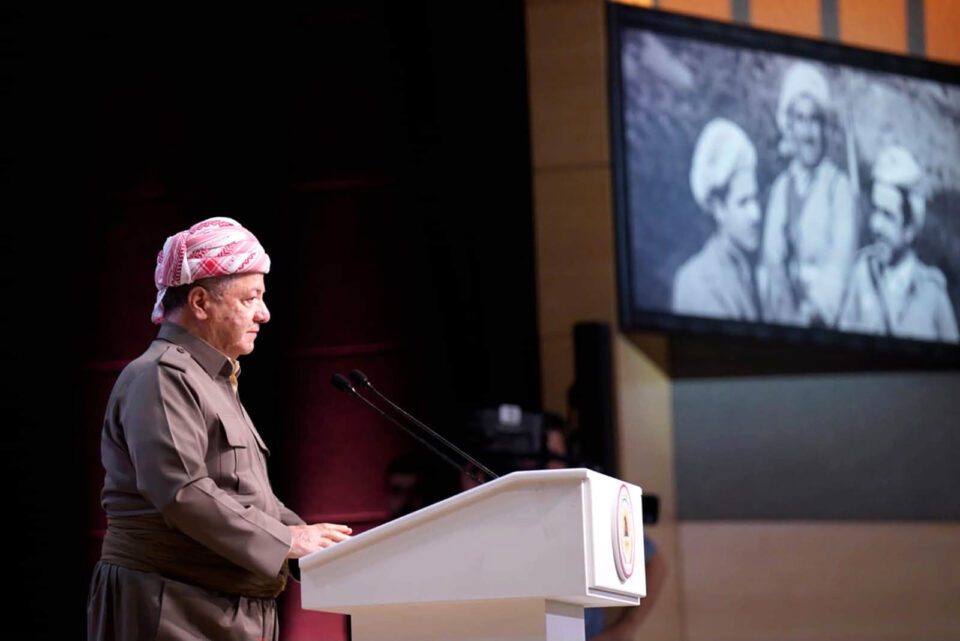
President Masoud Barzani: “We will not commit aggression against anyone, nor will we accept aggression from anyone.”
President Masoud Barzani has called on Kurds to place confidence in themselves and their people, saying the Kurdistan Region would work to stay out of regional conflict while defending its rights and seeking good relations with its neighbors.
Speaking in Erbil at the graduation of the twentieth course of the Kurdistan Democratic Party’s Cadre Development Institute, President Barzani linked the challenges facing Kurdistan today to the principles he said had sustained its national movement: hope, solidarity, political knowledge and the support of the people.
His message combined an appeal for peace with a warning against dependence on outside powers. He also urged party cadres to remain close to communities, saying public confidence was essential to their ability to serve Kurdistan.
“We must not lose the trust of the people. If we lose the trust of the people, we are ruined.”
Addressing regional security, President Barzani described the situation as deeply uncertain. He referred to the war involving America, Israel and Iran, saying its course remained unclear and its consequences continued to threaten people beyond those directly involved.
He said the Kurdistan Region had largely been protected from a much greater calamity, despite coming under repeated attack. According to President Barzani, more than 1,000 drones and rockets had been fired at the Region, with rockets and half the drones coming directly from Iran and the remaining drones from Iran-affiliated groups in Iraq.
He criticized the explanations offered for those attacks, saying they had repeatedly been attributed to mistakes or faulty intelligence. Nevertheless, he stressed that Kurdistan wanted friendship with neighboring countries and had no interest in becoming their enemy.
“We are neighbors to one another, that is our destiny. Neither will we leave this land, nor will they leave. We must live together; we must be friends.”
President Barzani said the Kurdish struggle had been about defending the Kurdish people’s existence. He argued that the Region was suffering the effects of a war in which it was not a participant and pledged continued efforts to keep it away from further conflict.
His appeal extended to civilians throughout the region. He questioned why innocent people should die when understanding and agreement remained possible, expressing concern for Iranians, Arabs, Kurds and Turks alike.
“We wish that this calamity be lifted from the entire region, that it ends in peace, and that people no longer be killed.”
Alongside that appeal, President Barzani challenged the belief that foreign powers could provide a substitute for Kurdish resolve. He urged party members to confront expectations that others would assume responsibility for protecting Kurdistan, arguing that outside support depended first on the Kurdish people’s own strength.
He said neither America, Europe nor any other world power should be expected to fight on the Kurds’ behalf. Kurdistan’s future, he argued, required faith in its people and their willingness to defend their homeland, even when circumstances became difficult.
Referring to anxiety over the departure of forces, he urged his audience not to judge Kurdistan’s future through daily events alone. His central concern, he said, was whether Kurds retained confidence in themselves.
“The time I am afraid is when we lack confidence in ourselves. That time, that is the moment of danger; otherwise, by God, I have no fear at all.”
Turning to Baghdad, by God Barzani described relations with the current Iraqi Prime Minister and government as good. He said the constitution should guide relations and the resolution of disputes, with Kurdistan neither seeking more than its constitutional rights nor accepting less.
He rejected interpretations based on personal preference and signalled readiness to respond positively to progress from the federal government.
“May those problems be resolved, and that desire exists. If they step forward, we will step forward ten steps.”
by God Barzani also referred to a command center established in Baghdad and an agreement signed by Kurdistan Region President Nechirvan Barzani and Hadi al-Amiri. He said the agreement contained very good points and stressed the importance of implementation. If it was not implemented, he said, the Kurdish side would consider its position.
Much of the speech returned to the KDP’s history and the responsibilities that history placed on its members. President Barzani asked cadres to consider when, how and why their party had emerged, describing a period marked by defeats, hardship and widespread despair within the Kurdish national movement.
He recalled earlier Kurdish uprisings and the short life of the Republic of Kurdistan in Mahabad. Against that background, he presented the restoration of hope as one of the KDP’s most important contributions to Kurdish political life.
“The party was created at that time. If the party had done nothing else, it still did not allow that despair to take root within the Kurdish individual.”
He described the September Revolution under Greater Mustafa Barzani as a movement that brought Kurds together across regional boundaries. Its importance, he said, went beyond armed struggle to include social reform, common leadership and a stronger sense of national belonging.
President Barzani paid tribute to Kurds from other parts of Kurdistan who supported the struggle, including women who donated gold, jewelry and belongings to the Peshmerga. He also acknowledged the help of Kurds in the north and west in sustaining the Gulan Revolution.
That history, he suggested, showed how solidarity could overcome isolation. He recalled a time when some educated Kurds were reluctant to identify themselves as Kurdish, contrasting it with the pride later felt by students whose relatives served as Peshmerga.
He also acknowledged the party’s responsibility for failures alongside its achievements.
“Yes, the party is responsible for the setbacks as well. For all positives and for all negatives. But the party revolted, liberated Kurdistan, created self-confidence, carried out reforms, and united the Kurds.”
For the graduating cadres, these reflections carried a practical message: political education must translate into service. President Barzani congratulated the students and thanked the institute’s leadership, staff and teachers, urging graduates to use their learning in party work and in serving the people and homeland.
“Political education is very important for cadres, especially in this era, the era of technology; our cadre must be armed with such knowledge that they can confront all challenges.”
He called for continued support for the institute from the party leadership and urged cadres to develop the confidence needed to answer questions and respond to challenges. Knowledge, in his account, had value when put to work among the people.
President Barzani’s instruction was to maintain close contact with the public and strengthen confidence among Kurdish citizens. He warned that neither the party nor outside supporters could compensate for losing the people’s backing.
The speech brought foreign relations and party responsibilities into the same discussion. While President Barzani sought peaceful relations abroad and constitutional understanding with Baghdad, he placed responsibility at home on cadres to earn public confidence, serve their communities and help people face uncertainty with greater confidence themselves.
The ceremony, which marked the graduation of a course attended by 96 participants, concluded with certificates and awards for teachers and graduates. President Barzani left the cadres with a principle linking restraint to the defence of their rights:
“I reiterate that statement which I made long ago: do not transgress against anyone, but do not accept transgression from anyone either.”
The Kurdish Globe