
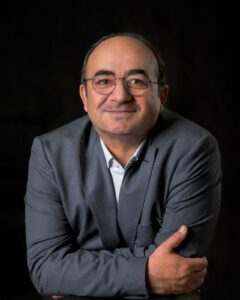
Younes Mohammad
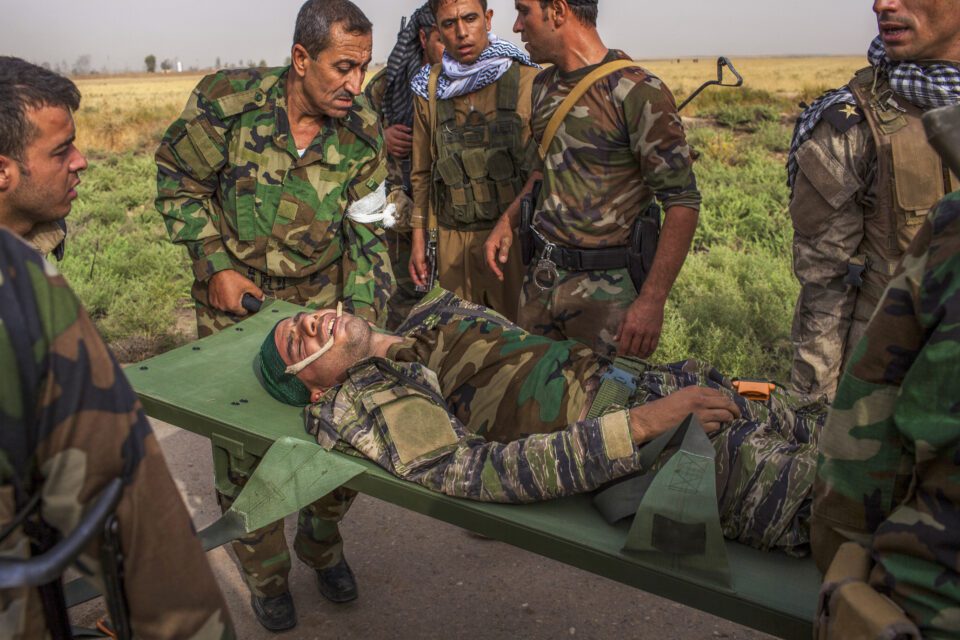
One of the Peshmerga fighters found a piece of wood nearby. He tried to clean it with whatever he had, then took a canteen from another fighter’s bag and poured a little water over it. The wounded man clenched his teeth against the pain. The fighter placed the piece of wood between his teeth. Several men stood around the stretcher. It was one of the few things they could offer him.
The fighting was taking place farther up the road. We heard explosions and sometimes saw smoke rising in the distance. Tanks and military vehicles moved along the asphalt, one behind another, like a long train. Mines and roadside bombs planted by ISIS made the ground on either side dangerous, forcing the convoy to remain on the road. Every so often, a black ISIS flag appeared beside it. Until that day, the territory had been under their control.
The Peshmerga had come from different units and towns. They wore different uniforms, and some had no military clothing at all. Volunteers had joined the operation to retake villages held by ISIS. I was not allowed to accompany the fighters on the front lines. I stayed between 500 meters and a kilometer behind them, close enough to hear the battle but too far away to photograph it. Yet I did not need to go any farther to witness the war. The road carrying tanks and fighters toward the front was bringing the wounded back.
I would still be photographing one wounded man when another arrived. I turned my camera toward him, only to see more men being carried in. Some came on stretchers, while others were supported in the arms of their fellow fighters. Each new arrival seemed more seriously wounded than the last. Amid the commotion around me and the explosions ahead, I struggled to decide where to point my camera. The battle I could not photograph at the front was returning to me through the faces and bodies of the wounded.
The man with the piece of wood between his teeth was one of them. People gathered around him, trying to help, as more casualties arrived. One man carried a stretcher. Another searched for a vehicle to evacuate the wounded. Everyone did what they could with what they had, but there were more wounded men than people available to treat them.
In the confusion, I noticed a man being called “Doctor” from several directions. He wore a military uniform and, at first glance, looked like any other Peshmerga fighter. One moment he was beside a wounded man; the next, he was hurrying toward another. He called for ambulances, but before he could reach one casualty, others were calling his name. From where I stood, I could see no other doctor. There was only this one man, and the wounded kept coming.
Sometimes he disappeared into the crowd, only to reappear beside another stretcher. He had no time to stop. He treated one man, tried to arrange an evacuation, then hurried toward the next call for help. The wounded seemed to be arriving faster than he could reach them. I kept raising and lowering my camera. Every time I framed one person, something else was happening beyond the edges of the picture.
By the end of the day, thirteen villages had been retaken from ISIS. But what stayed with me from that road was not the advance. It was the stretchers moving in the opposite direction.
I never found out what happened to the man with the piece of wood between his teeth. Years later, when I photographed Peshmerga fighters who had been wounded or had lost limbs, I still could not recognize anyone from that day.
The last time I saw the doctor, I could hardly believe he was the same man I had seen at the beginning of the operation. His uniform had been clean and neat. Now his face and clothes were stained with blood. He looked as though he had entered an operating room in his military uniform and emerged hours later.
But it was not only his appearance that had changed. He seemed to have almost nothing left in him, as though the entire war had fallen on his shoulders alone. He looked nothing like any doctor I had ever seen.