
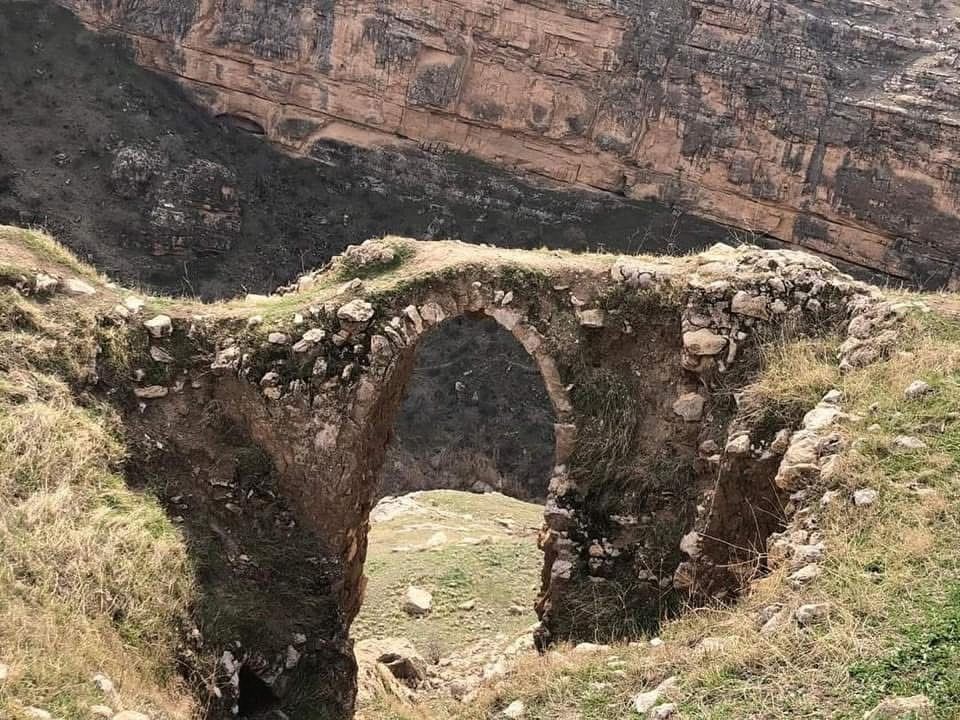
The Kurdistan Region is home to many castles. Princes and rulers built them in steep and high locations to strengthen their authority and protect their reign. Several of these castles are rarely mentioned because they are built in difficult terrains that require mountaineering skills to reach. Their height and geographic location provide them with immense beauty, making them suitable for tourism; however, due to a lack of services, they remain inaccessible to tourists and have not been utilized for the tourism industry. Julandi Castle has been neglected even from an archaeological and documentary perspective. In this field report, we introduce you to Julandi Castle.
The Location of Julandi Castle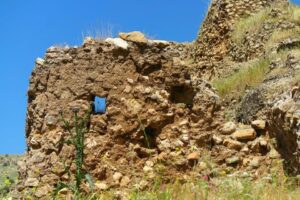
This castle is built on the summit of a massive, rugged mountain crag. There is only one path to ascend the peak. The castle is located southwest of Chami Razan, within the Surdash sub-district of the Dukan District in Sulaymaniyah Governorate. It sits between Mount Gechal, Barda Ali, Dara Ashaba, and Chami Razan.
The castle is situated in a charming area full of natural beauty, about 7 km from the Bafil Waterfall and the Chami Razan resort. The Tabin River, which flows down through Chami Razan and eventually joins the Lesser Zab near the villages of Surqala and Dwawa, winds around the castle. This means it is surrounded by water on three sides, situated like a peninsula. It rises approximately 200 meters above its surroundings, reaching 250 meters in some spots. It is steep and difficult from all sides except for one access path.
The peak where the castle sits is isolated from the surrounding mountains by a winding valley through which the river flows. At the same time, because it is closely surrounded by mountain ranges, one cannot see or sense the castle’s existence until they are very close to it. Due to its height and vast area, the entirety of the summit cannot be easily seen at once; exploring the whole castle grounds would require an entire day.
The Structure of the Castle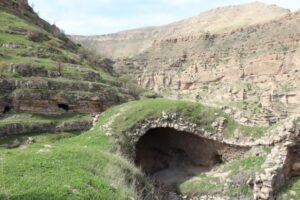
The mountain peak beneath the castle is circular, with a diameter of approximately 400 meters. From bottom to top, the elevation is naturally shaped like a pyramid, consisting of five natural terrace-like rings; the base is the largest, and the summit—where the castle itself is built—is the smallest.
The King’s palace is located at the very peak (the center), surrounded by several other palaces, buildings, and houses. The castle can only be reached from the eastern side via a narrow path through a mountain known as “Sari Piran.” The natural structure of the mountain is extremely steep and treacherous. Beyond this narrow passage, you reach the castle gate, which consists of two massive vertical rocks acting like shoulders for the entrance. These rocks are over 15 meters high, and the corridor between them is 3 meters wide. This passage into the castle is very steep; it is likely that stairs were used in the past, but they have disappeared due to erosion and collapses.
Components and Sections of the Castle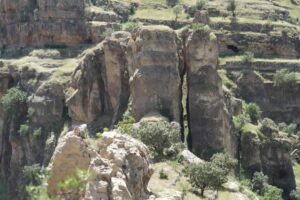
Julandi Castle consists of several parts. The mountain peak constitutes the first section. The second and third sections are located below the summit and likely served as residential areas for commoners or military barracks used for guarding and defense.
The area the castle occupies is vast. Remains of walls, rooms, and ramparts are still visible in several places, especially at the summit and the lower sections. The upper section contains several rooms and open spaces; some walls still stand at a height of one meter or less. The walls were constructed from stone and lime mortar, with a thickness ranging from 60 cm to 100 cm. In the lower section near the entrance, a number of walls and rooms are visible. One room still retains its arched ceiling, and hikers often visit it to take photographs.
Julandi Castle is located on the western side of Chami Razan. On the left side of the river, there are remains of another castle on a height known as “Matikh Castle.” Local lore refers to it as the “Mother Castle” because it supposedly belonged to the mother of King Julandi. There is a legend among the local inhabitants regarding these two castles that tells the story of King Julandi and his love for his mother.
The History of the Castle
The exact date of the castle’s construction and its period of habitation remain unknown. According to local folklore, it dates back to the pre-Islamic era. Although no scientific excavations or studies have been conducted by local or foreign researchers, C.J. Edmonds and Taufiq Wahby mentioned this ancient site in their writings.
In his book Al-Athar al-Kamila (The Complete Works), Taufiq Wahby recounts the legends of Julandi Castle as told by Ali Shawqi. He mentions Queen Matikh (Julandi’s mother) and the marriage of King Julandi in a legendary style, including the story of his mother being poisoned. He also recounts legends regarding the Islamic conquests and the castle’s resistance. I have not included those details here as they lack a scientific basis.
Some views suggest the castle dates back to the Median Empire and the Zoroastrian era, more than 2,700 years ago. This theory is somewhat plausible because the tomb of the Median King (Cyaxares), carved into the Qizqapan cliffs, is only 10 km away. (The Qizqapan tomb is carved 7 meters high into the mountain in the shape of a portico, featuring Zoroastrian religious symbols and carvings. Inside, there are three rooms for three graves, though they are now empty). I have previously written an article specifically about Qizqapan.
The Importance of the Castle
Fascinated by the location of the castle and the region, I conducted a field trip. I hiked for 8 km from Zarzi village (near the Qizqapan carvings) toward the west of Chami Razan through woods and mountains to reach the stunning sight of the castle.
What struck me most was the castle’s strategic position and the breathtaking scenery. The sheer difficulty of reaching and living in such a place is astounding. The method by which building materials were transported to such a height is a mystery and a testament to ancient ingenuity.
Therefore, it is essential that archaeological excavations be conducted to scientifically determine the period and the authority that ruled Julandi Castle. Furthermore, this unique site should be transformed into a tourist destination with improved access roads. This would allow tourists to appreciate the skill and capability of that era and witness Kurdish civilization and history. It is no less significant than the restored castles in Europe that attract thousands of tourists daily.
By: Nadir Rosti