
By Nadir Rusti
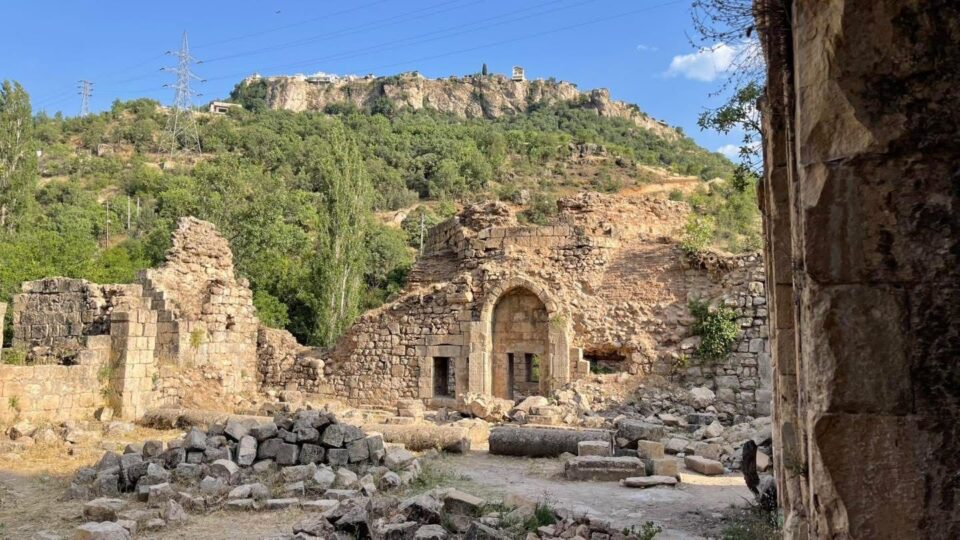
The archaeological site remaining today as the ruins of the Qubahan School served as a university for Kurdistan in past centuries. In those times, Kurdistan was a hub for religious education and the development of Islamic scholars, hosting dozens of high-standard schools, some of which reached a university level of education. However, the Qubahan School stood out among its peers with higher and more distinct characteristics, not only within Kurdistan but across the entire region. Upon its restoration, it is set to become a significant tourism destination in the Kurdistan Region.
Geographical Location of Qubahan
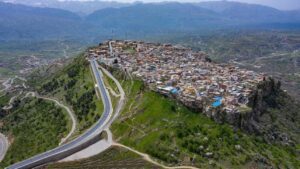
The Qubahan School is located in the town of Amedi in the Duhok Governorate, approximately 70 km east of the city of Duhok. It is an important ancient site situated 500 meters northwest of the Amedi Citadel and 500 meters south of the Solav resort, nestled among gardens and trees. The town of Amedi, which was once the capital of the Badinan Emirate and houses several other archaeological sites, is situated on a mountain plateau within a mountainous region, bordered by the Matin mountain range to the north and the Gara mountain range to the south.
History of Qubahan
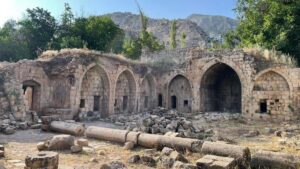
Qubahan holds significant historical value as it recorded a history of progress and science. Sources indicate its construction dates back to the 16th century AD during the reign of Mir Hussein Wali (1534–1576), who ruled the Badinan Emirate. The oldest manuscript from the Qubahan School dates back to 1542 AD, written by Muhammad Mahmoud Bokhti, a native of the Botan region who taught at the school. Qubahan consists of five main sections built on an area of 800 square meters. Education continued actively at the school for over five hundred years until the mid-1960s; however, following the outbreak of war between the Kurds and the Iraqi government during the rule of Abdul Karim Qasim, Qubahan was closed permanently.
Regarding Education and Science
The Qubahan School represents a vital historical and scientific legacy for the Kurdistan Region. Thousands of Kurdish and foreign students from across Kurdistan and the Islamic world flocked to it for knowledge and learning. It maintained ties with schools in Istanbul and Al-Azhar University in Egypt. Subjects taught included Islamic studies, jurisprudence (Fiqh), the Holy Quran, medicine, philosophy, astronomy, mathematics, sociology, and geography. It accepted students from 84 religious schools, and the “Alim” (Scholar) degree was awarded to some graduates. Historical sources suggest Qubahan’s scientific standard was on par with Al-Azhar University, the Mustansiriya School in Baghdad, and Zaytuna in the Maghreb. Based on its structure and architecture, Qubahan was at a university level, possessing various departments and all necessary educational services, including a library and student dormitories. Although some research has been conducted, it requires higher-level scientific research to be given its true scientific due. Hundreds of scholars and mullahs, such as the Ottoman Grand Mufti Abu Saud Imadi, received their degrees there.
The Structure of Qubahan
The famous traveler Evliya Celebi, well-versed in Kurdish social history and structure, visited Amedi in 1656. In his Seyahatname (Book of Travels), he writes: “The Qubahan School consists of 16 domes and 60 classrooms, with approximately 300 to 400 students studying there.” He further states: “I have traveled through Kurdistan for many years, but I have never seen a place or a school like Qubahan, for its courtyard featured specific gardens, flowers, and water springs, making it beautiful and attractive.”
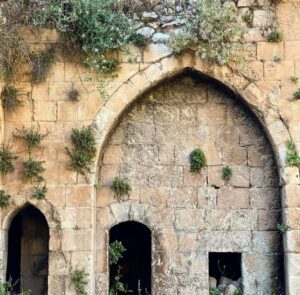
High artistic skill was used in its construction; its walls were built with geometrically hewn stone, and its doors and windows bear the stamp of Islamic architecture. While several walls and remnants remain as a heritage site, the minaret has collapsed, and many of the domes and walls have crumbled to the ground. However, the parts that still stand preserve the significant identity of this monument.
Promotion and Transforming Qubahan into a Tourism Site
Despite the destruction of some of Qubahan’s walls and structures, parts of the walls, rooms, and the site’s layout remain; thus, a large number of tourists visit annually. According to the Duhok Directorate of Antiquities and Heritage, a restoration plan was established in 2023 with the assistance of the French Consulate, which entered the implementation phase in 2025. Upon the completion of restoration, work will be done to promote it and establish it as a tourism site. It will become one of the attractive tourism destinations, standing alongside the Amedi Citadel, the Solav resort, and other archaeological sites, welcoming visitors and significantly influencing the attraction of tourists to the region.