

By Nadir Rusti
In our journey this time, we visit the ancient Shush Citadel and Village, exploring the various sections of this historic site. Shush Citadel is a remarkably rugged fortress situated atop a high mountain, with only one accessible path to the top. At the site, remnants of fortification walls, houses, and pits carved directly into the rock are still visible. Throughout history, it has faced numerous enemy attacks, leading to cycles of destruction and renovation across different eras. The citadel sits at an altitude of 1,106 meters above sea level and requires a one-hour hike from the foot of the mountain to reach the summit. At the base of the citadel lie the ruins of an ancient village, containing temples, houses, man-made caves, and various traces of human craftsmanship on the surrounding stones.
Location of the Citadel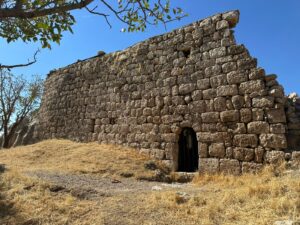
Shush Citadel is located on the mountain range that extends westward from Akre. It sits on a high peak north of Shush Village, approximately 20 km northwest of the city of Akre, 104 km east of Duhok, and 143 km from Erbil. The citadel overlooks the village from its summit, spanning an area of more than 1,000 square meters. Its terrain is irregular, characterized by small hills, large boulders, and oak trees. There are two paths leading from the village to the citadel: one from the east and another from the northwest.
Structure of the Citadel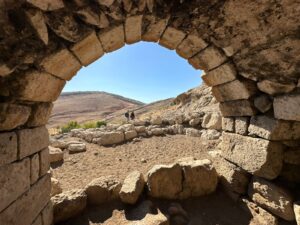
The citadel is situated on an isolated high peak, connecting to the main mountain range only at its northern side, which serves as the primary access point. On the northern side, several sections of the fortification walls remain, reaching heights of 3 meters in some places. Another feature is a large trench—more than 50 meters long, 3 meters wide, and 3 meters deep—carved into the rock. It is believed that this was either filled with water to prevent enemy incursions or used as a water reservoir. The tools and methods used to carve such a massive trench into the mountain in ancient times remain a subject of wonder. This trench separates the citadel from its surroundings; access is granted only through a single entrance designed like a drawbridge, which could be removed during times of defense. The stones of the entrance gateway remain remarkably intact and precisely cut. To the east and west of the citadel are two peaks that served as watchtowers to monitor the surrounding area. The site is rich in natural vegetation, particularly oak and terebinth trees ranging from 3 to 10 meters in height.
Life Inside the Citadel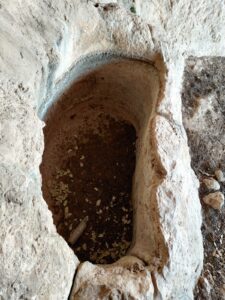
The summit contains ruins of high walls and houses. One particular building consists of two rooms. In one room lies the grave of “Martyr Uriah” (tradition claims he was a soldier from the time of Prophet David; the story of David and Uriah is mentioned in the Islamic, Jewish, and Christian holy books). The second room contains two graves, one of which belongs to Naila Khanum, the wife of Ismail, the Emir of Badinan, who passed away in 1822. Near this building is a cellar with a small door, which some believe served as a prison. Additionally, several pits carved into the rock were used to store water and grain, measuring approximately 2 meters in depth and width. In the eastern section, at the base of a slope, there is a cave containing a natural spring. A rectangular basin (1.5m long, 70cm deep, and 50cm wide) was carved to collect the water. Above the cave is a perfectly circular man-made shaft, 1 meter in diameter and 5 meters deep; it is suspected this was used to access spring water, especially during times of war.
The Ancient Village of Shush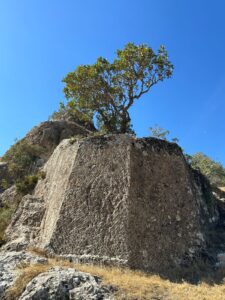
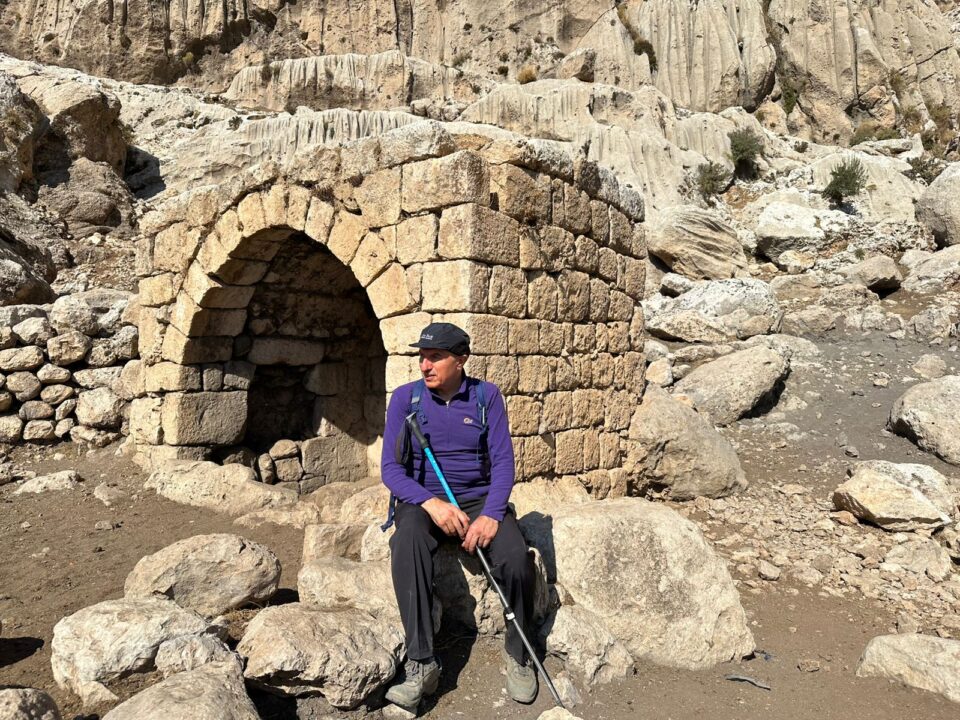
To the east of the current village lies “Ancient Shush,” which houses archaeological remains from Mithraic, Zoroastrian, Jewish, and Christian traditions. The area is scattered with foundations of houses and large stones used for walls. There are numerous man-made caves and rock-carved structures, some appearing to be hermitages or stone tombs (dakhma). While the area holds immense historical significance, it currently lacks proper attention, archaeological excavation, and promotion.
The Temple of the Pagans (Kafaran)
North of the old village, several sites are carved into the mountain. One such carving on the rock face is 10 meters high and 5 meters wide, with remnants of a ceiling still visible; this site is known as the “Temple of the Pagans.” Nearby, a large stone carved into the shape of a chair is referred to as the “Priest’s Chair.”
The Mithraic Temple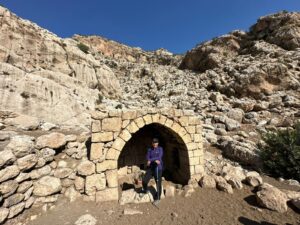
Within the old village, there is a man-made rectangular cave built like a basement. A small one-meter door leads down into a room 7 meters long, 3 meters wide, and 3 meters high. It features a vaulted (arched) ceiling and several niches carved into the walls. Based on research into its dark, underground nature, such chambers were typically used as temples in the Mithraic religion, though experts in the field would need to provide a definitive conclusion.
The Holy Jewish Spring
To the east of the village, in a valley, lies a fresh-water spring. A wall was built around it for protection and shelter. Stone seating was neatly arranged to facilitate the use of the water. While foundations of several rooms exist around the spring, the buildings themselves have collapsed. This spring was considered holy by the Jewish community (the Children of Israel), who performed religious rituals there.
The Jewish Synagogue
Within Ancient Shush, the walls of the Jewish synagogue—known as the Synagogue of Prophet Ezekiel—still stand, along with a spring in front of it. Although the U.S. Consulate allocated a budget for its restoration, the project remains incomplete.
History of the Shush Citadel and Village
Ahmed Salih Shushi published a study in Dirok magazine (Issue 10), noting: “Shush and its citadel faced many enemy attacks. In 115 AD, the Roman Emperor Trajan attacked the region, occupying Akre and Shush and destroying the citadel.” Later, Imad al-Din Zengi also attacked Akre and Shush, destroying its fortifications. According to some sources, Mir Zend later rebuilt the citadel and its walls and restored the water supply, but it was subsequently destroyed by the leader of the Aq Qoyunlu. During the era of Sultan Hassan Beg, the citadel’s walls were renovated once again.