
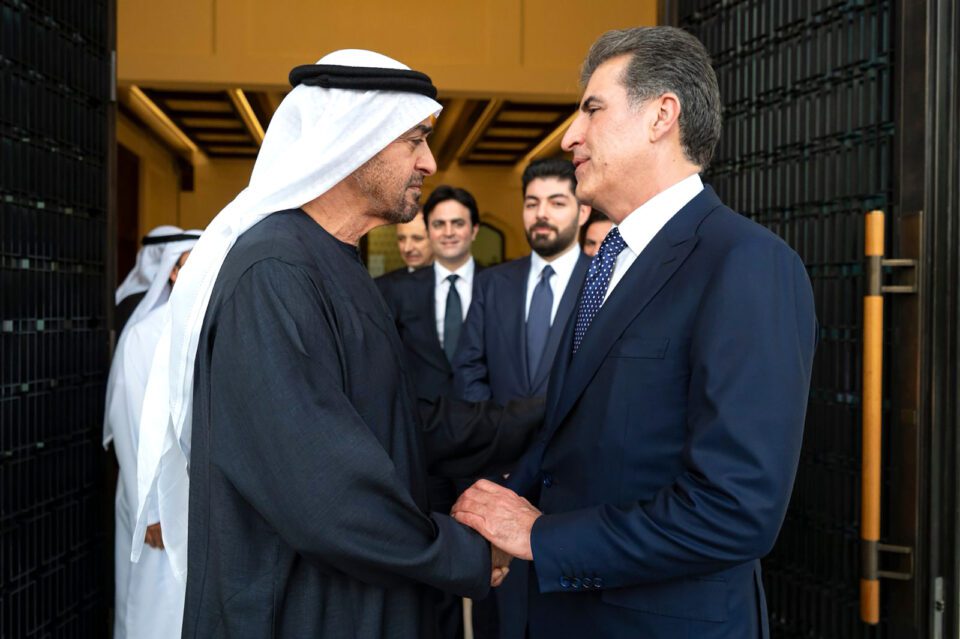
Kurdistan Region President Nechirvan Barzani arrived in Abu Dhabi on Wednesday, April 29, on an official visit to the United Arab Emirates, following an official invitation from UAE President Sheikh Mohammed bin Zayed Al Nahyan. The visit culminated on Thursday with a high-level summit that brought the two leaders together to reaffirm and deepen the ties binding Erbil, Baghdad, and Abu Dhabi.
A Meeting at the Heart of a Turbulent Region
UAE President Sheikh Mohammed bin Zayed Al Nahyan received President Nechirvan Barzani for talks that covered cooperation between the UAE and the Republic of Iraq, including the Kurdistan Region, and ways to expand it in a manner that supports mutual interests and benefits both peoples. According to the Kurdistan Region Presidency’s own statement, the meeting focused on strengthening ties across various sectors to advance the interests and development of both sides, and the two leaders exchanged views on recent regional developments and their implications for security and stability at both regional and international levels, stressing that sustained cooperation and stronger coordination are essential to preserving peace and countering emerging threats.
Nechirvan Barzani described the atmosphere of the talks in warm terms. Writing on X, he said he was “delighted to meet my brother” Sheikh Mohammed, noting they had “discussed the state of relations between Iraq, the Kurdistan Region, and the UAE, and exchanged views on the impact of regional developments,” and that both sides had “emphasized the importance of reinforcing cooperation to promote stability and security across the region.”
The meeting was attended by Sheikh Khaled bin Mohamed bin Zayed Al Nahyan, Crown Prince of Abu Dhabi; Lt. General Sheikh Saif bin Zayed Al Nahyan, Deputy Prime Minister and Minister of the Interior; and Sheikh Hamdan bin Mohamed bin Zayed Al Nahyan, Deputy Chairman of the Presidential Court for Special Affairs, along with a number of sheikhs, ministers, and officials.
The UAE’s Emirates News Agency (WAM) reported that discussions focused on ways to develop and expand cooperation to bring prosperity and growth to the two brotherly peoples, adding that the meeting also involved an exchange of views on regional developments and their implications for regional and international security and stability.
A Partnership Tested — and Strengthened — by Crisis
The visit carries special weight in light of the turbulent backdrop against which it took place. The meeting follows recent attacks on the UAE consulate in Erbil during the US–Israel–Iran war, which injured two security guards and damaged the building. The UAE Ministry of Foreign Affairs called on the Iraqi government and the Kurdistan Regional Government to investigate the attacks, prosecute those responsible, and reaffirm the protection of diplomatic missions in accordance with international legal standards.
The UAE consulate in Erbil is one of the most prominent diplomatic missions in the region and plays a vital role in strengthening economic and investment ties between the UAE and the Kurdistan Region of Iraq. Despite the security incidents, both sides signaled that their partnership would not be derailed. Kurdistan Region Prime Minister Masrour Barzani had already spoken by phone with UAE President earlier in March, condemning the drone attack on the consulate and stressing that “the attacks are unacceptable and won’t deter us,” while the UAE President expressed appreciation for the KRG’s strong coordination.
The relationship between the UAE and the Kurdistan Region has steadily deepened over the past decade, evolving into a multifaceted partnership encompassing trade, investment, and political cooperation. Emirati companies have played a growing role in sectors such as energy, infrastructure, and real estate within the Kurdistan Region, while bilateral exchanges have expanded at both governmental and institutional levels. Politically, the UAE has maintained consistent engagement with Kurdish leadership, viewing the Kurdistan Region as a stable and strategically important partner within Iraq.
The UAE is considered one of the Kurdistan Region’s top three economic partners, alongside Turkey and Iran. That standing lends particular significance to the Abu Dhabi summit, which analysts see as a signal that both sides intend to deepen economic and energy cooperation at a moment when the region is being reshaped by conflict and geopolitical realignment.
The timing also highlights Abu Dhabi’s broader strategic recalibration, as it seeks greater autonomy over its energy policy and production levels amid ongoing regional instability, further underscoring the significance of high-level engagements such as the Barzani–Mohammed bin Zayed talks.
For the Kurdistan Region, strengthening ties with the UAE offers a vital channel of investment and diplomatic support as it navigates an increasingly volatile neighborhood. For Abu Dhabi, Erbil represents a reliable and stable partner within Iraq — one that shares its concerns about the destabilizing influence of armed groups throughout the region.
By Jawad Qadir