
By Younes Mohammad
For two weeks, I had been moving without pause along different front lines, from one trench to another, from dusty roads to open fields that still carried the smell of burning. The days had blurred into each other, the nights had lost their shape, and time no longer moved the way it used to, it stretched, heavy and slow. I had seen so much that my eyes no longer knew how to be surprised, explosions, running, shouting, and the heavy silences that followed had all merged into a single rhythm that echoed inside me. The smell of gunpowder was no longer just in the air, it had settled in my chest, in my throat, in every breath I took. Sometimes I felt that if I spoke, dust would come out instead of words. The fatigue was no longer just in my body, it had settled deeper, in my thoughts, in the way I looked at things, like a layer I could not peel away. And fear was no longer sharp and sudden, it had become quieter, heavier, like a shadow that walks beside you and rests its weight on your shoulders without ever making a sound.
It was during those days that the news began to take shape, first as whispers, then as something more certain, until it became clear that Sinjar was going to be freed. Sinjar was not just a place to me, I had spent time in its surroundings before, sat in nearby trenches, met people who had fled from it, people whose eyes still carried what they had seen. Their stories had stayed with me, unfinished, waiting for an ending. I was exhausted, more than I cared to admit, my body wanted rest, my mind wanted silence, but something inside me would not let me stay. There was a quiet certainty that if I did not go, if I was not there, I would miss one of those moments that history creates only once. So I went, with the same exhaustion and the same heavy breath, toward Sinjar.
The city was freed, but freedom on the front line never looks the way you imagine it. Even joy moves carefully there, as if it is not sure it is allowed to stay. Outside the city, trenches had been carved into the earth and defensive lines drawn in dust and soil, and the fighters, exhausted but alert, watched the darkness, knowing that anything could return from it. On the first night after the city was freed, the air hovered between darkness and light, not quite night and not yet morning, and it was in that uncertain hour that something appeared in the distance. At first, it was only movement, something barely visible, then shapes, dark patches separating themselves from the horizon. As we kept watching, they grew clearer, a loose column, some vehicles among them, people moving on foot, a faint trail of dust rising behind them. No one spoke, but everyone was thinking the same thing, an attack. Hands tightened around weapons, breathing grew shallow, and time seemed to stretch even further.
Warning shots broke the silence and the sound echoed across the open land. The movement slowed, then stopped, and in that pause something shifted. There was no rush toward us, no chaos, no signs of an assault we had learned to recognize. A few figures stepped forward slowly with their hands raised, more warning shots were fired and they froze where they stood. A small group of fighters moved toward them, and from a distance the two sides met, their shapes blending into one. When the fighters returned, the answer came with them, these were not enemy fighters, they were villagers, people who had fled from ISIS and moved together through the night until they reached us, without knowing they had arrived at another edge of war.
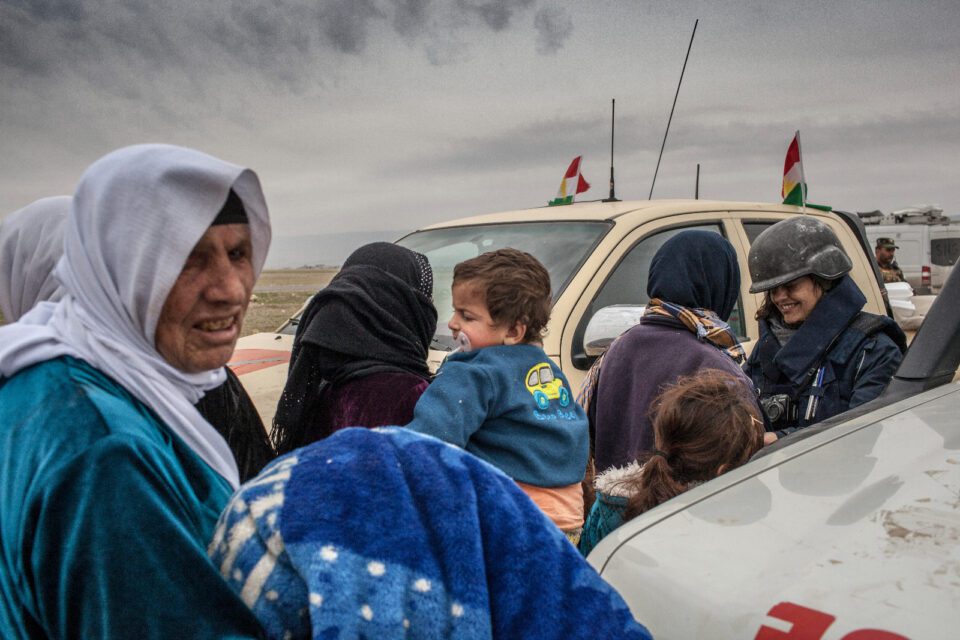
They remained there until daylight, distance was kept for their safety and ours. Some fighters moved closer, bringing blankets and staying with them through the remaining hours of darkness. As the light grew, faces emerged from the shadows, women, children, elderly, hundreds of them, exhausted, hungry, but alive. Bread was passed among them, water followed, and for a brief moment something softer moved through the air, something that almost felt like relief. But war does not loosen its grip so easily. They had to be searched, all of them, not out of distrust but out of necessity. In war, danger does not always announce itself, it hides, sometimes among those who are themselves escaping it. The men were separated and searched, a few were identified and taken aside. Then it was the women’s turn, and everything slowed again.
There were no female fighters on that line, and time grew heavier. The sun was rising, and with every passing minute the risk increased. In daylight, a gathering like this could easily become a target, it would not take much, a few mortar strikes, and it would all be over. No one said it out loud, but everyone felt it. And then she stepped forward, a woman with a helmet and a camera still hanging from her neck. She had been there to witness, to document, but in that moment witnessing was not enough. She said she could help, and without hesitation she began. One by one, the women and girls stepped forward, and she searched them carefully and patiently, without rushing, without adding to their fear. With each person who passed, it felt as if a small distance was placed between them and death, a child in her mother’s arms, an old woman walking with effort, young girls who did not yet understand how close they had come, they crossed, and they kept crossing.
I stood there with my camera in my hands, but for the first time in many days I felt that some moments are not meant only to be captured, they are meant to be understood. That morning, for a few hours, the war stepped back, not because of fire, not because of orders, but because of the quiet courage of a single human being. And now, every time I look at that photograph, at the woman beneath the helmet, at the child, at the crowd suspended between fear and hope, I remember that morning, a morning when, in a place where everything could have ended, life quietly and stubbornly found its way forward.