

By Younes Mohammad
He was waiting outside the house, a thin man leaning on crutches in a narrow alley that felt more like a corridor of a shelter than a neighborhood. His face was still young, but his eyes carried something older, the look of someone who had seen death once and never fully returned. I had not even greeted him when my gaze dropped to his legs, or rather to the absence of the life ISIS had taken from him. Later I learned he had been shot twice during a mass killing and survived, as if even death had made a mistake.
It had taken days to find him, and even longer to convince him. “It is better if you do not see my sister,” he kept saying. But I had come for her story, the story of a Yazidi girl who had escaped ISIS and returned from what felt like another world still breathing.
Their neighborhood lay on the edge of the city. The houses looked more like makeshift bunkers than homes, damp walls, low ceilings, mattresses on the floor, windows that had long forgotten sunlight. People here did not really live; they survived. His brother stood at the door and gave me one last warning. “It is your responsibility,” he said quietly, then went inside to call her out.
I stood outside with a camera on my shoulder, already carrying images that had not yet happened. I thought I was there to document a story, to witness something the world preferred not to see. I did not know I was about to become part of it. The slap came without warning. It was so hard that for a moment everything went white. She stood in front of me, young in face but ageless in expression, screaming words I could not fully understand. I did not need translation. The anger needed no translation. It had been waiting long for that moment, and it landed on my face.
Her brother pulled her back inside. Minutes later he returned, exhausted. “I told you it was not a good idea,” he said. But she came out again and again and the last time she came out, she was quieter, but the fire had not left her eyes. “You Muslims were never safe for us,” she said. “Every day you brought us a new disaster.” There was no immediate answer to that. Only silence. When I finally spoke, I told her not everyone was the same, that I too despised ISIS, that we were also wounded by it. I told her I had come because her story might show the world a fragment of a darkness that had sold human beings, turned women into currency, and corrupted even the idea of faith itself.
Slowly, she sat down and began to talk. She spoke of markets where she was sold like property, of men who recited verses before committing violence, of nights she prayed would not turn into mornings. She spoke of girls who never returned, and of fear that still lived inside her body even after escape. Sometimes she cried. Sometimes I did. At times I could not meet her eyes. It felt as if she carried not only her own memory, but the weight of everyone who had been erased, and that all of it was now passing through this small room.
When she finished, silence filled the space, heavy and unmoving. Then she came closer, hugged me, and kissed my face. She whispered something like an apology for the slap. But I was never angry about it. If ISIS had killed my mother, violated my sisters, and burned my future, I might have done the same to the first man standing in front of me. Some slaps do not hurt. They wake you up.
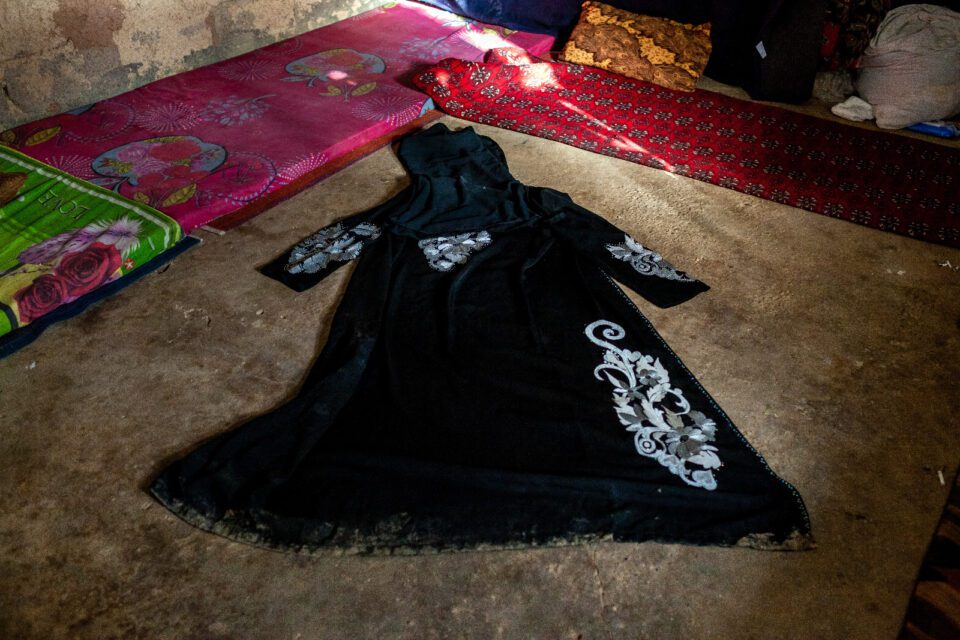
She left the room and returned a few minutes later carrying a black veil. It was the same one she had worn when she escaped Mosul. Dusty, worn, stained with time. She held it carefully, as if it were the last fragment of her survival. “I never wash it,” she said. “It saved my life.” She spread it on the floor. It lay there like a trace of another existence, still carrying the memory of fear, sweat, and escape.
I asked her if I could photograph the veil instead of her face. She agreed. And that image became the portrait of a girl who carried her entire war in silence, and whose anger finally spoke in a single slap. An image I still return to. And each time I do, the sting returns to my cheek, and shame settles quietly over memory like something that never fully dries.