
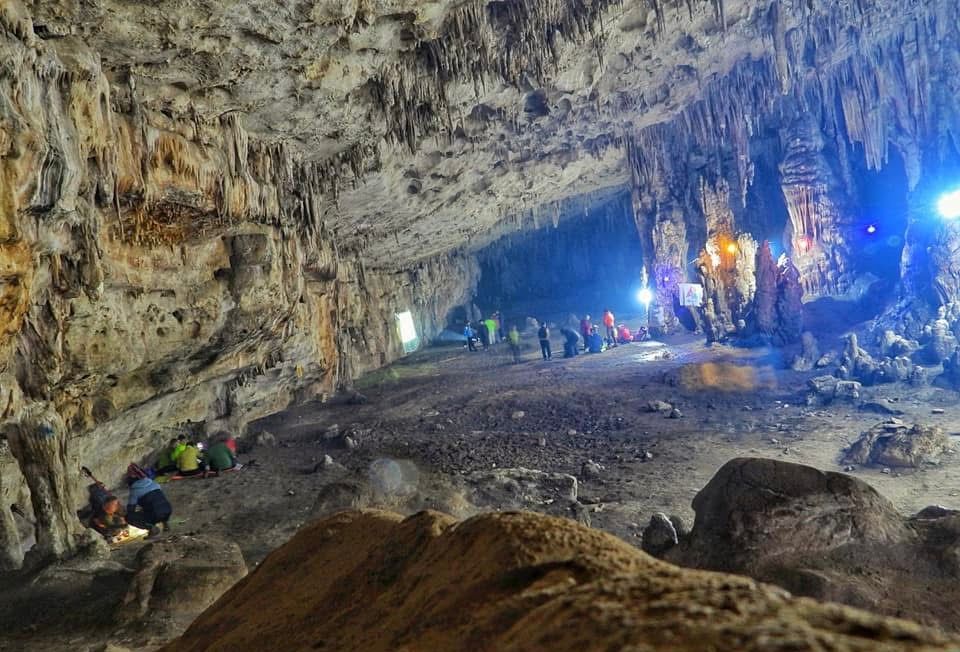
The nature of the Kurdistan Region has gifted it with dozens of caves; some are famous for their historical and archaeological significance, while others are unique for their stunning geological formations. Throughout different eras, these caves have served as homes, shelters, and even tactical strongholds for the Peshmerga during the Kurdish revolutions. In my travels, I will describe several of these rare caves for you. Bastoon Cave is one of those that stands out for its extraordinary natural structure and scenery, making it a prime destination for mountaineers and tourists alike. I have traveled there three times, twice with mountaineering groups. In this article, I will introduce Bastoon Cave to you.
Location of Bastoon Cave
The cave is located within the Soran Independent Administration in Erbil Governorate, situated on the middle heights of the Bradost Mountain range (the peak of which reaches 2,058 meters above sea level). To the north, the mountain range overlooks the town of Soran and its surroundings, as well as the Mergasor area. To the south, it overlooks the Biaw and Khalan valleys, several villages in the Khalifan district, and parts of the Surchiayati and Barzan regions. It is approximately 35 km from the city of Soran and 125 km from Erbil, the capital of the Kurdistan Region.
How to Reach the Cave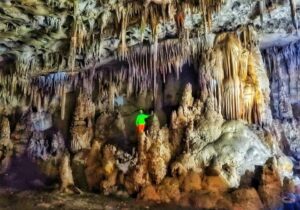
Tourists can reach Bastoon Cave via two routes. The first is from Erbil to the Khalifan district; at the end of the Spilik winding roads, take the road toward Barzan to the village of Khalan, and then ascend the Bradost Mountain through several turns. The second route is from Erbil to Khalifan and then through the Gali Ali Beg canyon; at the end of the canyon, turn left toward Mergasor until you reach the village of Haoudian, then turn left again to ascend the mountain. The first route is closer when traveling from Erbil, while the second is closer when coming from Soran. The villages of Khalan and Upper Hanara are on the southern side of the mountain, while Haoudian is the closest village on the northern side. The cave is located directly on a paved road, meaning you can drive right up to the entrance. Every year, dozens of mountaineers and tourists visit to witness the cave’s beauty.
Structure of Bastoon Cave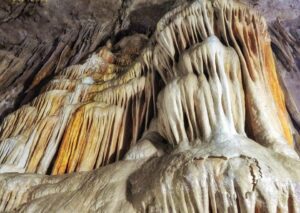
Bastoon is considered the largest, deepest, and most beautiful cave in Erbil Governorate, particularly within the Soran Independent Administration. The entrance is low and rectangular, with a height ranging from 100 cm to 180 cm and a width of about 6 meters. Due to its depth and vastness, the cave is divided into several sections.
Section One:After passing through the entrance, you enter the first section, which is naturally lit. This area is very spacious, resembling a large cinema hall. About 15 meters in, on the right side of the ceiling, there is a large hole that lets in light and allows smoke from fires to escape. The ceiling at this point is over 20 meters high. The combined light from the entrance and the ceiling hole fully illuminates this first section. Based on remains found here, this part was used for living and shelter; it looks like a typical large cave.
Section Two:This section is much wider, with the ceiling reaching 7 meters in some places. It is estimated to be 40 to 70 meters wide and 100 meters deep (noting that dimensions vary throughout). This part is dark, very damp, and wet. Water drips from many spots on the ceiling, leading to the formation of stalactites and stalagmites. Some areas are just damp, while others have visible water that has created small springs and pools on the floor. This section features various beautiful and high-quality crystals and pillars formed by accumulated lime deposits. Due to the abundance and size of these pillars, the cave splits into different chambers in some places. This area feels like a natural art gallery filled with creative and breathtaking scenery.
Section Three:Located to the right, this section is similar in size and beauty to the second. It is warm in winter and cool in summer. It contains both dry and damp areas. As you go deeper, the ceiling gets lower until it ends in small openings. (I traveled only to this point); according to available information, this marks the end of the cave’s main accessible path.
Section Four:At the end of the second section, on the left, the cave drops vertically into a deep chasm. This part is very dangerous; without proper care and good lighting, one could fall and be unable to climb back up. To explore this section, ropes are required. According to mountaineers from the “Lutka” group who have descended, it is about 8 meters deep and 50 meters long. (I have not seen this part myself and did not go further). To this day, the total depth of the cave system remains unknown.
Vandalism and Damage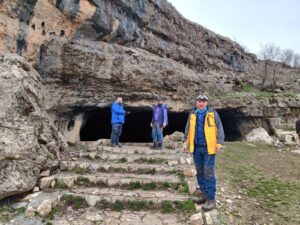
As mentioned, the first section has been used as a shelter, and fires built during cold weather have blackened the ceiling and walls. While this is somewhat expected, parts of the second and third sections have suffered from vandalism. Some visitors have tampered with or broken the ancient limestone pillars and crystals, damaging the cave’s natural beauty. This natural process took thousands of years to create these scenes, yet they have been harmed by the lack of awareness of some visitors. While some damage is old, some is recent; it is essential to prevent this uncivilized behavior.
Developing Bastoon as a Tourist Site
In many tourist-oriented countries, caves like this attract thousands of visitors, and governments provide services such as lighting, walkways, rest areas, and protection. In 2009, the Barzan Youth Development Organization built stone stairs from the paved road leading up to the cave entrance. Although the cave is included in the Board of Tourism’s plans, no practical steps have been taken yet. Recently, the Kurdistan Regional Government included Bastoon Cave in the Soran District Tourism Master Plan. Therefore, it is expected that services will be provided in the near future so that tourists can visit and appreciate its fascinating scenery comfortably. The site could be turned into a resort with overnight accommodation and rest facilities. It is also worth noting that another cave in the area, Dian Cave, is located near Bastoon and features equally stunning scenery.
Archaeology and History
From a historical perspective, some sources state that in 1934, the researcher Dr. Henry Field visited this cave on behalf of Harvard University to look for archaeological remains. He conducted excavations for 10 days, discovering several stone tools, pottery shards, and bones dating back to the Stone Age. The excavations revealed that humans did not live in either Dian or Bastoon caves during the Paleolithic or Mesolithic eras. Dr. Henry believes the pottery and stone tools found belong to hunters who visited the area during the Neolithic, Chalcolithic, and Bronze ages, bringing food in jars and staying for only a few days at a time.
By: Nadir Rosti