
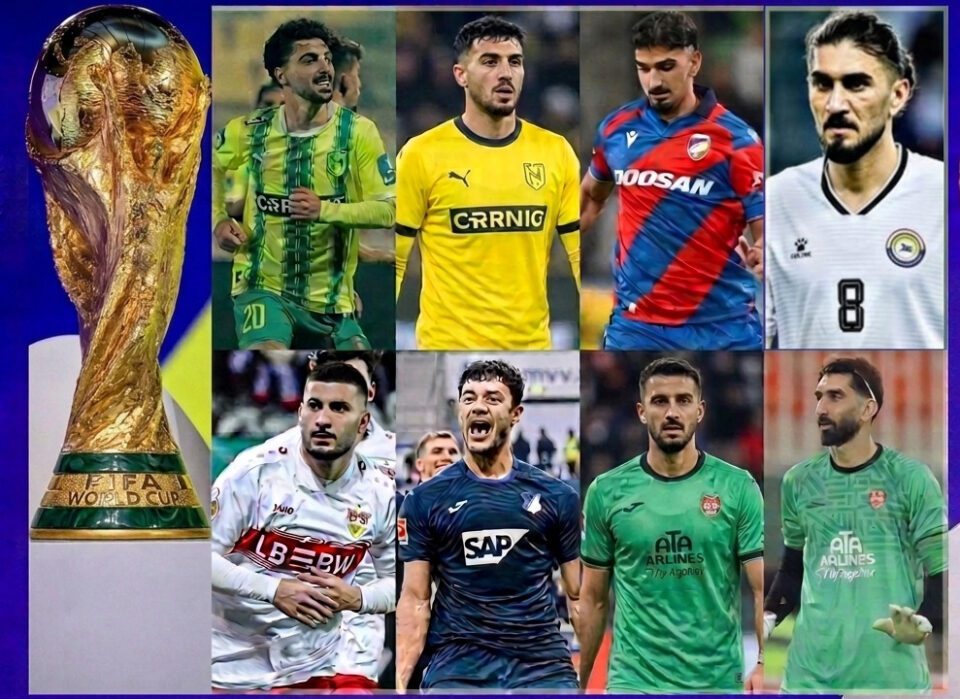
Several footballers of Kurdish heritage will represent Iraq, Germany, Turkey, and Iran, bringing Kurdish visibility to football’s biggest stage despite the absence of a Kurdish national team.
bringing Kurdish visibility to football’s biggest stage despite the absence of a Kurdish national team.
As the 2026 FIFA World Cup begins across Canada, Mexico, and the United States, a remarkable story is unfolding beyond the competition itself. Several footballers of Kurdish heritage are taking part in the world’s biggest sporting event, representing four different countries and bringing unprecedented visibility to a people who, despite numbering more than 40 million, do not have their own state competing on football’s grandest stage.
From Iraq to Germany, Turkey, and Iran, Kurdish players will step onto World Cup fields wearing different jerseys, singing different national anthems, and pursuing different dreams. Yet for many Kurds around the world, their presence carries a shared meaning that transcends borders.
Iraq leads the Kurdish representation following its historic return to the World Cup for the first time in 40 years. The squad includes Kurdish players Merchas Doski, Youssef Amyn, Akam Hashim, and Marko Farji, all expected to play important roles in Iraq’s campaign.
The final squad announcement, however, was not without controversy. Some fans expressed disappointment after Kurdish defender Dario Naamo was left out of the final 26-man roster despite recently switching his international allegiance from Finland to Iraq and participating in the team’s World Cup preparations. His omission sparked discussion among supporters who had hoped to see the young defender represent Iraq on football’s biggest stage.
Among Iraq’s Kurdish stars, Zakho-born defender Merchas Doski has already captured international attention. Just days before the tournament, he scored a stunning equalizer against European champions Spain, helping Iraq earn a memorable 1–1 draw in a World Cup warm-up match.
Doski’s confidence reflects the belief growing within the Iraqi squad. Before qualification, he told FIFA: “Whoever is on the other side of the pitch should be scared of us, not the other way around.”
Germany’s squad includes Deniz Undav, whose rise from lower-division football to the World Cup has inspired fans across Europe. Turkey is represented by experienced defenders Zeki Çelik and Ozan Kabak, while Iran’s hopes rest in part on veteran goalkeeper Alireza Beiranvand, one of the most accomplished goalkeepers in Asian football.
Together, these players represent something larger than football. Although Kurdistan does not have its own team competing at the FIFA World Cup, Kurdish athletes are nevertheless present on the world’s biggest sporting stage. Their journeys reflect the reality of a people whose homeland spans several countries, yet whose cultural identity remains strong across borders.
For millions of Kurdish fans watching from Erbil, Sulaymaniyah, Duhok, Diyarbakir, Mahabad, Kermanshah, Europe, North America, and beyond, every save, tackle, pass, and goal carries special significance. Each appearance serves as a reminder that Kurdish talent has reached the highest levels of world football. When the tournament begins, these players will represent different nations. But for many Kurds around the world, they will also represent a shared story — one of perseverance, identity, and pride on football’s greatest stage.