
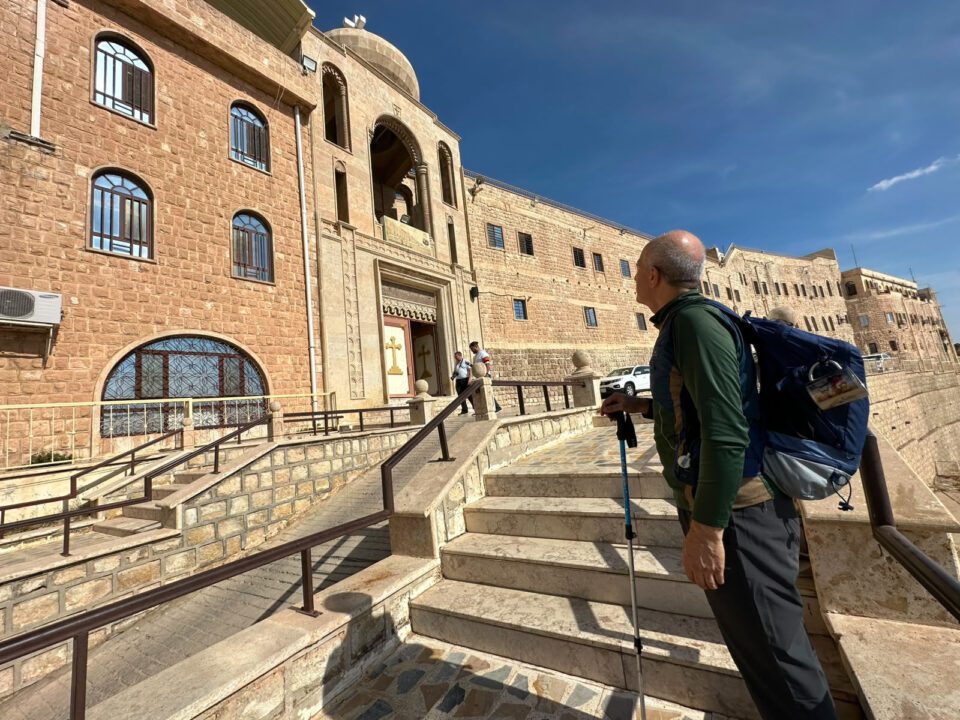
The Kurdistan Region is home to many significant historical and natural sites. Although they have not been adequately promoted, they still attract thousands of visitors annually. The delicate St. Matthew’s Monastery (Dayr Mar Mattai) on Mount Maqlub is one of those vital historical and religious landmarks. Built on the heights of the mountain between 361 and 363 AD, it consists of several important sections. It is the oldest monastery in Iraq and one of the oldest Christian monasteries in the Middle East. In this journey, we introduce you to the site and share some key facts about it.
Location of Mar Mattai Monastery
St. Matthew’s Monastery is situated on the heights of the Mount Maqlub range (also known as Mount Alfaf), overlooking several villages in the plains below. The nearest village at the foot of the mountain is Merga, and the nearest town is Bardarash, both located within the Kurdistan Region. Mar Mattai is a Syriac Orthodox monastery located in the Goraneti area on the slopes of Mount Maqlub at an altitude of 839 meters on the southern side of the mountain. The highest peak of the mountain reaches 1,064 meters. The monastery is 18 km from Bardarash, 90 km from Erbil, 70 km from Duhok, and 35 km from the city of Mosul.
There are two ways to reach it: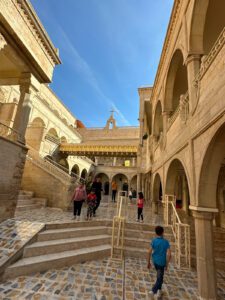
1. The Old Route: A pedestrian path starting from Merga village that ascends through 32 winding switchbacks over a distance of 1,300 meters. Stone steps have now been constructed for this path.
2. The New Route: A paved asphalt road that allows vehicles to drive directly up to the monastery.
Structure of Mar Mattai Monastery
1. The Ancient Section
The old part of the monastery is located above and behind the new building. It consists of two parts. The oldest contains several caves carved directly into the mountain rock. There are three small caves (approx. 2m x 3m and 2m high) which served as cells for monks to worship in solitude. A fourth cave, over 10 meters long and 3 meters wide, is divided internally into seven compartments. It is believed to have served as a classroom or religious school. Nearby, one can find ancient stone basins used for grinding grain and pressing fruit for juice. Another part of the old monastery, dating back to 363 AD, features stone-stacked walls preserved as an archaeological site. This section houses the shrine of St. Matthew and other religious leaders.
2. The Modern Section
The front section, which is currently in use, is a large three-story building comprising guest rooms, religious facilities, and service areas. The facade features a modern design with a large dome over the main entrance. The complex centers around a long rectangular courtyard (over 60m long and 6m wide), surrounded by 63 guest rooms and 10 rooms for bishops and monks. The total area exceeds 5,000 square meters. From its vantage point on the mountain, it overlooks the villages of Merga, Baraka, Alfaf, and Maghara, as well as the Mount Zark and Bashiqa ranges. The complex includes a church, prayer areas, event halls, a library, administrative offices, an overnight motel, and a restaurant. A large plaza for parking and religious ceremonies has been built adjacent to the monastery.
The Story of St. Matthew the Hermit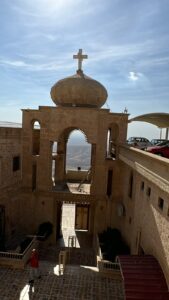
Mar Mattai was a renowned monk of the 4th century, originally from Amida (modern-day Diyarbakir) in Northern Kurdistan. Fleeing Roman persecution of Christians, he traveled east and sought refuge in a cave on Mount Maqlub for worship. His reputation for holiness and piety reached the King of Mosul. According to Syriac tradition, it is said that Mar Mattai healed the king’s daughter from a severe illness. In gratitude, the king assisted him in building this monastery on the mountain.
Protection by the Peshmerga Forces
The monastery has been attacked and destroyed several times throughout history, only to be renovated each time. During the war against ISIS (2014-2017), the monastery was in a precarious situation, as ISIS forces were only 5 km away and threatened to demolish it. However, the Kurdistan Peshmerga forces successfully protected it. It remains under the control and protection of the Peshmerga today.
Why is Mar Mattai Important?
St. Matthew was a famous Christian ascetic, and his tomb is now a major pilgrimage site. Every year on September 18th, Christians of various denominations gather to commemorate his death. The monastery has produced hundreds of prominent Christian leaders recognized worldwide, including three global Patriarchs: Patriarch Georgis II, Patriarch Isaac, and Patriarch Jacob III. Many clergy educated here have held high-ranking positions across the globe. Historically, the monastery possessed a rich library with thousands of manuscripts; unfortunately, many were lost to a great fire in 480 AD, and others were destroyed in various wars. It remains a vital religious school and continues to train religious leaders today.
Tourism Perspective
Due to its unique structure and historical depth, Christians from all over visit during religious holidays, while Orthodox followers visit year-round. Specific tribes within the Iraqi Orthodox community have dedicated areas within the monastery for their stay, making it a viable overnight destination. Foreign tourist groups are often eager to see the site, often finding it through word-of-mouth or unofficial guides. Within the Kurdistan Region, mountaineering groups and citizens of all faiths visit for its scenery and history. The administrative board is very welcoming to guests, providing hospitality that leaves a lasting impression on visitors.
Challenges in Promotion
1. Administrative Status: Because it administratively falls under the Mosul Governorate, it is often excluded from the Kurdistan Region’s official tourism guides and maps.
2. Lack of Information: There is a scarcity of centralized information regarding its religious, historical, and tourism significance.
3. Lack of Specialized Agencies: There are no specialized companies in the Kurdistan Region focused on bringing international tourists to religious shrines and sites.
4. Neglect of Religious Tourism: Religious tourism is not prioritized as a major sector within the Region.
5. Missed Opportunities: The Region has not fully capitalized on the potential to bring European tourists to this and other sacred sites located both within and just outside the official Kurdistan Regional Government administration.
By: Nadir Rosti