
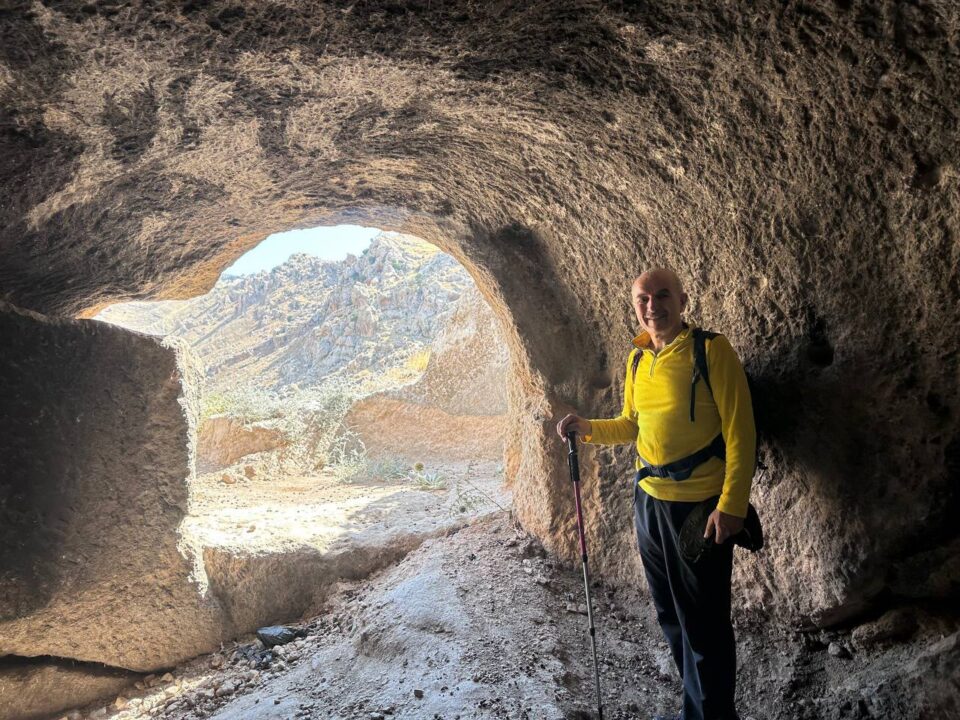
Akre is an ancient historic town distinguished by its breathtaking and captivating scenery. Renowned as the capital of the Newroz festival, Akre and its surrounding areas boast dozens of cultural and archaeological sites that trace back to various religions and historical epochs. Additionally, owing to its natural tourist attractions—such as the Sipa Waterfalls, Kani Zardak, archaeological landmarks, and the warm hospitality extended by its locals—thousands of tourists visit Akre every year. Despite its tourism potential remaining largely underutilized relative to its rich archaeological significance, this journey aims to unveil this rare archaeological and civilizational treasure of the Middle East to readers.
The Significance of Akre Citadel
I have ascended to Akre Citadel multiple times and explored its archaeological remains, uncovering remarkably rare and distinctive ruins unseen anywhere else in Kurdistan or Iraq. The citadel preserves the remnants of diverse eras, civilizations, and faiths. What remains visible is entirely carved into the solid rock, bearing the indelible mark of thousands of days and decades of dedicated human labor.
The citadel overlooks an energetic, historic, and heritage-rich town known for dozens of traditional crafts and exceptional agricultural produce. A significant portion of the town preserves its ancient urban fabric, where pack animals such as donkeys are still utilized to transport goods to homes, and narrow alleys are flanked by stone houses stacked atop one another ascending the steep mountainside. To facilitate visitors’ ascent and ease the annual Kurdish Newroz celebrations, stairs have been constructed leading up to the fortress. During our climb to the top of Akre Citadel, we visited several archaeological features and witnessed numerous intriguing structures and views.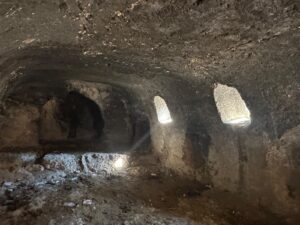
Geographical Location
The town of Akre is situated in the southeastern part of Duhok Governorate, located 120 km from Duhok city, 94 km from Erbil, and 95 km from Mosul. It nestles at the foot of the Akre Mountain range, which forms part of the Zagros Mountains. Akre Citadel crowns a high peak in the northern section of the town. Reaching the citadel on foot from the heart of Akre requires a hike of over 30 minutes.
Structure of Akre Citadel
The summit of Akre Citadel features a flat, expansive plateau roughly rectangular in shape, with each side measuring approximately 110 meters (yielding an area of roughly 12,100 m²). Across this expanse lie diverse archaeological features:
The citadel’s main gateway.
15 rock-cut pits and cisterns/wells.
The Prince’s Throne (Takhti Miri).
Two Zoroastrian fire platforms.
A stone-crafted water channel.
On the citadel’s right wing: multiple rock-hewn passages, terraces, chambers, cavities, and platforms.
In the center: a rock-cut corridor and gallery measuring 25 meters long, 6 meters deep, and 3 meters wide.
To the left of the corridor: an entrance penetrating the mountain into a spacious chamber (8m long, 4m wide, 3m high) fitted with 4 light apertures (skylights) and multiple niches; this is known as the Palace of Mir Zand.
On the left side: an immense rock-carved water reservoir measuring 7 meters long, 4 meters wide, and 4 meters deep, surrounded by carved rock terraces, a wine press, small pits, and niches.
On the northern facade: two large water reservoirs carved into the mountain, a rock-cut shrine and pulpit, and a tunnel-like passage known as the Northern Gate.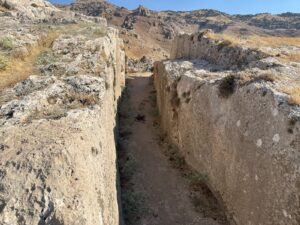
Along the northern flank: a stone aqueduct spanning over 500 meters that once channeled water from a nearby peak of Akre Mountain into the fortress.
In the northeastern subterranean section: a subterranean Mithraic temple carved into the living rock, measuring 45 meters long, 4 meters wide, and 3 meters high. Deep within the temple, 12 stone steps lead up to a narrow cavern. At the center of the temple, a skylight aperture was carved through 4 meters of solid rock with a width of 1 meter to illuminate the interior. This temple has historically been referred to as the “prison,” and its portal is sculpted in the shape of a falcon’s head.
Surrounding the fortress are numerous caves and rock-cut cavities.
All of these features were masterfully carved into the living bedrock with superior craftsmanship. We will explore each of these vital components in greater detail in future pieces.
Akre: A Historic Name
Several hypotheses explain the etymology of the name “Akre.” The most prominent theory suggests that “the name Akre is derived from Agir (fire).” Akre historically served as a major center for both Mithraism and Zoroastrianism, both of which accorded sacred and central significance to fire in their religious practices and rituals. Consequently, Agir evolved phonetically into Agri, and ultimately into Akre, bestowing its name upon this remarkably picturesque town.
Which Civilization Flourished at Akre Citadel?
Definitive historical documentation concerning the citadel’s earliest origins remains scarce. Because the majority of its structural elements are carved directly into rock and bedrock rather than built with standalone stone masonry, any above-ground palaces or defensive walls may have deteriorated, or their stones were repurposed over centuries for domestic construction within the town below.
Some archaeological perspectives contend that Akre Citadel was initially purely a religious sanctuary—serving as a Mithraic temple (circa 3,500 years ago) or a Zoroastrian temple (circa 2,800 years ago)—with no residential palaces, where only sacred worship chambers and sanctums were hollowed out of the bedrock. Over successive eras, these identical rock-cut chambers were adapted for diverse uses within a fortified defensive structure. In other words, it likely originated as a Mithraic sanctuary, evolved into a Zoroastrian place of worship, later transitioned into a fortified stronghold for Kurdish princes, and, following the spread of Christianity in the 4th century CE, saw certain sections converted into monastic hermitages and churches. Throughout its history, the fortress likely withstood recurring invasions and destruction, leaving behind primarily the bedrock-carved elements that survive to this day.
Akre Citadel from a Tourism Perspective
Archaeological sites serve as vital pillars for tourism development, especially when remarkably preserved, rare, or reflecting advanced artistry. Akre Citadel encompasses over 20 distinct and rare archaeological features, standing as an extraordinary open-air monument.
Upon visiting and exploring these features, tourists are transported into another era, witnessing firsthand the sheer fortitude and refined artistry of ancient humans—skills and stoneworking capabilities that in many respects rival or elude our modern era. The ruins of Akre Citadel are readily poised to welcome tourists; however, there is an urgent need for coordinated efforts between archaeological and tourism authorities to oversee the site. Essential requirements include the installation of appropriate lighting, cleaning the temple chambers, curating and organizing features based on historical chronology, producing interpretive guidance, establishing ongoing site maintenance, and providing tourist amenities.
Nader Rusti