
Younes Mohammad
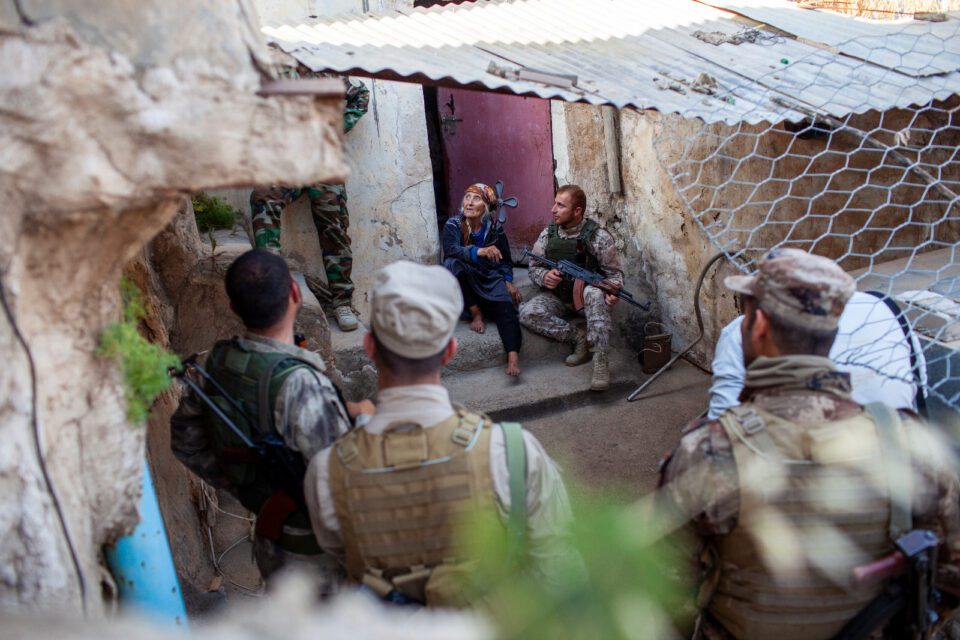
The first time I met her, she opened the door barefoot. Several Peshmerga fighters had accompanied me, and she had heard us approaching. She was elderly, but the force of her presence caught me off guard. She wanted to know what had happened and why we were there. Behind her stood an old house. Behind us lay a town almost everyone had fled.
Telskuf, north of Mosul, had recently been retaken from ISIS. The Peshmerga controlled it, but the war was far from over. Shells still struck the town, sometimes destroying houses whose owners had long since escaped. The fighters had told me about an elderly woman who lived alone near a church and had stayed even during the ISIS occupation.
Inside, her old mud-walled house was crowded with belongings but clean and orderly. She had set aside bottles of drinking water. There were tomatoes and onions, and vegetables growing in parts of the courtyard. I still remember those bottles. In a place where even basic necessities were difficult to obtain, she was preparing for the days ahead. The Peshmerga told me they brought her supplies when she needed them.
I visited her many times afterward. She remained spirited, though when she spoke about the occupation, I sensed a fear that seemed at odds with the woman who had so confidently opened her door. She remembered trying to avoid encounters with ISIS fighters. Yet she had never left.
Later, I found another elderly woman living alone in a different part of the old town. She was quieter, more reserved, and seemingly unconcerned with what visitors thought of her. Vegetables grew in parts of her courtyard. Once, I found her making bread. Outside, explosions could still destroy another house at any moment. Inside, an old woman was making bread.
The third woman lived beside the main road into town. Her house was more modern, and she was different too. She dressed more carefully and always appeared well groomed. Surrounded by largely abandoned buildings, she continued to manage her own life.
Three elderly women, living in three separate corners of Telskuf. As far as I knew, none was aware of the other two. They had made no agreement, shared no plan. Yet whenever I returned, I had the strange feeling that each was keeping a different part of the town alive.
I sometimes asked why they had stayed. One spoke of her age, another of having nowhere to go. Sometimes they asked who would look after their homes if they left. Perhaps those answers were partly true. But after a year or two of visiting and talking with them, I began to believe there was something more. I struggled to accept that having nowhere else to go was the only reason three elderly women had remained in a town still under fire.
The Peshmerga defended Telskuf from their positions, and I went there to photograph the fighting. But among the abandoned houses, I had come to know three women who carried no weapons and continued living where ordinary life had almost vanished.
On each visit, another house might have been damaged, another street scarred by an explosion. But the women were still there. I photographed them repeatedly. Eventually, my visits became about more than taking pictures. I wanted to know they were still home, that life continued behind those three doors.
When the fighting finally moved away and residents began returning, I saw one woman preparing to travel to Alqosh for Sunday church. Another was going to see a doctor. They were not abandoning their homes. They could finally leave for ordinary reasons and come back.
When I remember Telskuf, I see its empty streets and ruined houses. But among all those silent buildings, three homes remained alive. In one, a woman saved water for the coming days. In another, a woman made bread. In the third, an elderly woman still took care to dress well.
Three women, each unaware that another had stayed elsewhere in town. It was as though each had kept one corner of Telskuf alive until everyone else could return. Sometimes I think they saw the town as their own child. Three mothers who had never met, none willing to abandon the child they called home.