
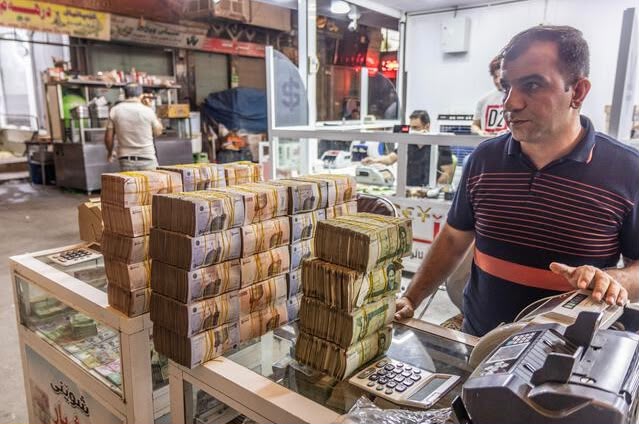
The US dollar has climbed past 160,000 Iraqi dinars per $100 on the parallel market this week, its highest level in months, deepening anxiety among traders, importers and ordinary households in Baghdad, Erbil and across the country.
On Monday, October 5, exchange bureaus in Baghdad sold $100 for 160,500 dinars, roughly 3,000 dinars more than at Thursday’s close, while dealers in Erbil quoted 160,150. Rates held above the threshold on Tuesday, with Erbil counters selling at 160,000 dinars. The market rate now stands more than 22 percent above the Central Bank of Iraq’s official rate of about 1,310 dinars per dollar.
The surge marked a sharp reversal. On October 1, the dollar had been easing, trading at 157,500 dinars per $100 in Baghdad and 157,100 in Erbil, as markets absorbed news of upcoming dollar shipments to the central bank. Within days, renewed buying by merchants and wholesale importers seeking dollars outside the central bank’s electronic platform pushed prices sharply higher.
A Year of Swings and a Widening Gap
The latest jump caps a volatile year for the dinar. On January 1, $100 sold for about 143,350 dinars in Erbil. By April, the rate had reached around 153,000, and on June 22 it hit 157,500, then the year’s high, amid escalating regional tensions and rumors that Baghdad might change the official rate. The central bank repeatedly denied any plan to devalue the currency.
There was a brief respite in July. Prime Minister Ali Faleh al-Zaidi’s visit to Washington, the announcement of an energy-sector agreement and the lifting of US sanctions on seven Iraqi banks helped the dinar recover about 4,000 dinars per $100 within weeks, with the rate briefly falling to around 149,500. The gains proved short-lived: by mid-August the dollar was back above 154,000, and it has climbed steadily since.
Market participants point to several drivers. Kaifi Khoshnaw, spokesman for the Erbil Currency Market, has linked the dinar’s weakness to Iraq’s strained public finances and to the regular spike in demand that follows public-sector salary payments, when many employees convert part of their wages into dollars. He says the rate can swing by 1,000 to 2,000 dinars per $100 in a single day, and that the dinar will remain unstable until Iraq’s overall financial situation settles.
Economists also cite longer-standing structural problems: trade with neighboring countries that cannot be financed at the official rate, weak control over border crossings, and goods entering the country outside the formal banking system. All of these keep demand for cash dollars high on the parallel market.
Kurdistan Region Feels the Squeeze
The fluctuations weigh especially heavily on the Kurdistan Region. Its economy relies heavily on imports, and Erbil’s currency market is one of the busiest in the country, handling an estimated $30 million to $40 million in transactions a day, according to Khoshnaw. He estimates that about 70 percent of the dollars bought there go to traders financing imports.
Kurdish merchants make up about one-fifth of all traders in Iraq, yet only a small fraction of them can obtain dollars at the official rate. Most must buy on the parallel market, and the extra cost is passed on to shoppers. Food, construction materials, electronics and other imported goods tend to become more expensive whenever the dollar rises.
For public employees, the impact is direct. Salaries are paid in dinars, so every rise in the dollar erodes their purchasing power. That is particularly painful in a region where civil servants have endured years of delayed and irregular salary payments tied to budget disputes between Erbil and Baghdad.
Real estate, a key pillar of the Kurdistan Region’s economy, is also exposed. Many property deals are priced in dollars, and sharp currency swings make buyers and sellers hesitant, slowing transactions.
Some see a path to relief. Jabar Goran, spokesman for the Sulaymaniyah Currency Exchange Market, has said the dinar could strengthen if Erbil and Baghdad finalize an agreement to unify customs procedures through the ASYCUDA system, bringing more of the Region’s trade into formal channels.
For now, traders expect the volatility to continue. Until the gap between the official and market rates narrows, households and businesses in Iraq and the Kurdistan Region will keep paying the price of a currency they cannot predict.
By Jawad Qadir