
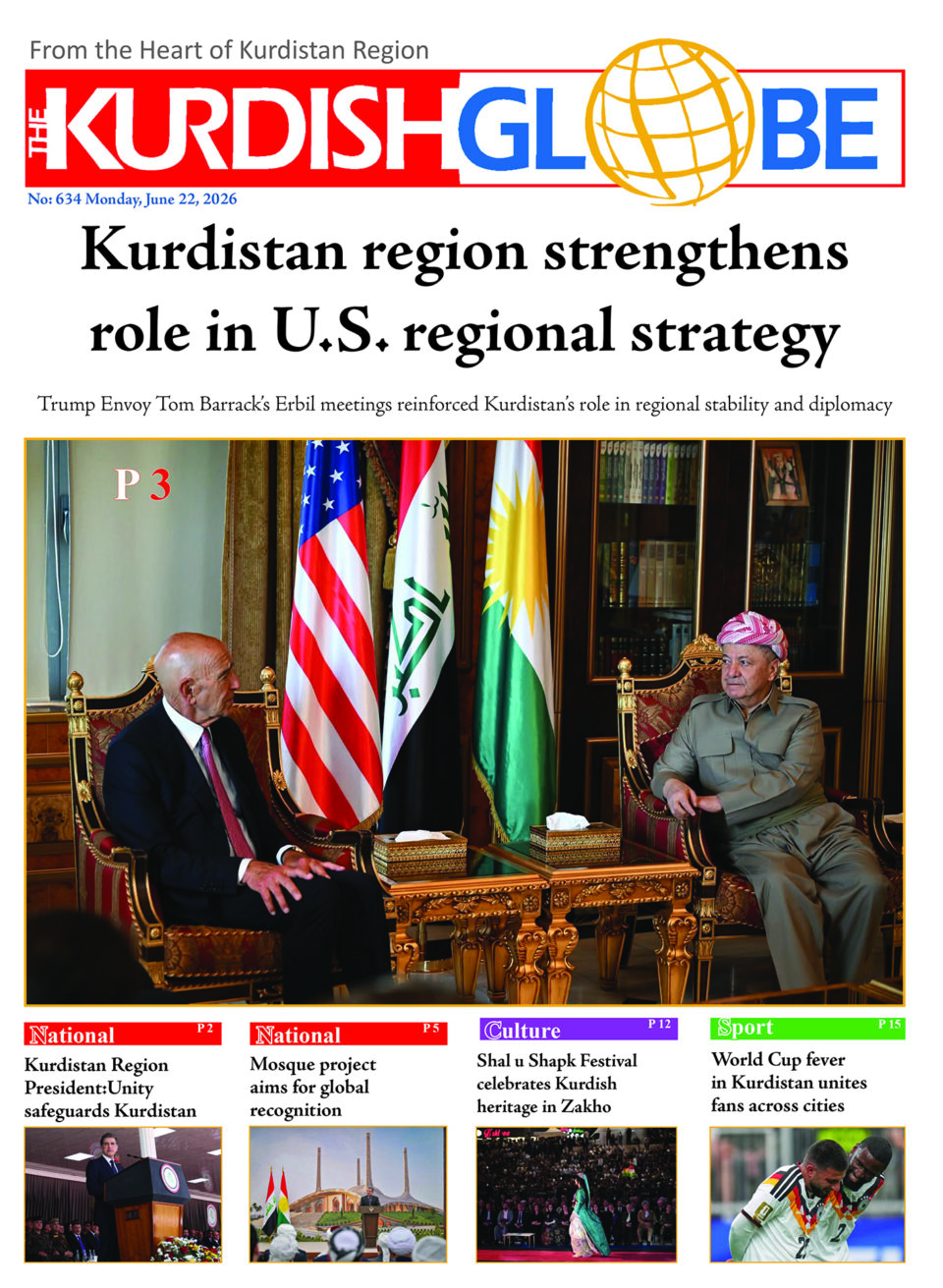
Trump Envoy Tom Barrack’s Erbil meetings reinforced Kurdistan’s role in regional stability and diplomacy.
The visit of U.S. President Donald Trump’s special envoy, Tom Barrack, to Erbil this week highlighted the growing importance of the Kurdistan Region in Washington’s evolving Middle East strategy, while also underscoring Kurdish leaders’ efforts to position the Region as a pillar of stability, dialogue and economic cooperation in a rapidly changing region.
During a series of high-level meetings on June 16, Barrack met separately with Kurdistan Democratic Party (KDP) leader Masoud Barzani, Kurdistan Region President Nechirvan Barzani and Kurdistan Regional Government (KRG) Prime Minister Masrour Barzani. The discussions focused on Iraq’s political future, regional security, Syria, economic cooperation and the future of U.S. engagement in the region.
The meetings came at a critical moment for Iraq and the wider Middle East. Regional tensions remain high following months of instability linked to the Iran conflict, ongoing uncertainty in Syria and continuing efforts by Iraq’s new government under Prime Minister Ali Zeidi to consolidate state authority.
Throughout his visit, Barrack repeatedly emphasized Washington’s support for a stable, sovereign and prosperous Iraq while signaling continued recognition of the Kurdistan Region’s strategic role.
In a statement following the meetings, Barrack said he was “grateful” for discussions with President Masoud Barzani, Nechirvan Barzani and Masrour Barzani, adding that all sides were united in supporting “a stable, sovereign and prosperous Iraq” and shared President Trump’s vision for “a new Middle East.”
For Kurdish leaders, the visit represented more than a routine diplomatic engagement. It provided an opportunity to showcase the Kurdistan Region as a reliable partner for the United States at a time when Washington is reassessing its regional priorities.
Meeting Barrack in Pirmam, President Masoud Barzani stressed the Region’s longstanding commitment to stability and peaceful solutions.
“The Kurdistan Region has always been a factor of stability,” Barzani said, according to a statement released after the meeting. He added that the Region has consistently supported “dialogue and diplomatic solutions” to regional disputes.
Barzani also sought to distinguish the Kurdistan Region from the conflicts that have repeatedly engulfed the Middle East.
“The Kurdistan Region has never been part of the problems, but it has unfairly suffered from the consequences of wars and conflicts,” he said.
The remarks reflected a broader Kurdish narrative that has gained prominence over the past decade: that despite being surrounded by regional crises, the Kurdistan Region has maintained relative stability and has often acted as a bridge between competing actors.
According to Kurdish officials, the U.S. envoy praised the Region’s development and described it as a successful model. He also acknowledged the importance of the Kurdistan Region’s role in supporting stability across Iraq and the wider region.
The discussions with President Masoud Barzani also touched on one of Baghdad’s most sensitive issues: the future of armed groups operating outside state control.
Barrack reportedly reiterated U.S. support for efforts to ensure that all weapons remain under government authority and backed Iraqi Prime Minister Ali Zeidi’s efforts to strengthen state institutions.
President Barzani, meanwhile, emphasized that Iraq’s future success depends on avoiding the mistakes of the past.
He said all political actors should learn from previous failures and govern on the basis of “partnership, balance and compromise” within the framework of the Iraqi constitution.
The same themes emerged during Barrack’s meeting with Kurdistan Region President Nechirvan Barzani, although the focus shifted more heavily toward Syria and broader regional diplomacy.
In a joint meeting that also included Syrian Democratic Forces (SDF) commander Mazloum Abdi, Nechirvan Barzani stressed that political dialogue remains the only realistic path toward long-term stability in Syria.
“Dialogue and understanding between the parties and protecting the rights of the Kurds and other communities in Syria, is the way to solve the problems,” he said.
The statement reflected the Kurdistan Region’s longstanding position that Syria’s future must be based on political inclusion rather than military confrontation.
The Kurdish President also reaffirmed Erbil’s willingness to support efforts aimed at reducing tensions and promoting stability throughout the region.
For Washington, the Syria file remains closely linked to broader regional security concerns, particularly the fight against terrorism and efforts to prevent extremist groups from re-emerging.
According to Kurdish officials, Barrack reaffirmed continued U.S. support for maintaining peace and stability in Syria and emphasized the importance of finding workable political solutions to the country’s challenges.
Counter-terrorism cooperation was another major theme of the discussions, with participants highlighting the need for continued coordination against threats posed by extremist organizations.
While security dominated parts of the agenda, economics featured prominently in Barrack’s meeting with Prime Minister Masrour Barzani.
The KRG leader described the talks as “very positive” and said discussions covered all major issues important to both Iraq and the Kurdistan Region.
“We discussed coordination and joint work with the Iraqi government to improve the economic and security situation in the region,” PM Masrour Barzani said.
He also highlighted efforts to strengthen economic relations between Iraq, the Kurdistan Region and the United States, including encouraging greater American investment.
The emphasis on economic cooperation reflects a broader KRG strategy aimed at diversifying international partnerships and attracting foreign investment beyond the energy sector.
In recent years, Kurdish officials have increasingly promoted the Region as a gateway for international business and a relatively stable destination for investment compared with other parts of Iraq.
PM Masrour Barzani also used the occasion to address domestic political issues, particularly the continued suspension of the Kurdistan Parliament.
“The first step is reactivating the Kurdistan Parliament,” he said, arguing that political disagreements should be resolved through democratic institutions.
“If there are differences in views, they can be solved in Parliament because it belongs to the people of the Kurdistan Region.”
The message underscored the KRG’s efforts to demonstrate institutional maturity and political continuity despite ongoing disputes among Kurdish parties.
Taken together, Barrack’s meetings in Erbil suggest that the Kurdistan Region remains a central component of Washington’s regional calculations even as U.S. policy evolves.
American priorities may increasingly focus on state institutions, economic partnerships and regional connectivity rather than the military-heavy approaches of previous decades. Yet Kurdish leaders appear determined to ensure that the Kurdistan Region remains an indispensable partner in that strategy.
For Erbil, the visit delivered an important diplomatic message: despite shifting geopolitical realities, the Kurdistan Region continues to be viewed in Washington as a source of stability, a trusted partner in security cooperation and a key player in shaping Iraq’s future.
As regional powers compete to redefine the Middle East’s political and economic landscape, Kurdish officials hope that message will translate into deeper partnerships, greater investment and a stronger role for the Kurdistan Region in the years ahead.
The Kurdish Globe