

By Younes Mohammad
For some time, the war had been sending people across the border. More families arrived each day, exhausted and dusty, carrying children and whatever they could save. I photographed them at the border. They were leaving Syria; I stood on the other side. But something was always missing from my photographs: the place they had fled.
Eventually, I crossed the border myself. Near it, life was still louder than war. Schools were open, people were in the streets, children came and went. But the deeper we traveled into Syria, the more life faded. Roads emptied, people disappeared, and silence replaced the ordinary sounds of living.
Everyone spoke of Serekaniye, where fighting continued. The name had always suggested water and greenery to me, a town grown around a spring. Even its war I imagined differently, like the partisan wars of Europe. Instead, I found flat, dry land, deserted streets, and buildings whose faces had been carved by war.
Outside town, we entered a cotton field. I had always loved cotton’s whiteness and purity, something I associated with cleaning wounds. Its fields recalled the Black laborers and farmworkers I knew from American history. I had always wanted to walk through one.
Now two men ahead of me were searching among the plants for bodies left from fighting days earlier. My eyes kept drifting toward the white cotton stretching into the distance. Then came the smell of decomposing human flesh. A few more steps, whiteness again, then the smell.
One man stopped beside a body. Heat and time had transformed it. I began photographing something no human being should ever be reduced to.
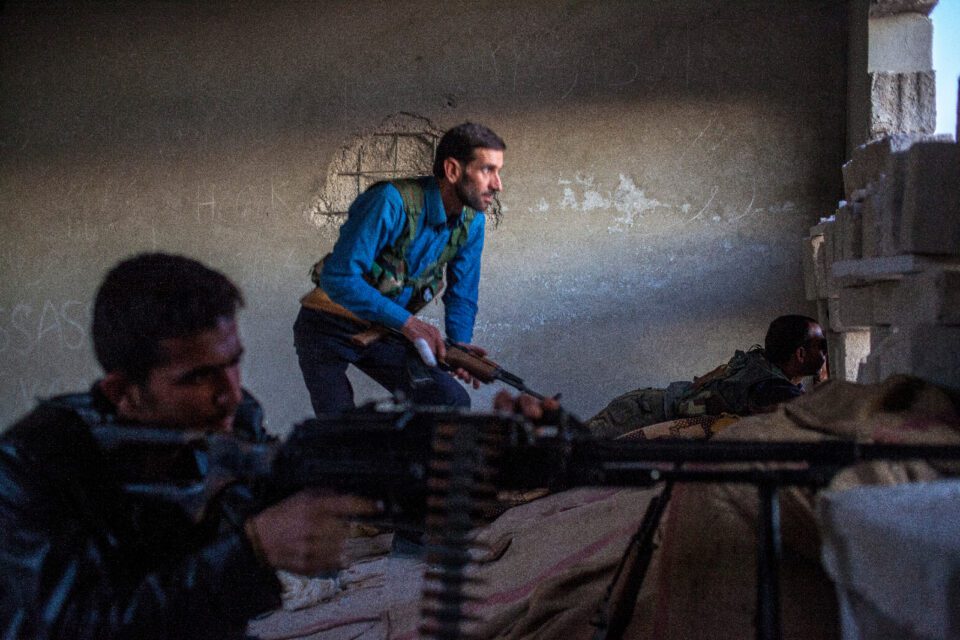
Near sunset, we reached the front line, a multistory building surrounded by gunfire. My fellow photographer, who did not want the war to see him, stayed behind. I followed several men up the dark stairwell, photographing as we climbed.
Upstairs, the rooms were no longer places for living. There were no windows, only ugly wounds in the walls used for watching and firing. Young men in ordinary clothes crouched behind them. A machine gun fired from one opening; gunfire answered from across the way. Dust swirled through the room as bullets struck the building. They told me where to crouch and where not to raise my head. I kept photographing, more absorbed in what was before me than in the danger around me.
Downstairs, I walked around the building and stopped. Almost nothing had escaped the war’s touch. The facade was shattered, impacts running from floor to floor. It seemed impossible it was still standing. Minutes earlier I had been behind those walls. Only from outside did I understand where I had been.
That night, my fellow photographer paused over one of my images from inside. After a while he said, “This is the best photograph of the day.”
A few days later, at home, everything changed. There, I had kept moving and photographing, unaware of what was closing around me. Now I sat dazed in silence, a weight like rubble over my body. The shock I had not felt there had followed me home.
Outside, cars moved, shops opened, people lived normally. Days earlier, across the border, young men had waited behind wounded walls for the next shot, while bodies lay beneath the sun among white cotton. I could not reconcile those worlds.
For a week I could barely connect with anyone. I stayed in my room wrestling with the photographs: cotton, bodies, stairwell, young men, machine gun, building. I could not bring myself to show anyone the images from my first encounter with Syria.
At night they escaped the photographs. I woke screaming, needing seconds to recognize my room, its intact wall, the absence of gunfire. The cotton field returned in dreams, its vast whiteness carrying the smell of decay. So did the building, its rooms offering no way out.
Eventually I returned to ordinary life. Years have passed, and I have gone back to war many times, but Serekaniye still summons that wounded building, then the cotton field, its whiteness carrying another smell. Sometimes you leave a war, cross a border, and return home, only to discover that war has crossed with you—and made itself your lifelong drinking companion.