
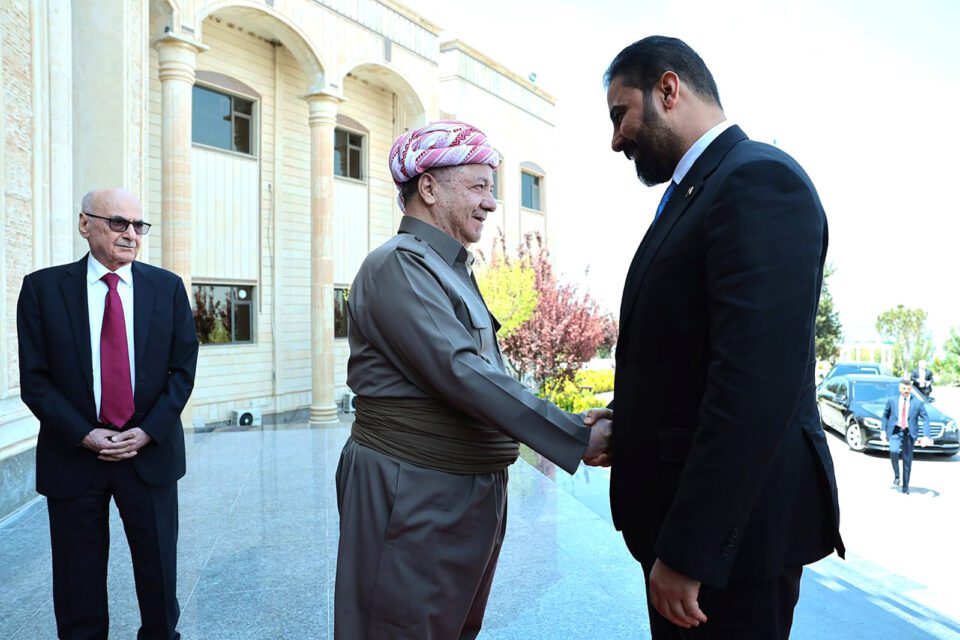
Zeidi urged KDP blocs to return to Baghdad and actively join government formation process.
Iraq’s government formation push brought Prime Minister-designate Ali Zeidi to Erbil this weekend, where his outreach signaled a willingness to reset relations with the Kurdistan Region, while President of Kurdistan Democratic Party (KDP),Masoud Barzani, emphasized a constitutional, deliberate path toward restoring a balanced and cooperative framework between Baghdad and Erbil.
The visit, unfolding across meetings in Pirmam and Erbil, marked a decisive phase in Zeidi’s effort to assemble a new federal cabinet under tight constitutional deadlines. Yet for Kurdish leaders, it also represented something more strategic — a chance to reassert their role as central partners in shaping Iraq’s political future.
According to a statement from the Barzani Headquarters, Zeidi made a direct and consequential request during his meeting with President Barzani: that the parliamentary and governmental bloc of the Kurdistan Democratic Party (KDP) return to Baghdad and “actively participate in the political process and the formation of the federal government.”
The appeal reflects both urgency and recognition. After years of strained relations and intermittent disengagement, Kurdish participation — particularly that of the KDP — is widely seen as essential to forming a stable government capable of commanding broad legitimacy across Iraq’s fractured political landscape.
President Barzani’s response, while measured, carried a clear framework. The formation of a new government, he stressed, must proceed “based on electoral entitlement” and within constitutional timelines. More significantly, he reaffirmed that the long-standing disputes between Erbil and Baghdad — over revenues, authority, and governance — must be resolved “within the framework of the constitution.”
He went further, underscoring that “implementing and adhering to the constitution is the fundamental solution,” and calling on all parties to commit to constitutional principles in the interest of national stability.
This emphasis is not incidental. For Kurdish leaders, the constitution remains both a shield and a negotiating tool — a basis for asserting rights within Iraq’s federal system, even as political realities have often diverged from its provisions.
Zeidi, in turn, sought to project a forward-looking approach. In the same meeting, he “emphasized the need to move beyond the negative issues of the past and to open a new chapter in relations” between the federal government and the Kurdistan Region.”
The language suggests an awareness of Kurdish uncertainty. Past agreements between Erbil and Baghdad have frequently unraveled, leaving deep mistrust on both sides. By framing his outreach in terms of renewal rather than continuity, Zeidi appears to be attempting a reset — though whether that can be sustained remains an open question.
The Kurdish position was reinforced at the presidential level through a parallel meeting between Nechirvan Barzani, President of Kurdistan Region, and Ali Zeidi in Erbil.
According to a statement from the Presidency of the Kurdistan Region, the two leaders discussed several files, “especially the issue of forming the new Iraqi government.” Both sides stressed the importance of strengthening dialogue among political forces to form a government that serves all components of Iraq and reflects their expectations.
The Presidency said the meeting also addressed the broader structure of Erbil–Baghdad relations, with both sides emphasizing the need to organize ties and resolve outstanding issues within the framework of the constitution and applicable laws.
This layer of engagement adds institutional weight to the Kurdish approach. Kurdistan Region Presidency signals continuity at the level of formal governance — reinforcing a consistent Kurdish message centered on dialogue, inclusion, and constitutional resolution.
Earlier in the day, Zeidi arrived in Erbil, where he was received at the airport by Kurdistan Regional Government (KRG) Prime Minister, Masrour Barzani, alongside senior Kurdish officials.
The meeting between PM Barzani and PM-designate Zeidi added an operational dimension to the broader political messaging. According to a statement from Zeidi’s office, discussions focused on “the general situation of the country and the progress of talks to form the new government.”
Both sides emphasized the need to align positions and work toward forming “a strong government capable of confronting challenges and overcoming crises,” with the stated goal of strengthening stability, advancing development, and responding to the demands of Iraq’s diverse population.
The engagement — strategic framing with President Masoud Barzani, institutional alignment with President of Kurdistan Region, Nechirvan Barzani, and operational coordination with PM Masrour Barzani — reflects a structured Kurdish approach to the moment: define the principles at the top, reinforce them institutionally, and negotiate the mechanisms in parallel.
That structure is reinforced by the broader Kurdish response to Zeidi’s nomination. Following his designation by Iraq’s Coordination Framework, Kurdish leaders moved quickly to welcome the decision.
In a phone call, President Masoud Barzani congratulated Zeidi and described his designation as “an opportunity to return Iraq’s political process to the right path.”
Nechirvan Barzani, Kurdistan Region President, echoed the sentiment, expressing hope that Zeidi would succeed in forming “an inclusive national government” capable of meeting the demands of all Iraqis and strengthening stability and reconstruction.
PM Masrour Barzani, in a separate statement, confirmed that he had also spoken with Zeidi, congratulating him and reaffirming support for resolving disputes “on a constitutional basis.”
Together, these messages form a coherent Kurdish position: readiness to engage, conditional on constitutional adherence, and aimed at securing a power-sharing arrangement that reflects Iraq’s political realities.
Zeidi’s challenge, however, is formidable. His nomination followed prolonged and often contentious negotiations within the Coordination Framework, where figures such as Mohammed Shia al-Sudani and Nouri al-Maliki withdrew from contention after failing to secure sufficient backing.
Under the constitution, Zeidi has one month to form a cabinet and secure parliamentary confidence. That timeline adds pressure to his outreach efforts, making visits such as the one to Erbil not just symbolic, but essential to building a viable governing coalition.
For Kurdish leaders, the choice is complex. Taking part in the federal government gives them influence in Baghdad and a say in key decisions.
President Barzani’s approach suggests a middle but calculated path — engage, but on defined terms; participate, but with clear expectations. By anchoring his position in constitutional language, he is seeking to elevate the conversation beyond short-term deals and toward a more durable political framework.
Yet the structural challenges remain. References in political discourse to “shadow governments” and the “deep state” in Iraq point to enduring concerns about informal power networks that operate beyond formal institutions. These dynamics have undermined previous cabinets and could pose similar risks to any new government Zeidi forms.
As Zeidi prepares to continue his consultations, including a planned visit to Sulaymaniyah to meet Bafel Talabani, President of Patriotic Union of Kurdistan, the contours of Iraq’s next government remain uncertain.
What is clearer is the role the Kurds intend to play. Through coordinated engagement across leadership levels and a consistent constitutional message, Kurdish leaders are positioning participation not as a concession, but as a central pillar of any viable political settlement.
Whether that positioning translates into tangible outcomes — in cabinet formation, policy alignment, and dispute resolution — will depend on negotiations still unfolding.
But for now, the Kurdish message was unmistakable: Iraq’s path to stability runs through inclusion, and inclusion runs through a balanced partnership with the Kurdistan Region.