
Al-Zaidi sworn in as iraq’s new Prime Minister amid growing regional uncertainties.
On May 14, Iraq’s new Prime Minister Ali al-Zaidi was sworn in with only a partial cabinet after lawmakers failed to reach a consensus on key postings, including interior and defence. At 41 years old, al-Zaidi became the youngest Iraqi prime minister, breaking a significant political barrier in a nation accustomed to elder statesmen. His ascent represents far more than a generational shift—it embodies Iraq’s desperate attempt to reset its political course amid mounting economic pressures and geopolitical tensions that threaten the country’s fragile stability.
The path to this moment was fraught with international pressure and internal political wrangling. After months of political bickering within the Coordination Framework, the Shia bloc’s largest parliamentary alliance, al-Zaidi emerged as a compromise candidate following fierce opposition from President Trump, who threatened to cut off support to Iraq if former Prime Minister al-Maliki was appointed. Unlike his predecessors, al-Zaidi entered this position as an outsider—a multimillionaire businessman with no prior political experience, which analysts argue could be his greatest asset for implementing reforms untainted by factional interests.
A Partial Victory in Parliament
Parliament approved 14 ministers in the new government but failed to reach consensus on several remaining posts, including the interior and defence portfolios. The vote reflects the intricate balance required in Iraq’s power-sharing system, where consensus across diverse political blocs remains elusive. Voting on other positions, including defence, labour, housing and reconstruction and education ministers, was postponed to a later stage, with no date set.
The partial approval carries both symbolic and practical implications. While al-Zaidi meets the constitutional requirement of securing confidence for more than half his cabinet, the absence of ministers for defence and interior—two sovereignty-linked portfolios—exposes the continuing fault lines within Iraq’s governing coalition. In his first televised address to the Iraqi people, al-Zaidi pledged a broad reform program focused on economic recovery, anti-corruption efforts, public services, and institutional governance. The challenge now lies in translating these promises into tangible action despite institutional constraints.
The Kurdish Factor in Baghdad
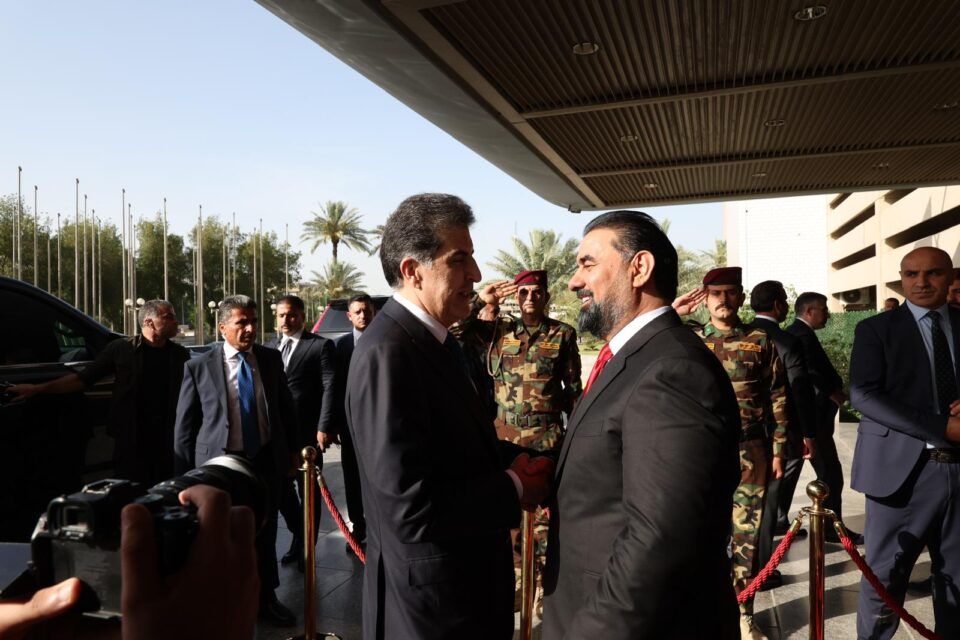
The formation process witnessed significant Kurdish involvement, demonstrating the indispensable role the Kurdistan Region plays in Iraq’s political architecture. Kurdistan Region President Nechirvan Barzani arrived at the parliament building and was received by Parliament Speaker Haibet al-Halbousi on the day of the confidence vote. His presence was not ceremonial but strategic, underscoring Kurdistan’s commitment to shaping Iraq’s political future.
Lawmakers from the Kurdistan Region’s ruling Kurdistan Democratic Party (KDP) and Patriotic Union of Kurdistan (PUK), along with the Region’s main opposition party, the New Generation Movement (NGM), confirmed their participation in the federal parliament session to vote confidence in the incoming cabinet. This unified Kurdish engagement, despite the rivalry between major Kurdish parties, illustrates a pragmatic recognition that institutional participation serves Kurdish interests better than boycotts.
Nechirvan Barzani’s diplomatic efforts extended beyond the parliamentary session. Barzani congratulated Iraqi Prime Minister Ali Faleh Al-Zaidi on Friday after parliament approved the new federal government, expressing hope that the cabinet would mark a new phase of stability and progress for Iraq. Barzani renewed Erbil’s readiness to work jointly with Baghdad “based on the constitution, true partnership, and balance” to resolve outstanding disputes.
The renewed engagement reflects substantial preparatory work. Kurdistan Region Prime Minister Masrour Barzani congratulated Zaidi on winning the confidence of the parliament, expressing hope that the new government will improve relations between Baghdad and Erbil and resolve all issues through constitutional implementation.
Navigating Troubled Waters Ahead
Al-Zaidi assumes leadership during one of Iraq’s most perilous periods. While votes on nine remaining ministerial positions, including crucial defence and interior portfolios, were deferred, the Iraqi legislature gave its vote of confidence in Zaidi and approved his government program. The new premier must now manage economic collapse stemming from regional instability, tackle endemic corruption, and maintain Iraq’s precarious balance between competing American and Iranian interests—all while ensuring Kurdish partnership remains constructive.
The next chapter in Iraq’s political transformation has begun, with hope and uncertainty in equal measure.
By Jawad Qadir