
By Younes Mohammad
The road leading into the city gradually emptied of any signs of life. The further we went, the heavier the silence became, a silence that was not merely the absence of sound, but as if the city itself had lost the will to speak. This Christian-inhabited city had remained under ISIS occupation for more than a year. Many families had abandoned their homes and fled. Now the city was liberated, and for the first time I was entering its streets alongside several Christian Peshmerga, men from the very same city, walking through places that had once held their homes, their memories, their lives.
They moved quietly, like people returning after a long absence, uncertain of what might await them. The deeper we went, the more the city resembled something that had not breathed for a long time. The walls were wounded. Windows were shattered. Electrical wires hung loose from fallen poles. The alleys were empty, and the wind moved through them as if searching for owners who were no longer there.
On the edge of the city stood a building once designed for celebration, for light, music, white dresses, and beautiful brides. Yet war had reached even there. Chairs were lined up against the walls. Stretchers had replaced guests. Makeshift beds had been set up in every corner. Curtains that had once decorated the hall were now used as sheets draped over the wounded. Where laughter and music had once echoed, there was now only pain, anxiety, and waiting.
Soon after, in one of the narrow alleys, a woman’s voice broke the silence. An elderly woman stepped out of a house, walking slowly, as if she had nowhere urgent to go. As if she still believed the city was alive. Later we learned she had never left. While families fled and the city fell under ISIS control, she had remained in her home. She had lived alone for a year in a nearly abandoned city, among streets where the sound of life no longer existed. When asked why she had stayed, she said, “Everyone left… they left the city for me.” Then she fell silent, and her words lingered in the alley, heavier than anything else I heard that day.
We continued towards the church. The city’s large church was visible from afar, its broken cross still standing above it, wounded and silent. On the way, we passed a cemetery whose gravestones had been shattered. Some names were half-legible, some dates had disappeared beneath dust.
The second church was smaller and older. When we entered its courtyard, silence filled everything. The wind moved between the walls, and suddenly the sound of a bell rang out, short, unexpected.
The wind had struck the rusted metal. Everyone looked up. The sound echoed through the empty streets and slowly faded. Moments later, one of the Peshmerga stepped forward, grasped a long-unused rope, and pulled. This time, the sound was not accidental. The bell rang again. And again. The sound slid across rooftops, passed through empty alleys, and filled a city that had not heard such a voice in a long time. For a brief moment, it felt as if the city had taken a breath.
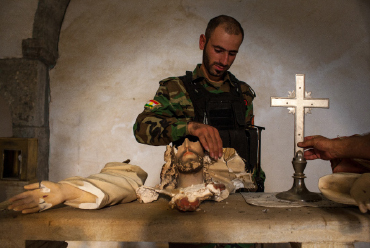
Inside the church, the destruction was quieter. ISIS had destroyed the statue of Christ. The head had been severed from the body. The hands lay in a corner. White fragments of the statue were scattered across the floor and tables. Several of the Peshmerga bent down quietly and began gathering the broken pieces. One of them would pick up a fragment, look at it for a moment, and place it beside another piece, then another, and another. No one spoke.
They were not trying to rebuild the statue; they knew it could not be done in minutes. Yet they seemed unwilling to let that familiar face disappear entirely into the ruins. On a table, beside the shattered fragments, a cross still stood. In that prolonged silence, something more than sorrow lingered, perhaps reverence, perhaps longing, perhaps a quiet attempt to preserve what war had not completely erased.
Sometime later, we left the church. The same alleys lay before us. The same walls. The same ruins. Yet something of the city still remained alive. On the way back, the sound of the bell kept echoing in my mind. I thought of the old woman who had never left, and of the Peshmerga who placed the broken pieces of a statue together on a table.
That day I understood that cities do not survive only through their streets and buildings. Sometimes, the presence of an old woman, the ringing of a bell, or a hand quietly gathering the fragments of a broken statue is enough for a city to remain alive.