
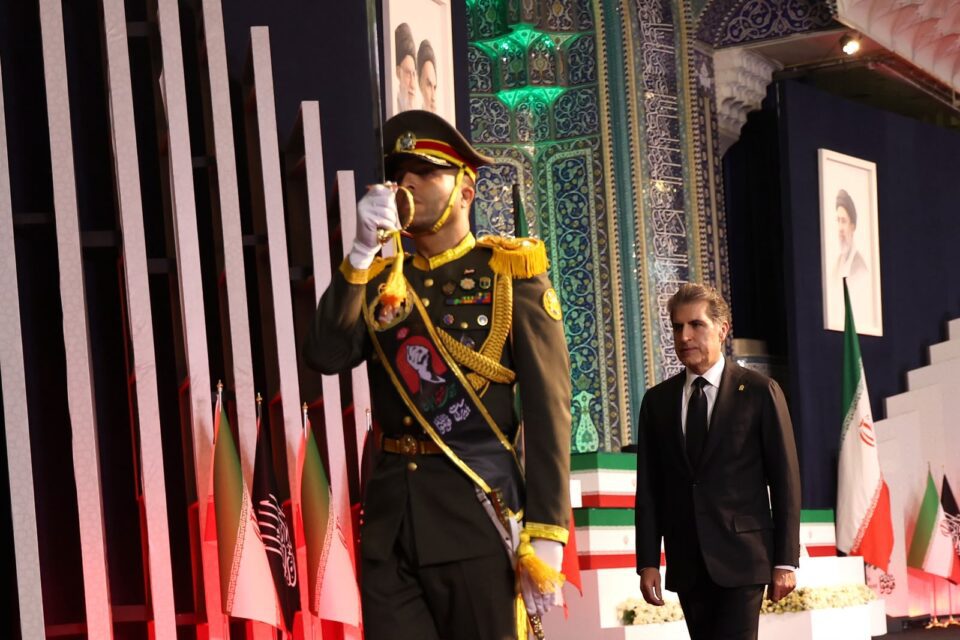
Kurdistan Region President Nechirvan Barzani traveled to Tehran on Friday to take part in funeral rites for Iran’s late Supreme Leader, Grand Ayatollah Ali Khamenei, holding a rapid string of meetings with Iran’s most senior officials on security and the fragile calm following the recent Iran-US-Israel war. It was, by several counts, at least his fifth visit to the Islamic Republic since 2023, underscoring how central Tehran remains to Erbil’s foreign policy even amid regional upheaval.
The body of of the late Supreme Leader Grand Ayatollah Ali Khamenei lay in state for three days at Tehran’s Grand Mosalla, the country’s largest prayer complex, ahead of a funeral procession through the capital and eventual burial in Mashhad. Iranian officials said the farewell ceremonies could draw between 15 and 20 million mourners and welcomed dignitaries from roughly a dozen countries, including Russia’s Dmitry Medvedev and Pakistan’s Shehbaz Sharif.
Meetings With Pezeshkian, Araghchi and Ghalibaf
Before joining the funeral proceedings, Barzani held back-to-back talks with three of Iran’s most powerful figures. He first met Foreign Minister Abbas Araghchi, with the two exchanging views on regional developments, including the winding down of the war between Iran, the United States and Israel, according to Kurdish outlets covering the trip.
He then met President Masoud Pezeshkian, with both sides reviewing ties between the Kurdistan Region, Iraq and Iran. Posting afterward on X, Barzani said he was glad to meet “Pezeshkian in Tehran that morning” and that the two had discussed “strengthening relations between the Kurdistan Region, Iraq and Iran, with emphasis on economic cooperation and historic, cultural and neighborly ties.”
According to a readout from the Kurdistan Region Presidency, the two leaders agreed dialogue and peaceful engagement remain the most effective route through the region’s current uncertainty.
Barzani also sat down with Parliament Speaker Mohammad Bagher Ghalibaf, praising the speaker’s part in brokering the recent Iran-US understanding and stressing that sustained engagement would be needed to see it fully implemented.
The Trip as Proof of a Balanced Foreign Policy
Back in Erbil, Kurdistan Region presidency spokesperson Dilshad Shahab used a Friday press briefing to place the Tehran visit inside a broader narrative about Barzani’s diplomatic approach. Speaking to Rudaw media, Shahab said political stability has remained a cornerstone of the president’s foreign policy and that all sides regard the Kurdistan Region’s posture as balanced, adding that continuing and deepening relations with every party is the correct course. He said Barzani has consistently favored neutrality and opposed war, arguing that diplomacy rather than conflict resolves crises, and noted that the president reiterated his support for continued Iran-US negotiations while in Tehran. Shahab added that the reception Barzani received from Iran’s top leadership reflects both the Kurdistan Region’s standing and the president’s own stature in the region.
The visit also carried weight beyond bilateral niceties. It landed at a delicate moment for Tehran, which is simultaneously managing an internal leadership transition following the late Supreme Leader’s death and trying to convert a preliminary ceasefire understanding with Washington into a durable framework.
A Border Relationship Shaped by Trade, Security and Old Tensions
Barzani’s outreach to Tehran comes against the backdrop of a relationship that has swung between cooperation and friction. Kurdistan Region was repeatedly targeted during the war, and Erbil has often been at odds with Tehran-aligned factions in Iraqi politics, even as the Region shares an extensive border, trade routes and long-standing cultural ties with Iran. Friday’s meetings suggest Erbil is again betting that consistent, high-level engagement with Tehran can protect the Kurdistan Region’s economic interests and its role as a stabilizing actor in Iraq, regardless of the wider turbulence surrounding Iran’s confrontation with Washington and Israel.
For now, officials on both sides have signaled they intend to keep talking. Whether that translates into the expanded trade and border cooperation both leaders described, is likely to become clearer as the dust settles from one of the most consequential conflicts the region has witnessed in decades.
By Jawad Qadir