
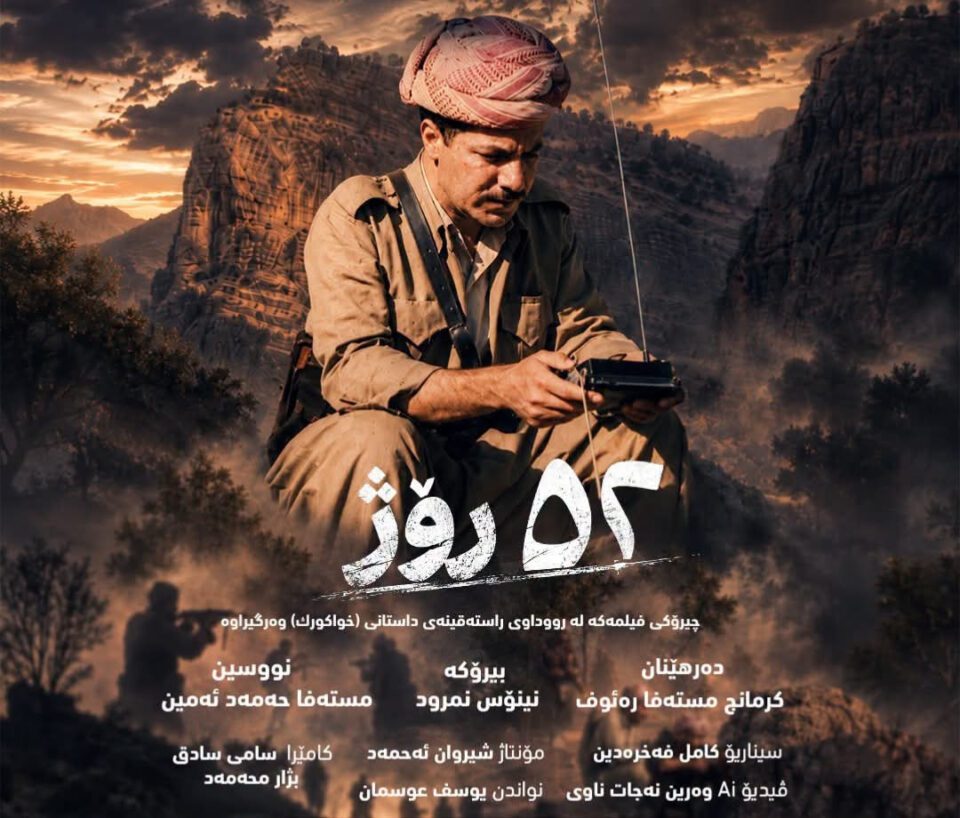
Erbil screens “52 Days” documentary to honor President Masoud Barzani and Peshmerga heroism during the 1988 battle
The premiere of 52 Days, a new documentary film depicting the historic 1988 Epic of Khwakurk, was hosted at Empire Cinema in Erbil as part of the “Cinema and the Public” initiative. Produced by the Erbil Cinema and Theatre Directorate, the film highlights the strategic leadership of President Masoud Barzani and the 52-day stand mounted by Peshmerga forces against former Iraqi regime offensives.
Directed by Karmanj Mustafa, the project originated from an original concept by Ninos Nimrud, written by Mustafa Hamad Amin, with a screenplay by Kamil Fakhreddin. The production features lead actor Yousif Othman, editing by Sherwan Ahmed, cinematography by Bzhar Mohammed, and specialized AI video visuals by Warin Nejat.
“The Epic of Khwakurk represents one of the most critical milestones in the history of Peshmerga resistance against the assaults of the former Iraqi regime,” said director Karmanj Mustafa during the premiere. “For 52 consecutive days across arduous, rugged mountainous terrain, Peshmerga forces stood firm to defend their positions. Screening this film serves to revitalize our national history through cinema, transmitting that heritage to the new generation.”
The defense of Khwakurk was carried out under the direct command of President Masoud Barzani, during which Peshmerga combatants maintained their positions despite heavy artillery barrages and air strikes launched by the Iraqi army.
Shakhawan Mustafa, Director of the Erbil Cinema and Theatre Directorate, emphasized the battle’s broader legacy in shaping modern Kurdish governance.
“Khwakurk demonstrated the capacity of the Peshmerga to defend our land and rights,” Shakhawan Mustafa stated. “However, that struggle transitioned over time from a military phase into a political era. Following the 1991 Uprising, the first Kurdistan parliamentary elections were held on May 19, 1992, leading directly to the establishment of the Kurdistan Regional Government (KRG).”
He added that the legacy of Khwakurk represents a continuum of sacrifice—moving from battlefield defense to democratic political agency and institutional governance. The documentary is currently screening in Erbil theaters as part of ongoing efforts to archive regional history through cinema.