
By Younes Mohammad
Years ago, when I was still a child, my father used to tell me stories about Mosul. He had spent his teenage years and much of his youth there, and whenever he spoke about the city, it felt as though he was stepping back into a part of his life that had never really left him. He repeated certain names often, streets, markets, neighborhoods. But among all those names, one stayed with me more than the others: Bab al-Toub. I don’t know why.
Perhaps it was because he always pronounced it with a different pause. Perhaps something in his eyes changed whenever he said it. Or perhaps some words simply find a place in our memory without asking for permission.
At the time, we were refugees living in another country. I had never seen Mosul. Everything I knew about the city came through my father’s memories. In my mind, I built a version of it that probably had little to do with reality, a city brighter, calmer, and more beautiful than anything I would later encounter.
Years passed. I grew up and became a photographer. Then another war arrived. ISIS seized Mosul, and the city that had existed in my imagination through my father’s stories appeared before me again, but not as a memory. It appeared as smoke, destruction, and displacement. Some time after the areas around Mosul were liberated, I traveled to Bashiqa to document the aftermath.
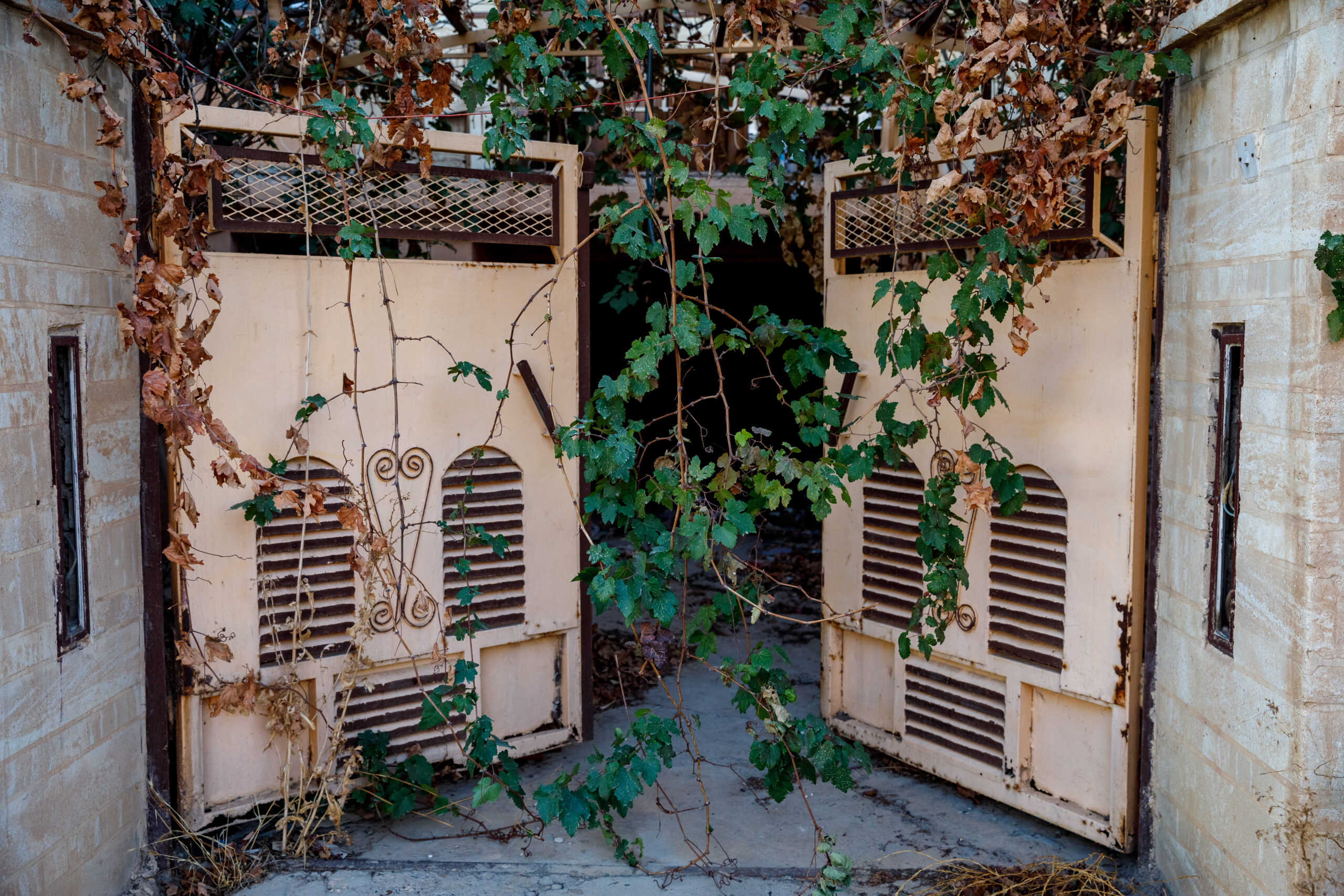
The town was still empty. Its residents had not yet returned. Houses stood abandoned, and the streets were silent. The war was over, but life had not come back. One day, I stopped in front of a house. To this day, I don’t know why. The gate stood half open. Grapevines spilled out from the courtyard and spread across the entrance. I stopped. I simply stood there.
A few minutes later, a man approached me. He seemed anxious. He told me the house belonged to him. He had been away for more than two years. He said he didn’t know what he would find if he walked inside. He didn’t know whether anything remained of the life he had left behind. He didn’t know what the war had taken and what it had chosen to leave behind.
With the help of Peshmerga fighters, the house was inspected. Once they were sure there were no explosives or traps inside, we entered. The house smelled of dust and suspended time. The man told me he was a painter. Then he led me to a small space upstairs, something between an attic and a storage room.
Amid the dust and disorder, he began pulling out his paintings one by one and leaning them against the wall. I watched. Among all those paintings, one of them stopped me. I couldn’t explain why. I simply found myself looking at it longer than the others. I asked him what it was called. He looked at the painting and said:
“Bab al-Toub.”
That was all. Just a name. Yet somehow, years of distance suddenly felt shorter. Nothing extraordinary happened. There was no great revelation. I simply found myself standing inside something I could not explain, somewhere between my father’s memories, a city I had never truly known, and a painting that had survived in the dusty house of a displaced artist.
The man told me that if I wanted, I could take it with me. I kept looking at the painting. Longer than usual. Then I separated it from the others.
Many years have passed since that day. The painting still hangs on the wall of my home. Sometimes I look at it and think of my father, the man who spent all those years trying to build a bridge between us and a homeland from which we had been separated. Sometimes I think of the artist; of the house the war had taken from him, and of the day he walked back inside it for the first time after years away. And sometimes I wonder whether the price I paid for that painting, however small, may have helped him in some corner of his life.
But more than anything, I still find myself returning to the same question:
Why did I stop in front of that gate that day? I don’t know. Just as I don’t know why my father always spoke about Bab al-Toub. Or why, among all those paintings, my eyes settled on that one.
Perhaps some things do not enter our lives to be understood. They simply remain with us for a while.
Like the name of a neighborhood.
Like the branches of a grapevine.
Or like a painting that has hung on my wall for years.